




Your child has been telling you that they want to sign up for a social media account. Their 13th birthday has recently passed and that’s the minimum age social media platforms require users to be. So, it should be ok, right?
Hold on.
13 – the magic number?
Are 13-year-olds really mature enough and ready for social media? And why is the age restriction up to 13 years of age?
The minimum age of 13 for social media accounts comes from the Children’s Online Privacy Protection Act (COPPA), a 1998 law protecting children’s privacy. When users sign up for social media accounts, they must declare that they are 13 or older, allowing platforms to collect their information. However, this age requirement is based on privacy law rather than whether teens are actually ready for social media.
To ensure that children are protected by the safety features that have been built into the various platforms, it is important that the age provided when setting up the account is accurate. For example, social media platforms like TikTok and Instagram automatically make accounts for users 13- to 16-year-olds private by default and prevent strangers from direct messaging them. Parents need to be aware that lying about children’s age when signing up for social media accounts bypasses important safety and privacy features designed to protect young users.
Sensitive content that may be considered upsetting, offensive or sensitive are often restricted for younger users. Hence by not providing their actual age, children have higher risks of exposure to inappropriate and sensitive content.
Aside from this, as Family Zone cyber expert Dr Kristy Goodwin points out, “If we tell our kids, it’s okay to set up an account before they are 13 years of age, we are sending them a powerful message that it’s okay to break the law, and that’s a difficult moral position to come back from. Okay, technically it’s not really ‘breaking the law’ – it’s ignoring an advisory restriction – but arguably the message we send to our kids is the same: ‘You can write your own rules online.’ And that is a risky precedent to set.”
That said, beyond advisories and legalities, it is also important to know when your child is mature enough to cope with the demands of social media and the risks that this world exposes them to.
How do I know if my child is ready for social media?
“Is my child ready for social media at 13 years of age?” is a question that only you can answer, as their parent. Here are some questions you can think about when assessing your child’s readiness.
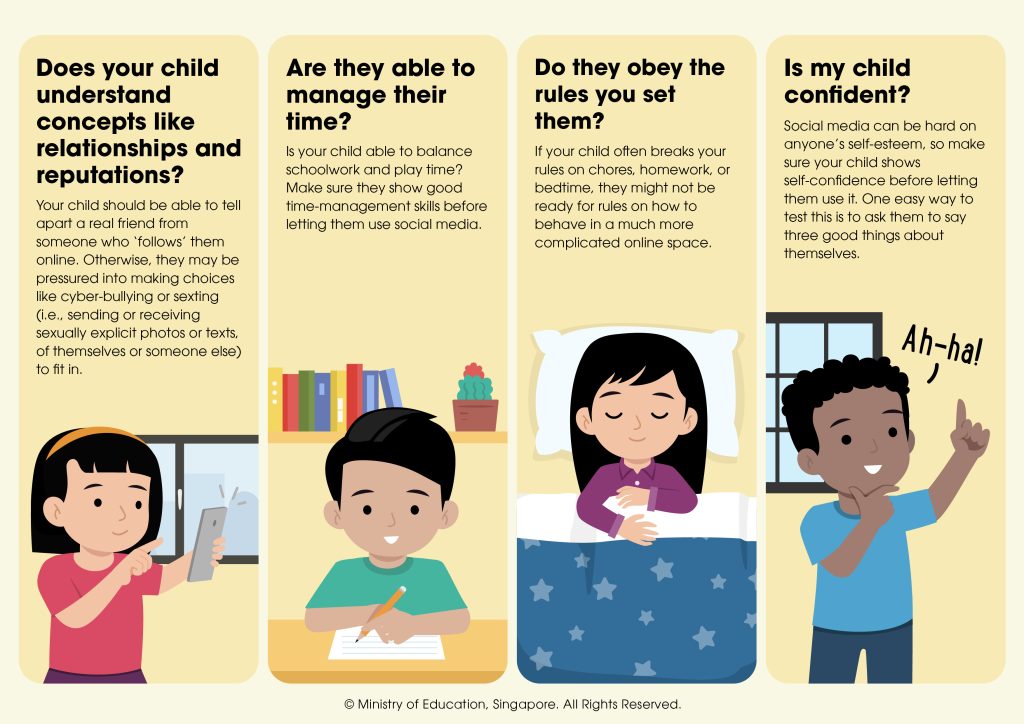
If you think that your child is not ready for an account, talk to them and help them understand why you think that way and hold out from allowing your child to start a social media account for as long as you think is necessary.
How do I help my child use social media safely?
When used in a healthy way, social media allows people to connect with their friends and other like-minded people, find support, and develop civic awareness by seeing different viewpoints.
However, use of social media use may lead to unhealthy comparisons with others, seeking validation through ‘likes’ and may lead to conflicts that may escalate into cyber bullying. There are also concerns that youth may use social media excessively. These may impact your child’s well-being negatively.
When you decide that your child is ready for a social media account…
1. Have open conversations with them on the risks of social media and establish clear ground rules on how to keep themselves safe when using it. Here are some suggested topics:
- What are some potential dangers of oversharing personal information?
- What does healthy social media use look like?
- How do we keep ourselves safe on social media?
- What are some ground rules we can establish as a family?
To find out more about the positive and negative impact of social media on youths’ well-being, visit go.gov.sg/pfw-social-media-impact.
2. When coming up with ground rules, you and your child may want to discuss:
- Registering for the account using their actual birth date to ensure that they can take full advantage of the safety features for younger users, i.e., 13- to 16-year-olds, that social media have in place.
- Having parental controls in place
- Having privacy levels set to private
- Types of content they are allowed to post
- Whether they recognise if they have used social media excessively
Social media platforms have parental supervision features that help you control the content your child sees online and who can interact with them. Combined with privacy settings, these will help you protect your child from inappropriate content and other online safety issues. You may also refer to this resource for more guides on setting up parental controls for various online platforms such as TikTok, Meta, Google, and X.
3. Emphasise to your child that you care for them and want them to be safe online, hence the reasons for putting in these parental controls. It is important to communicate your intentions to the children so that you can better support them as they navigate the online space.
4. Assure your child that they can come and talk to you should they come across any content, experiences or online interactions with others that make them feel uncomfortable. You could also explore the app together to familiarise yourselves with the self-reporting functions, so that your child would know what to do should they come across inappropriate or harmful content.
Mistakes can be expected along the way – do not panic and resort to removing access to social media or their mobile devices straightaway. Talk it through with your child. Maintain strong rapport and open communication, so that you can continue to provide the support and guidance they need to confidently navigate the cyber space (and other issues!) in a safe and responsible way.
For more tips on how to parent in a digital age, visit go.gov.sg/pfw-toolbox-for-parents
What are schools doing to prepare students to navigate the online space safely?
Our children are growing up in world surrounded by technology. While technology open doors to incredible learning opportunities, it is our shared responsibility to ensure that they navigate the digital landscape safely and wisely.
Think of it this way – just as we teach our children to look both ways before crossing the road, we need to equip them with skills to navigate the digital highway safely.
Through the Character and Citizenship Education (CCE) curriculum, your child learns knowledge and skills to:
- Have balanced screen use
- Be safe online
- Have positive online behaviours
The curriculum grows with the child. For example, in primary school, you child learns about the basic online safety rules and protecting personal information. In secondary school, they learn to be discerning of what they encounter online.
Each school customises its approach based on student needs. This includes:
- Targeted assembly programmes
- Peer support initiatives
- School-specific guidelines for device use
To find out more about what your child is learning for Cyber Wellness education in CCE, visit www.moe.gov.sg/education-in-sg/our-programmes/cyber-wellness.

.jpg&w=3840&q=75)