




Cyber bullying is a complex issue, but bullying someone online is not unlike bullying in person. In fact, it can be worse as it is easier to carry out away from view and may be harder to detect and prevent. Yet, the effects can be very public. The negative messages can spread fast and wide, and very quickly, the damage could be more hurtful and more lasting.
Here are three main forms of cyber bullying: revealing secrets, making fun of others, and exclusion. Note that the list is not exhaustive – there’s also flaming, harassment, denigration, and more – nor mutually exclusive, as one or more of these forms of hurtful behaviours could take place at the same time.
1. Revealing secrets
Friends confide in each other and keep each other’s secrets… until they fall out. Ms Nicole Choong, Senior School Counsellor at Bendemeer Secondary School, shares that when things go south, students who lack maturity might resort to posting personal things about their friends that were shared with them in confidence.
Such acts could result in students feeling unsafe or upset. It is therefore essential that students learn respectful behaviour, strong social skills and proper cyber etiquette.
2. Making fun of others
Bullies are often emboldened by the cloak of anonymity that social media provides. The actions taken and comments made may be harsher than what a person might say to another in person. An observable trend on the rise suggests that some students create anonymous social media accounts just to post negative comments about their classmates.
Appearance, for example, is often a common topic, says Ms Choong. Younger students tend to be a bit more blunt when they talk about their peers. At this developmental stage, students can be more sensitive towards criticism, especially about their appearance, and such words can hurt, she cautions. “It is crucial to consider how the person on the receiving end feels. Simple habits such as pausing to ask if what they are about to say is helpful, necessary, or kind can make a big difference.”
Like school hallways and playgrounds, chat groups have become a place online where children jostle with one another for social status.
Mdm Nur Rakeezah Bte Abdul Rahim, Head of Department (Student Management) at Westwood Secondary School shared that online rumours can also lead to students being ostracised, affecting their sense of belonging. She notes that even close friends can fall out and be excluded by their peers. In such situations, it is important to have conversations with students and help them understand that such behaviour constitutes social bullying. It is also important to repair strained relationships.
“Circle Time is one strategy that can help students reconcile. That said, some students affected may not feel ready to resume the friendship. We need to recognize that friendships cannot be forced, so guide students to be respectful of one another’s boundaries and differences, as everyone deserves to feel safe and respected,” adds Mdm Rakeezah.
No, it is not less serious than ‘traditional’ bullying
“Cyber bullying cases are often more complicated to resolve, especially when they involve students interacting online. When chat groups are created with good intentions, such as for sharing assessment dates and study tips, the situation can become complex when unkind words are used,” says Mr Jack Ong, Head of Department of Student Management at Punggol Green Primary School (PGPS).
He cites a case where unkind words were sent in an online group chat using an anonymous number, impersonating a student from the school. “Unfortunately, there's often a perception that because it happens online, it is somehow less real or impactful. However, the impact can sometimes be as great, or even greater as perpetrators can hide behind anonymity to continue hurting or bullying the victim around the clock. We have witnessed firsthand how hurtful cyber bullying can be, especially as students gain access to digital devices at younger ages these days,” adds Mr Ong.
PGPS addresses this through cyber wellness lessons integrated into assembly talks and classroom discussions. “We guide students about the effects of digital footprints and how to demonstrate empathy in digital spaces,” Mr Ong explains. “Even when perpetrators use anonymous accounts, delete messages, or make cases untraceable, we provide support to affected students. We use these incidents as learning opportunities for all students while focusing on prevention.”
What does not disappear overnight is the impact of the teasing. And it is not easy to wipe all traces of it off the Internet – even if the perpetrator has removed the offensive content or comments, a screenshot could have been easily taken by someone else and spread digitally again.
More time online, less openness with parents
When students have free rein over the use of their smartphones and devices, the amount of time they spend online can contribute to increased instances of cyber bullying.
“In this digital age, if you choose to give your child a smartphone, you must set ground rules and make sure that your child agrees and abides by them,” says Mr Tan King Ming, Principal of Chongfu School. “For example, when your child is home, where should the phone be? When sleeping, where should the phone be? Excessive phone usage underlies a lot of issues. Too much screen time affects outdoor time, physical exercise, quality of sleep… especially if students don’t have proper ground rules and have access to their phones in their bedroom at night.”
“The rules are important,” explains Mr Tan. “When students get too attached to their phones, they will constantly be on it as they are afraid to ‘lose touch’ with what is going on online.” Mr Tan has also observed that the more time students spend on their phones, the more value they place on what happens online, and the less open they are with their parents.
Mr Ng Yeow Huei, Head of Department of PE, Art, Music & CCA at PGPS shares, “As screen time typically happens outside school hours and at home, partnering with parents becomes very essential. The Grow Well SG initiative has helped us provide better support for parents in addressing concerns over their child’s excessive smartphone and device usage,” he adds. “PGPS conducts sharing sessions to equip parents with practical strategies, such as having open conversations with their children, to help them set routines and structures for meaningful technology use and to encourage healthier boundaries."
Beyond good screen-time habits, building a strong parent-child relationship is also important. It builds trust and encourages open communication about respectful and responsible behaviour, so parents can provide guidance on behavioural norms online and offline, especially when they are in distress.
Ways children can stand up against cyber bullying
Schools and parents can do their best to put in preventive measures, but cyber bullying may still occur. When incidents happen, other than informing a trusted adult – parent, teacher, or school counsellor – the most immediate action that your child can take is to remove themselves from the situation.
In the cyber context, it means avoiding reading comments, leaving the chat group, blocking friends, or even temporarily disabling their own social media accounts. Ms Choong explains that this limits the spread of negative comments and posts, and removes the “audience” that is often present in bullying situations to deescalate further impact.
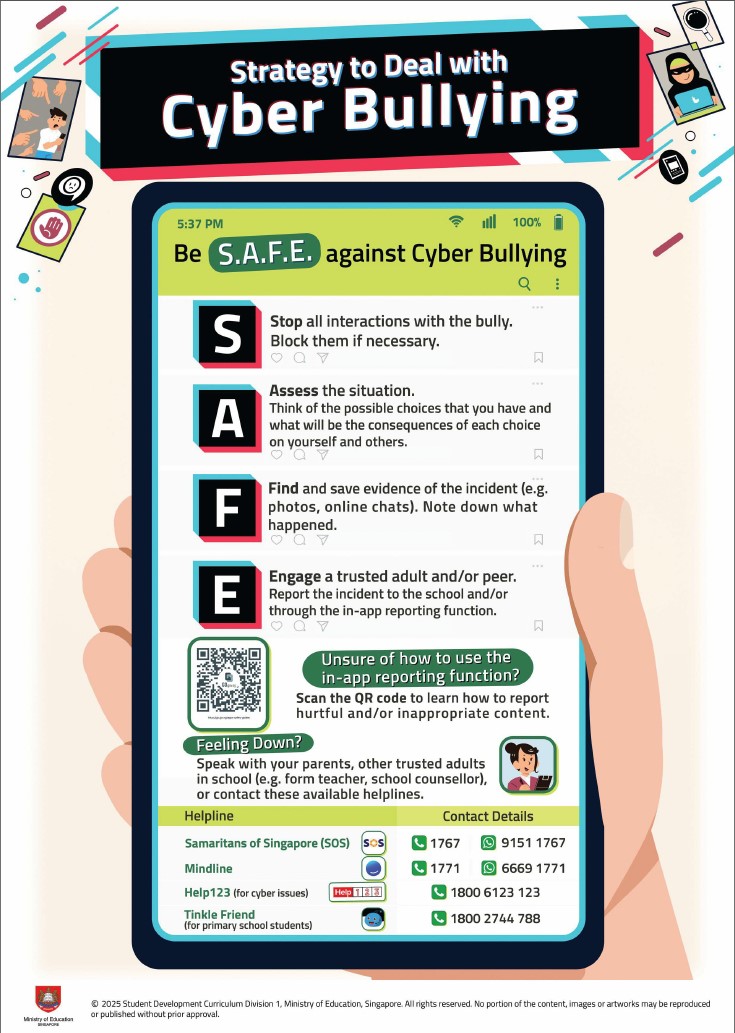
Schools are also equipping students with skills that they can use when they encounter instances of cyber bullying.
Part of Mdm Dawn Chew’s job as the Cyber Wellness Coordinator at Pasir Ris Primary School is to teach students how to be an upstander when they come across bullying online, and to approach a trusted adult to inform them about such situations.
Ms Ng Hui Yin, Subject Head of Student Management at Yio Chu Kang Secondary School, says that among upper secondary students, particularly girls, hurtful behaviour more commonly occurs in online spaces, where unkind or untrue remarks may be made within their social circles. At this age, students often try to resolve such matters among themselves first. However, when the situation escalates, they usually approach their form teachers, who will then advise them to report the matter to the student management team.
Ms Ng cites a case where two students reported that a peer had been insinuating rumours about their characters on her social media. When confronted, the peer became defensive and continued sending abusive messages through WhatsApp. “We spoke to all parties separately to understand their perspectives and establish the facts, before providing them with a safe and private space to have a mediated conversation,” says Ms Ng. “Through this process, they were able to reach a mutual understanding and agreed to give one another time and space to gradually rebuild the friendship.”
As with cases of hurtful behaviour and bullying, educators go back to grounding students in good values – respect, care and empathy – which guide them in their interactions, both online and offline.
Work on these points with your children at home
Children may at times hurt or bully others without being aware of it. Mdm Chew says that there are a few messages that are reiterated to students, which parents can highlight at home too, so children are aware of their behaviour and the impact it can have on others.
If you have that respect for yourself, you would not do that to others, online or offline.- Be safe and responsible online.
Think carefully about what you post and share, and be accountable for your words and actions. - Advocate positive online behaviour and be an upstander.
If you see friends behaving negatively, remind them that they shouldn’t do so. Stand up for others if they receive negative messages if you feel safe to do so. If you don’t, do not participate in the negative behaviour, and alert a trusted adult.
Also read:
.jpg&w=3840&q=75)