




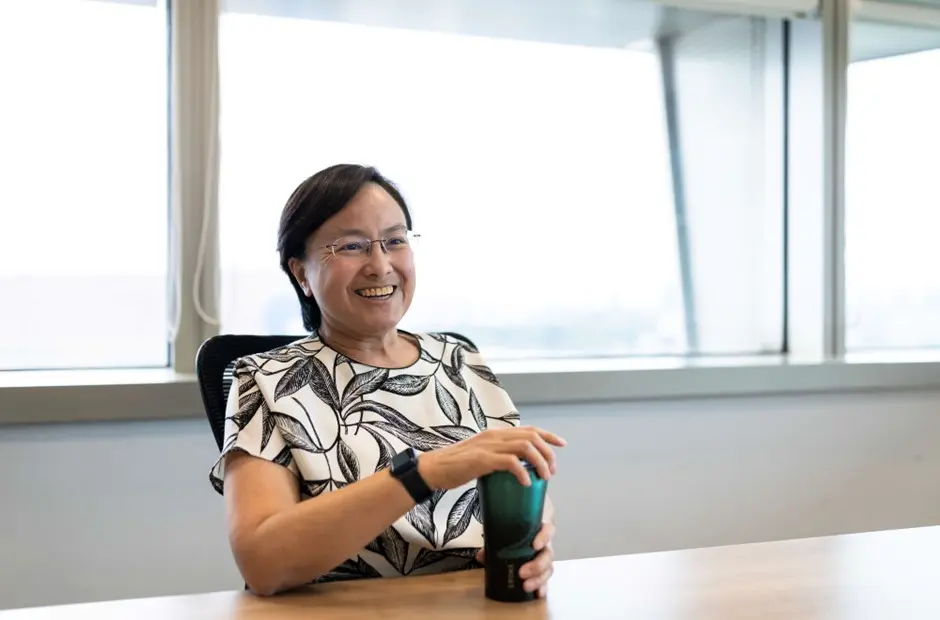
Strong bonds are often rooted in empathy – after all, there’s nothing like walking a mile in someone else’s shoes to truly understand where they are coming from. And if that means venturing into uncharted territory, Mrs Tan Chen Kee, MOE’s Deputy Director-General of Education (Schools) and Director of Schools, is up for the challenge.
To bond with her godson, who’s currently in Primary 6, Mrs Tan gamely took up gaming so she could better understand this pursuit he spent so much time on. “I’m really no good at it, but he takes me on his raids, and I wander around and randomly shoot where he tells me to shoot,” she describes, laughing heartily. “And I do it so I can understand his reality. The world the young generation faces today is totally different, and we won’t do them any good by judging them based on our reality. We need to enter their world and then bring them to where they need to be.”
In the same spirit, Mrs Tan decided to accept an invitation to a Facebook group for parents of primary school students about a year ago. “I wanted to get insights into what weighs heavily on parents’ minds and hearts, what keeps them up at night. It’s about seeing things from their lived reality.” From heated debates about different parenting approaches to unfiltered comments about schools and teachers, her year of observation spent “in the field” was illuminating.
“All parents want the best for their children,” says Mrs Tan. “They are trying their best based on the information they have access to, and their own life experiences.” If parents spent their own youth navigating a system that was more focused on academic results and saw how professional pathways opened up with the help of school experiences and networks, scepticism about the message that “every school is a good school” is understandable.
“Many parents still define a good school as one that is well-resourced and has a track record of producing good academic results,” she acknowledges. “They think that there is only a certain basket of schools that will create the best set of opportunities for their children and drive their own decisions along these directions.”
Coming to terms with a new reality
However, the reality that many parents lived through is changing fast, and the strengths that served one generation well can become weaknesses in new contexts. While post-secondary institutions and scholarships still require students to meet baseline academic requirements, aptitude-based requirements – which assess students’ passions, strengths, and experiences beyond the realm of academics – are becoming much more important to reflect changing demands of the real world now. “The world that our students will graduate into is very complex,” Mrs Tan stresses.
To navigate this complex reality, “cognitive development is important, but it should not just be based on exam results achieved through drill and practice”, she notes. With the emergence of technologies such as generative artificial intelligence (AI), for instance, students have to learn new skills, such as how to critically evaluate AI-generated answers.
“So it’s not just about knowing content, but about having cognitive flexibility,” she elaborates. And that’s just the tip of the iceberg when it comes to thriving in future realities. “You’ll also need to communicate your ideas, work in cross-cultural teams, be inventive in your thinking and not be confined in silos.” Exposure to a more diverse range of peers and school experiences can be more effective in building these skills and dispositions than more homogenous environments.
With change becoming a constant, strong values, such as resilience, also “need to form the core of a child’s being more than ever before”, she points out. “The stakes for failure can be perceived to be higher when you’re in a school of a certain profile, which means one may not be as prepared to take risks, fail, and pick oneself up,” says Mrs Tan.
Social-emotional competencies, which help students understand themselves and develop positive relationships with others, are equally crucial. “Research indicates that if we equip our kids with these skills, it actually has more far-reaching and lasting impact than solely focusing on achieving good grades.”
Every child is different, which means they have different needs
Imparting these values and skills are at the heart of MOE’s 21st Century Competencies framework. And each school hones these competencies in ways that best suit its culture and cohort. “Each school understands the profile of the students they receive, what their strengths are and where they need further support. The schools then create a range of experiences and opportunities to bring out the best in their students,” says Mrs Tan.
In other words, every school has its own way of working towards these common goals. So when it comes to choosing a school, the key question Mrs Tan suggests parents ask is: What makes a school a good school for my child?
“Answering that question means you have to understand your child first,” says Mrs Tan. “There’s nothing wrong with aspiring to get into a school with a strong academic environment, if the child thrives in such an environment. But parents first need to know how their children learn best. They need to understand their child’s disposition and aspirations, which may not be the same as the parents’ own aspirations for their child. This understanding will in turn help them evaluate how a school’s profile may or may not be a good fit for their child.”
This is where knowing their children and the reality they live in is crucial information for parents who are helping their kids choose a school. That’s not always easy, Mrs Tan knows, especially for “working parents who may only have limited time to spend with their children”. It is understandable if many parents spend this precious time focusing on the academic aspects of their child’s development, which are after all quantifiable markers of progress. “But if you only use that time to look at the academics, there is no time left to spend on building the parent-child relationship.” And without that bond, understanding our children will be hard to achieve.
Knowing schools and their programmes will help ensure it is a good match for the child
To answer the key question of “What makes a school a good school for my child?”, parents of course also have to get to know the schools better. In particular, parents should find out the different approaches the schools take to develop students holistically.
The challenge here is that the impact of holistic development is far less quantifiable than the traditional yardstick of academic achievements. In this respect, MOE is stepping up its efforts to help parents better understand schools. “We have been highlighting the exciting things that go on in all our schools, and we will continue to do that,” says Mrs Tan. “We are also looking into ways to better support schools so parents can see what they are doing to develop their students’ character and citizenship dispositions, as well as emerging 21st century competencies.”
Beyond that, there is a very straightforward way for parents to better understand the reality of a school – pay a visit to the school and talk to its school leaders and teachers. Mrs Tan, who was formerly the Principal of Crescent Girls’ School, knows first-hand how such conversations can clarify priorities and expectations.
“When I met parents as a school leader, I seldom talked about our students’ academic results. I would tell parents that character development was more important, and that was what I wanted to focus on,” she says. “So, if parents attend open houses and have these conversations, they will be able to get a better sense of a school’s environment, and how school leaders and teachers want to develop their students.”
Ultimately, “every school seeks to be a good school for the students that they receive”, Mrs Tan affirms. And parents who are able to enter into the realities of their child, the school, and the world, will find themselves in good stead when helping their child choose a school that matches their needs.

.jpg&w=3840&q=75)