




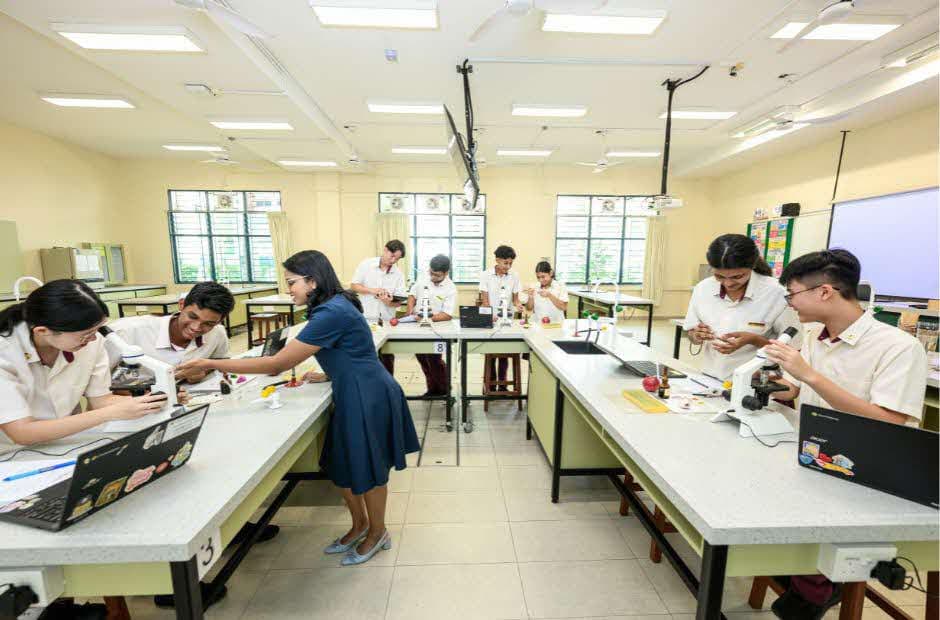
There has been a burst of fresh energy coming from the Science labs in Unity Secondary School lately.
The catalyst? Redesigned mobile workbenches with mobile segments that expand the possibilities of how lab layouts could be configured.
Since their implementation in January 2026, the Science Department has experienced greater flexibility in how it designs the learning environment, to better support practical investigations, collaboration, and varied teaching approaches.
Will it be a U, a T, or L shape today?
During a demonstration on the use the mobile workbench segments, Ms Sumitha Poonia Murthy, Level Head for Science, showed how the mobile segments could be rearranged to provide extended worktops for larger experimental setups.
By joining two mobile segments lengthwise, for example, she can now use a longer frictionless board to conduct experiment on measurement of distance, speed and force of a moving object. The longer board allowed students to roll objects over a longer distance, thus allowing her students to collect more data points, which improves the accuracy of the experiments.
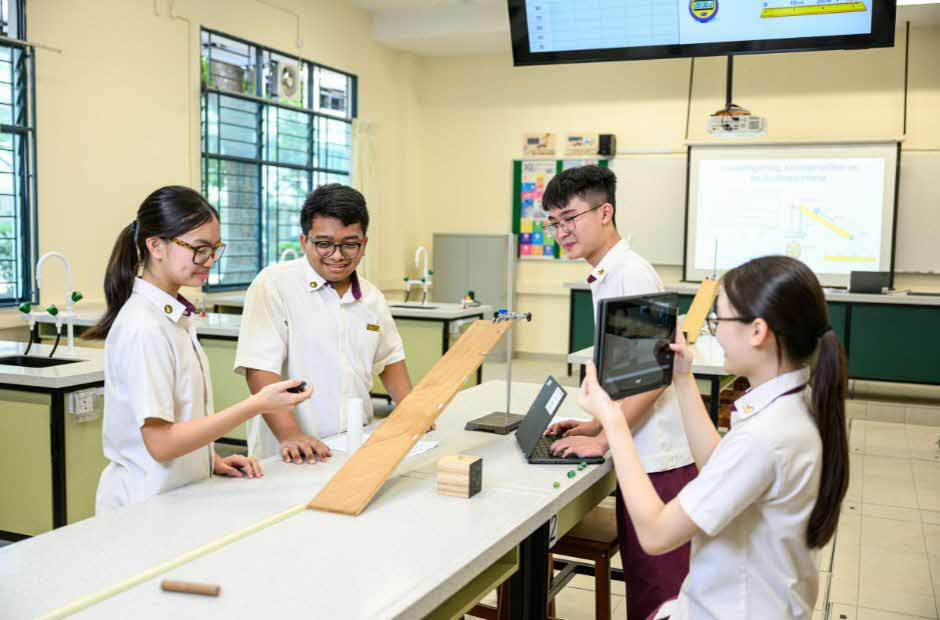 The mobile workbench segments can be reconfigured to facilitate greater collaboration and larger-scale experiments, like in Physics where students can use a longer inclined plane to conduct investigations on kinematics and forces.
Ms Sumitha also demonstrated how the mobile workbench segments can be configured into a U-shape configuration. This configuration allows her to better monitor and guide her students when using microscopes and making biology sketches.
For wet experiments involving liquids, chemicals or biological materials, L-shape configuration can be adopted to separate practical apparatus from learning materials, thus keeping laptops and worksheets away from wet area.
“This clear zoning enhances safety and space organisation, enabling students to be task focus and move seamlessly between the design, construction, and testing phases of the activity,” she explains.
Watch as Ms Sumitha claps her way to different workbench configurations in this reel:
Lesson energy flows with flexibility
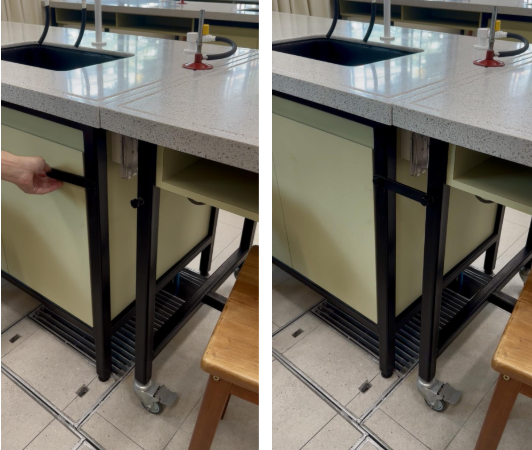
The workstations come with latches to secure adjoining stations, castors with stoppers, and durable work surfaces with spill gutters.
Though it’s early days yet, Ms Liang Yen Shan, HOD Science, has already received good reviews of the upgrade.
“Our teachers have observed that students are more focused and able to manage practical tasks more smoothly,” she says.
Teachers are also exploring ideas for experiments that encourage collaboration, such as comparing observations, discussing results, or moving between different stages of an investigation.
The redesigned workbenches of longer length also afforded the use of personal learning devices to collect, analyse, and reflect on data digitally.
“The improved layout also allows teachers to move more freely around the lab, making it easier to supervise students, ensure safety, and provide individualised support where needed,” says Ms Liang.
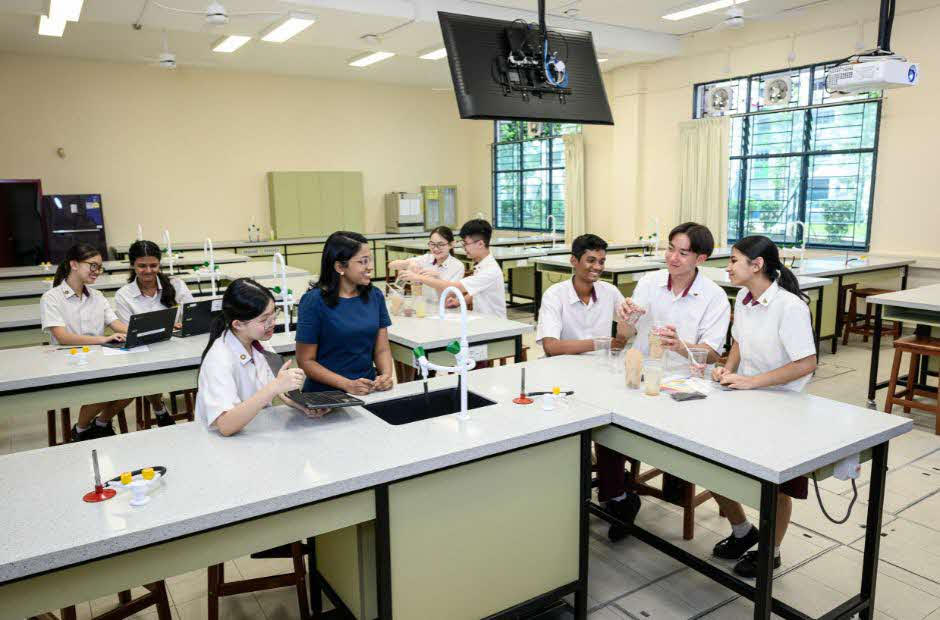 L-shape workbench configuration for clearer zoning and more safety when conducting wet experiments.
The initiative to enhance flexibility in Science labs is a collaboration between MOE’s Infrastructure Policy and Plans Branch of Infrastructure & Facility Services Division (IFSD) and Sciences Branch of Curriculum Planning and Development Division.
Unity Secondary School worked with IFSD’s School Campus Department to deliver on the pilot project with minimal disruption to classes.
What guided the initiative to upgrade labs? “The environment is the third teacher,” explains Ms Stephanie Jee, Lead Specialist at Sciences Branch. “When we make our labs flexible, we're not just about having mobile workbench segments. We're unleashing the 'third teacher' to inspire learning and encourage innovative teaching practices.”
.jpg&w=3840&q=75)