



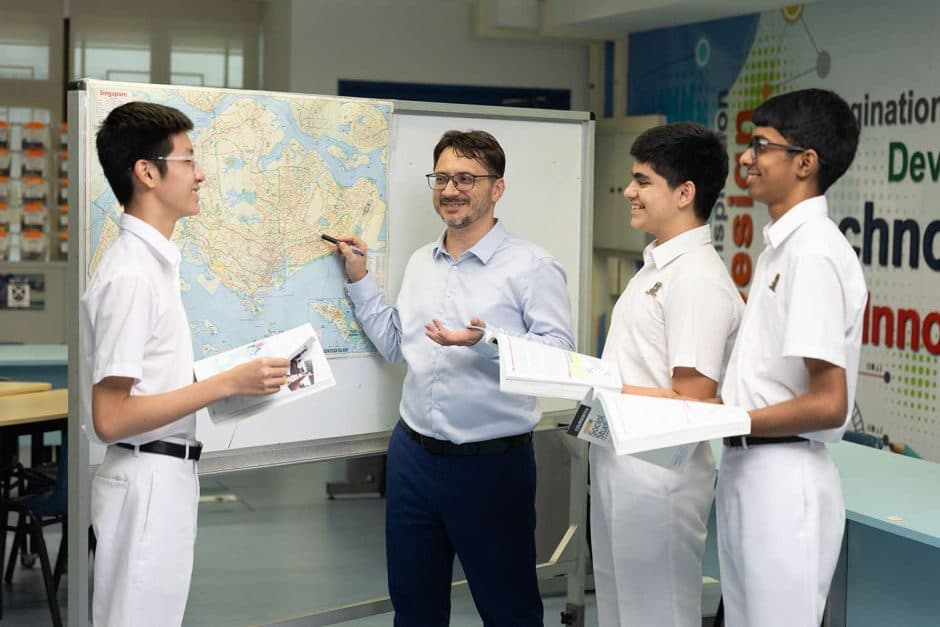
You could write your answers on paper or… How about getting out of your seat, pretend to be an influencer, find a spot around the school and deliver your answers via a video post?
To Mr Marek Otreba’s students, such are the fun and spontaneous activities he comes up with in class and out.
Get to know Mr Otreba better and it is clear that a lot of thought goes on behind these seemingly casual moves. Every task, digital feedback form, or station rotation (a structured circuit of short activities each focused on a specific skill), starts from an intentional place to help students think harder, grow in skill or values, or to simply benefit from differentiated instructions.
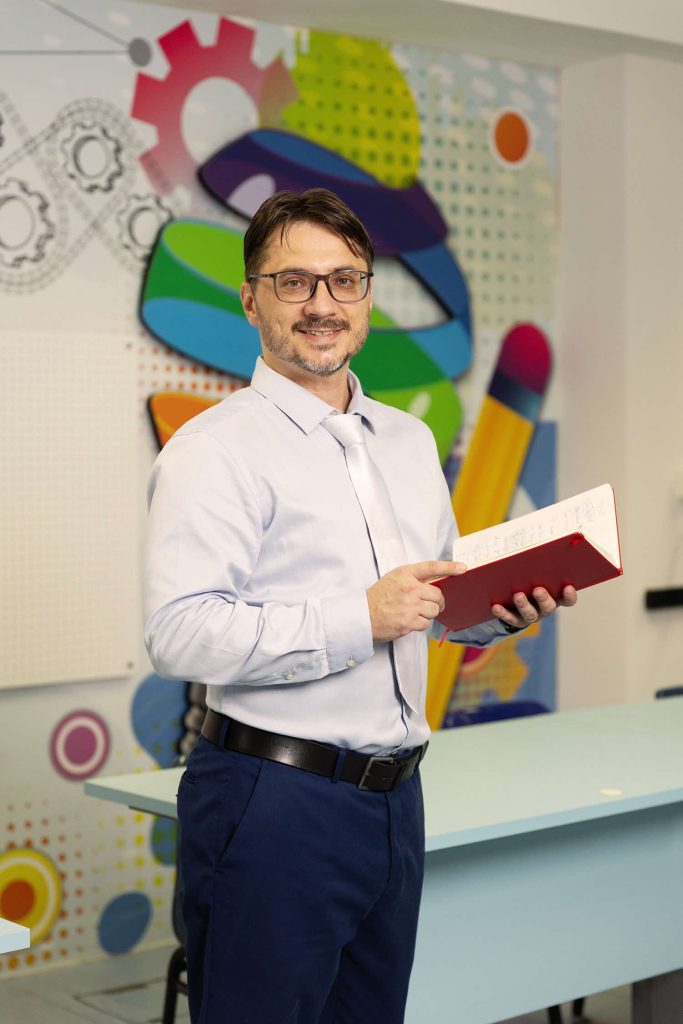
“I owe it to my students to give them the best version of the lesson I can.”
Mr Otreba
A different kind of Humanities teacher
Originally from Canada, the 42-year-old Lead Teacher (Social Studies) at St Andrew’s Secondary School came to Singapore in 2011 following two years of teaching in the UK. It was a “sliding doors” moment: He was seeking a permanent teaching role, and MOE reached out via an international job portal.
When offered the role, he was told: “We don’t want you to adapt to the way we teach Humanities. We want you to ignite change.” He has stayed true to that invitation.
Over the years, Mr Otreba has led and co-led cluster and national-level Networked Learning Communities (NLCs), and founded the Assessment and A.I. NLC, to explore how emerging technologies can support meaningful teaching and learning. For these efforts, he was conferred the MOE Outstanding Innovator Award in 2023.
Many improvements came about by improving processes. When students submit a piece of homework, their answers, teachers’ comments, and student application of feedback may be uploaded on shared online forms for easier side-by-side comparison and learning.
Again, this seemingly simple tweak allowed teacher and student to better monitor the edits across the feedback cycle.
Over 90 per cent of students across five pilot schools said this approach made them more confident in Social Studies.
Teaching for thinking
In his classroom, this plays out through hybrid lesson structures and blended learning models, like station rotation. In one memorable lesson, he used a board game to explain the end of World War II, paired with technology-enabled group activities and peer discussions. Another assignment required students to write two essay paragraphs: one entirely on their own, and the other using A.I. prompts.
“Some of them had misconceptions that using A.I. is just cheating,” he says. “But if you show them when and how to use it well, it builds their digital literacy and opens their thinking.”
“Adaptive thinking doesn’t happen by accident,” says Mr Otreba, who builds opportunities for it into his classroom. Adaptive thinking is one of MOE’s 21st Century Competencies. “Sometimes, you give students a puzzle, then shift the constraints. Or you ask them to complete the same task, but using a different tool. What you want is for them to think in a different way, and build the resilience to keep going when it gets uncomfortable.”
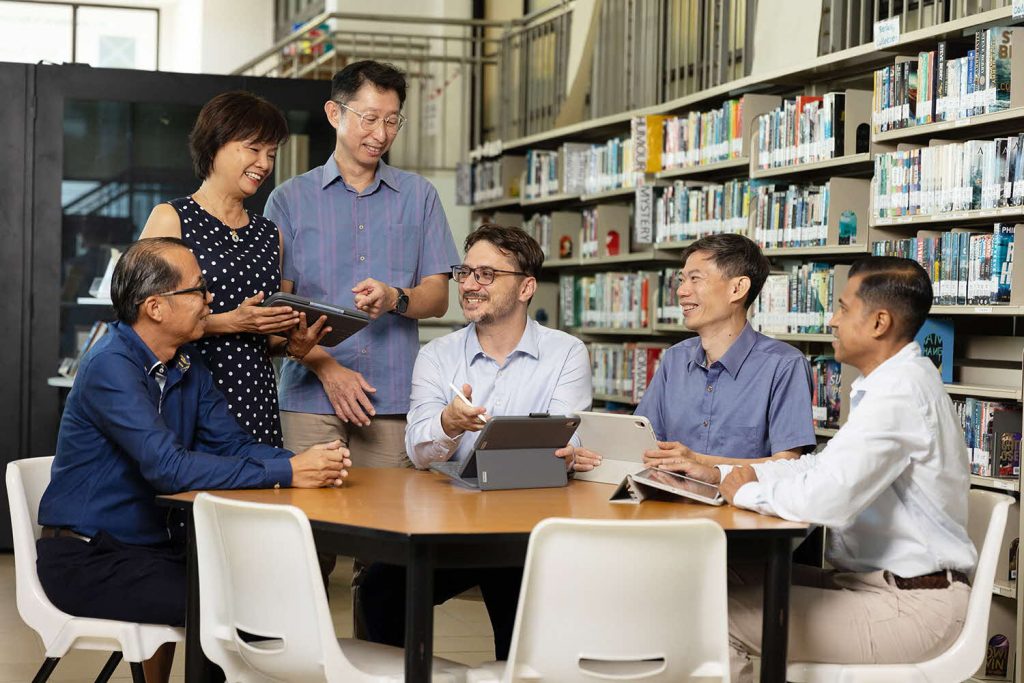
He brings the same intent to his professional learning work. A strong believer in sharing openly, he makes his source-based question packages and lesson design templates editable and accessible, supports colleagues post-workshop via Padlet, and answers follow-up questions even weeks later. “It starts with, ‘This helped my students.’ And if it helped my students, maybe it can help yours.”
Care behind the structure
That sense of care is what stands out most to his students.
Tejas Jaidev Mohan, 16, who has been Mr Otreba’s student for two years, recalls a lesson on World War II that was anything but boring. Mr Otreba had designed a series of stations to make it experiential. The students could move about from station to station, where they might analyse video clips at one, play a board game at another, and discuss military weaknesses during the war at a third. “It helped us understand a very complex topic. And it showed how much thought went into each station.”
Another project – a digital product on social cohesion – allowed students to dramatise interactions across belief systems. Instead of just writing an essay, they got to act out what it might feel like in certain scenarios, says Tejas. “And then we reflected on what message we were trying to send.”
What about the time he built a chatbot that can answer the students’ History questions 24/7, whenever they are ready to learn?
It is not just the creative options that leave a mark, but how clearly Mr Otreba communicates his expectations. That clarity makes even tough lessons feel doable, says Tejas. “It gives you confidence.”
When the learning gets tough
To offer a choice of learning experiences takes more effort on the teacher’s part, but that is par for the course to Mr Otreba and his team.
For a recent unit on Singapore’s socio-economic landscape, they used Universal Design for Learning principles to design various learning paths in SLS, scaffolded support, and provided the option to explore the content through video or article.
“It was time-consuming to curate,” he says, “but the journey was more accessible for those who needed it. All students engaged with the same content and achieved the same outcomes.”
Getting such differentiated lessons right takes discipline and persistence, “but it was worth it for the engagement we saw,” he says.
“Even when I am very busy, I will tweak lessons the night before. I will add a new article, a better scaffold, a clearer instruction. Because I owe it to my students to give them the best version of the lesson I can.”
His belief is that students deserve better, not just more runs through every workshop, worksheet, and walkthrough he creates.
“It is not about chasing innovation for its own sake,” he adds. “It is about building better ways for students to learn. And if we can do that, then why not?”