





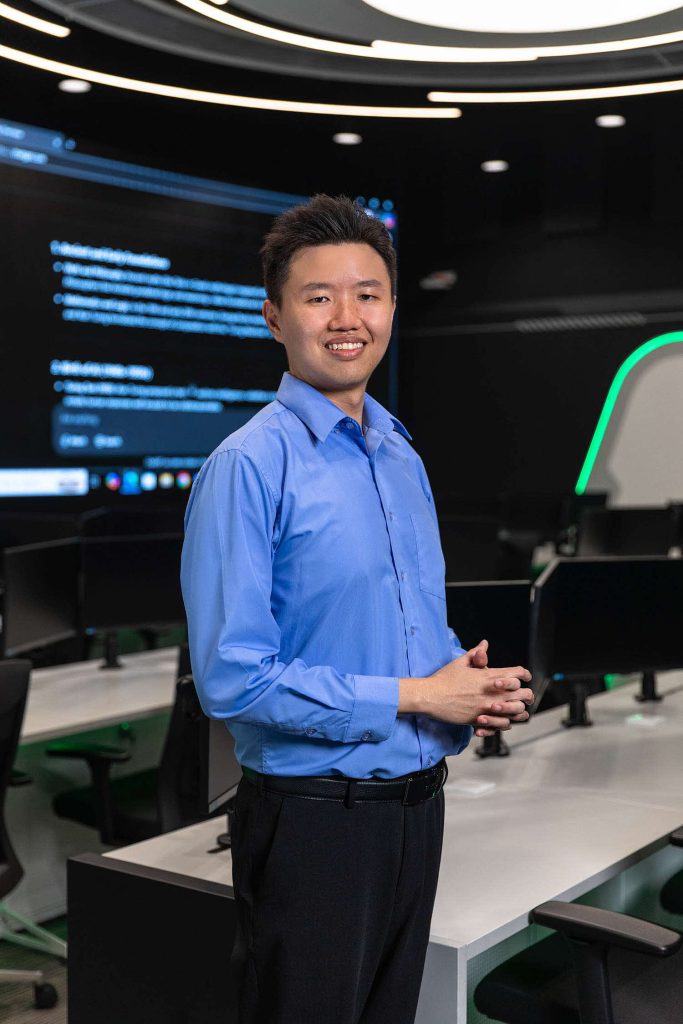
The Advanced Computing Lab at ITE College West is nearly bare. Just a few pieces of AI-generated artwork are displayed in a cabinet at the entrance, and bright green tables glow under fluorescent lights.
This minimalistic room is where Mr Max Chua, who teaches at the School of Electronics & Info-Comm Technology, reimagines how students learn AI. “As part of our curriculum and pedagogy development, I created the AI Classroom to personalise learning at scale – essentially giving every student the experience of a class size of one,” he explains.
In his classes, students self-explore key concepts using GenAI tools, supported by prompt engineering guides and scaffolding questions. With GenAI, students can enjoy personalised advice to their questions. Then, during lessons, Mr Chua guides the class to apply these concepts to solve real-world problems.
The results are promising. “Students who went through the AI Classroom scored around 20 per cent better than those in normal classroom groups. Many also shared that AI helped them better understand coding and gave them the motivation to explore further.”
Learning without barriers
Making technology accessible is a constant theme in Mr Chua’s work. He specialises in AI, High Performance Computing (HPC), and Electronics Engineering, and has created modules that allow students to build real-world AI applications, even if they have never written a line of code.
“Not everyone comes in knowing how to code. My job is to scaffold learning: to deconstruct concepts so students can build their foundation from the ground up,” he says, as a leader of ITE’s Generative AI HPC teams.
His curriculum work features partnerships with Amazon Web Services, Google, and the National Supercomputing Centre. He also leads Train-the-Trainer sessions and develops general electives that support fellow educators. His workshops on AI and HPC have benefitted over 100 fellow educators. “I myself cannot teach the whole world. I need to multiply this effect,” Mr Chua elaborates.
Beyond his work at ITE, Mr Chua contributes to the community to build up AI competencies in Singapore. He is part of digital community The Gen-C, a collaboration between the National Library Board and AWS that upskills the public in AI skills like prompt engineering, working with Large Language Models (LLMs), and fine-tuning models.
Path behind the pedagogy
When asked why he chose to teach instead of entering the tech industry like most of his peers, Mr Chua shares that it is his way of giving back as he was once an ITE student.
“I struggled in the traditional classroom setting, and was in the EM3 then Normal Technical stream,” he says of what are now defunct primary and secondary courses. “It was only when I entered ITE that things made sense to me. The hands-on work combined with the support from my teachers helped me find my place and footing.”
After graduating from ITE, Mr Chua continued to pursue his studies and went on to earn his Master of Science in Electrical Engineering from the National University of Singapore.
To boost his students’ confidence, Mr Chua draws on his own story and creates tangible opportunities for them to succeed: competitions, student-led projects, and support systems for students who require additional help.
“Every student has a story. We just need to be the ones who stay long enough to hear it. And help them write a good ending.”
Mr Chua
Hayden Tan, 19, was one such student. Soft-spoken and hesitant in group settings, he was uncertain when Mr Chua asked him to join a project called ‘AI Storybook’. “He said it might help me become more confident, so I gave it a shot,” Hayden recalls.
Mr Chua coached him and the team through presentations, offering specific feedback and helping him develop his public speaking skills and confidence. “He didn’t just tell me to speak louder. He gave me techniques on how to sound more confident.”
That project led to other competitions. Later, Mr Chua personally recommended Hayden for an internship with NEC Asia Pacific, an information and communications technology provider. “I learned so much about the industry and how to work with different people. If I hadn’t said yes to that first project, I don’t think I’d be where I am today.”
Another student faced such severe social anxiety that just hearing his name called in class could cause a panic attack. In consultation with the school counsellor, Mr Chua came up with a plan to support the student: Start small by encouraging the student to do group work with a few classmates, then ease him into larger settings. “I would have kept trying different approaches,” Mr Chua says, “but the first one actually worked!”
With Mr Chua’s support, that student has since become an emcee for graduation ceremonies and even landed a voice acting gig through IMDA. He now studies game design at the Singapore Institute of Technology.
Recounting this change, Mr Chua’s face lights up. “I was so happy when I saw him on stage. It felt like watching someone unlock a new part of themselves. I always tell my students, ‘Your past doesn’t define your future. I’m not here to be your friend, I’m here to help you succeed. But I will do it with care.’”
Stay long enough for the story
Mr Chua is also passionate about inclusion, not only in ability levels but also in neurodiversity. His AI Art Therapy Workshop, designed for students with special educational needs (SEN), shows how emerging technology can support emotional regulation and mental well-being.
In the workshop, students generate images using AI tools by crafting prompts tied to their emotions. The images become more than art: they are windows into students’ inner worlds, with the prompts and images providing educators and counsellors with observable, tangible clues about their emotional states.
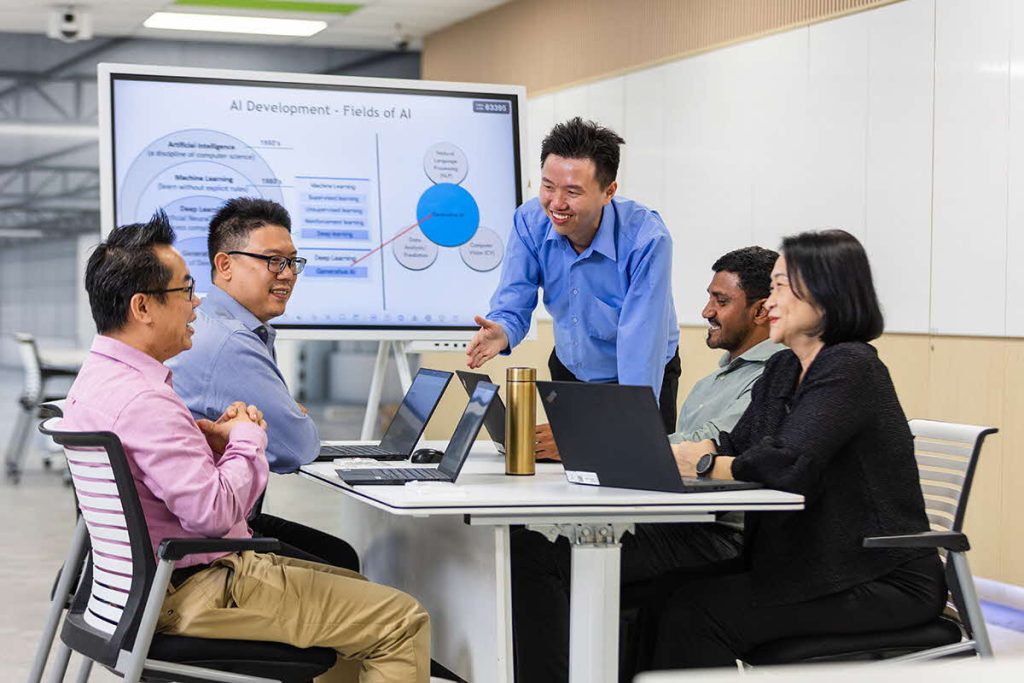
In teaching, there are difficult days, such as when a student misses class without good reason, when progress stalls, when motivation dips. Nevertheless, Mr Chua doesn’t shy away from this reality. “Teaching is tough. You deal with setbacks. You put in hours of work, and sometimes it still doesn’t go the way you hoped. But if you believe every student can be reached, it keeps you going.”
As fate would have it, his current reporting officer was once his teacher. To Mr Chua, this defines how he sees the profession – a cycle of paying it forward, one that began with his own ITE teachers and now, continues through him.
During the interview, he takes questions seriously, laughs often, and persuades you earnestly (thrice) to sign up for his AI workshop. But at heart, he’s still that student who once felt lost – and who never forgot what it meant to be seen.
“Every student has a story,” he says. “We just need to be the ones who stay long enough to hear it. And help them write a good ending.”
“I’m not here to be your friend, I’m here to help you succeed. But I will do it with care.”
Mr Chua


.jpg&w=3840&q=75)