



When a Secondary 4 student began attending school more regularly this year, most people might not have noticed.
For Mr Go Jun Hong, it was a breakthrough.
The student had struggled with absenteeism for years. Some mornings, teachers would visit his home to persuade him to come to school. His family faced financial difficulties, and his mother worked long hours.
One of the ways Mr Go and his colleagues stepped in was to suggest improvements to the family’s morning routine.
When the student could prepare for school before his mother left for work, he stopped drifting back to sleep.
It was a small intervention. But it worked.
“His attendance has never looked so good,” says Mr Go. “There are days he’s late, but he still comes.”
Success in schools isn't always measured by grades – sometimes, the greatest breakthrough begins with a student’s fresh outlook or a move away from an unhealthy habit.
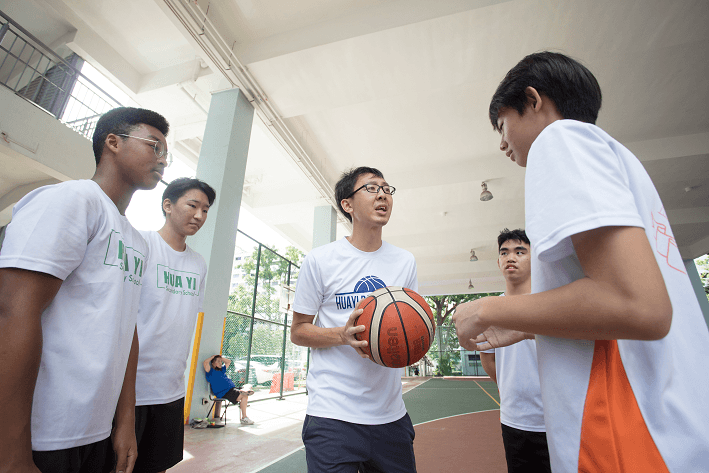
This belief shapes how Mr Go, the Head of Department for ICT and Applied Sciences, approaches teaching and student development. Whether he is supporting students with additional needs, building the confidence of his learners in Chemistry, or guiding them to better manage conflicts and emotions, his instinct is always the same: to help them find their way to a first win that is small enough to reach, but meaningful enough for change to begin.
Confidence before complexity
When Mr Go first entered teaching, he focused heavily on academic results. He spent much of his energy refining lessons and helping students score well.
But a conversation with a former principal, about a high-performing student who later suffered a breakdown, made him question whether schools were preparing students for life beyond examinations.
Experience gained from teaching diverse student profiles deepened that reflection. Mr Go realised that some students did not disengage because they lacked ability, but because they could not see themselves succeeding.
“I realised that when they experienced the first failure, they would maybe try one more time, and then they would just give up,” he says.
So he began redesigning his lessons around a “success-first” approach.
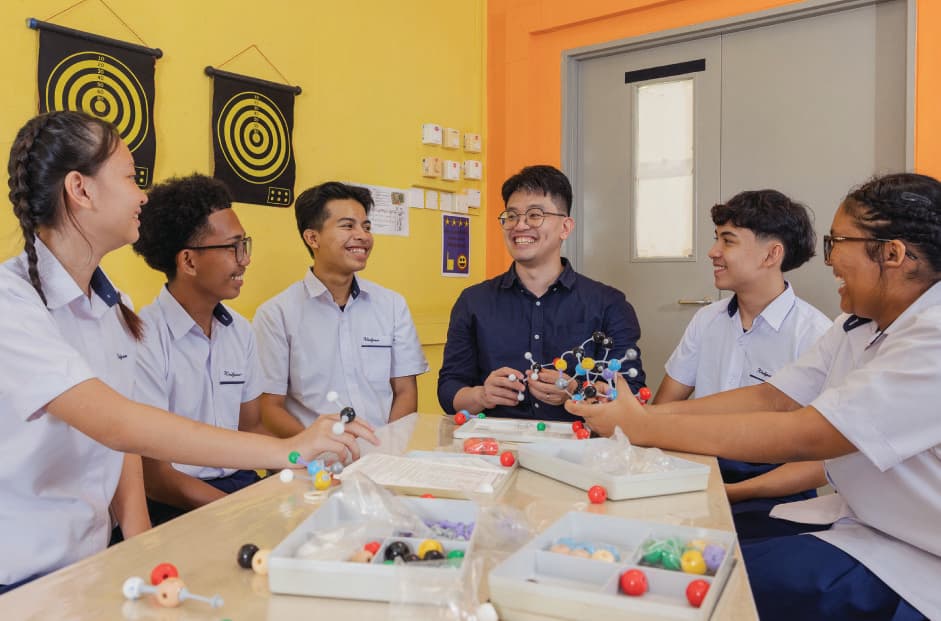
In Chemistry, where abstract concepts can feel intimidating from the start, that means designing lessons so students experience competence before complexity. He breaks learning into small, direct steps, and makes the first task closely mirror what has just been taught during the lesson.
For example, when students learn how atoms combine to form molecules, they first use a simple computer simulation to see how bonding works. Only after they have matched atoms successfully does the next layer of difficulty appear: choosing different atoms, testing whether the arrangement is stable, and trying again when it is not.
The shift may seem subtle, but Mr Go says it changes how students see themselves.
“They just want to get the assignment right,” he says. “When they finally experience that success, they feel more confident that they can do it.”
That is the point of “success-first”: not to lower expectations, but to help students stay in the learning long enough to meet those expectations.
‘A friend and a champion’
A learning journey to another school opened up new ways for Mr Go who is passionate about teaching across diverse learners.
It is important to understand each student’s needs, and ensure the right support reaches them. To him, the question is not simply: What are the learning needs of this student? It was: What does this student need in order to take the next step towards independence?
For one student who appeared dishevelled and struggled with social interaction, Mr Go found himself teaching him how to maintain personal hygiene.
For nearly a year, their conversations barely moved beyond one-word replies. Mr Go kept trying anyway – not always about schoolwork, but through conversations about family and daily life. Slowly, the student began to respond.
As trust grew, Mr Go looked for small ways to prepare him for post-secondary life, where there would be fewer adults managing his day. The goal was not just to get him through secondary school, but to help him function more independently beyond it.
“Students at risk often do not need a disciplinarian,” he observes. “They need a friend and a champion.”

Chances, not just consequences
That philosophy is reflected in the way students speak about him.
There was a student who struggled with emotional regulation, who recalls how Mr Go would always be the first teacher to pull him aside and speak to him calmly to help him understand what had happened.
That pattern repeated over the years. Each time, Mr Go gave him a chance to think through what he had done and why it mattered.
Today, the student is calmer and better able to control his emotions in school. He says, “Mr Go helped me learn to control my emotions and think before I act. Because of him, I have become a better version of myself.”
For Mr Go, progress is rarely dramatic or immediate. Behavioural relapses, careless mistakes, and occasional absences still happen. But growth happens when students believe that change is possible.
He encourages students by telling them the story of the oyster. When an irritant enters its shell, layer upon layer forms around it until it becomes a pearl.
Life, he tells them, works much the same way.
“There will always be things that irritate you, upset you or make you struggle,” he says. “But if you persevere through it, eventually something meaningful forms from it.”
For Mr Go, education is not about removing every obstacle from a student’s life. It is about staying close enough to notice the next possible step – and helping the student believe he can take it.
Sometimes, that step is passing a test. Sometimes, it is to master a small daily routine, ask for help, and sometimes, the most important milestone is simply this: the student shows up.
“When they finally experience that success, they feel more confident that they can do it.”
Mr Go