




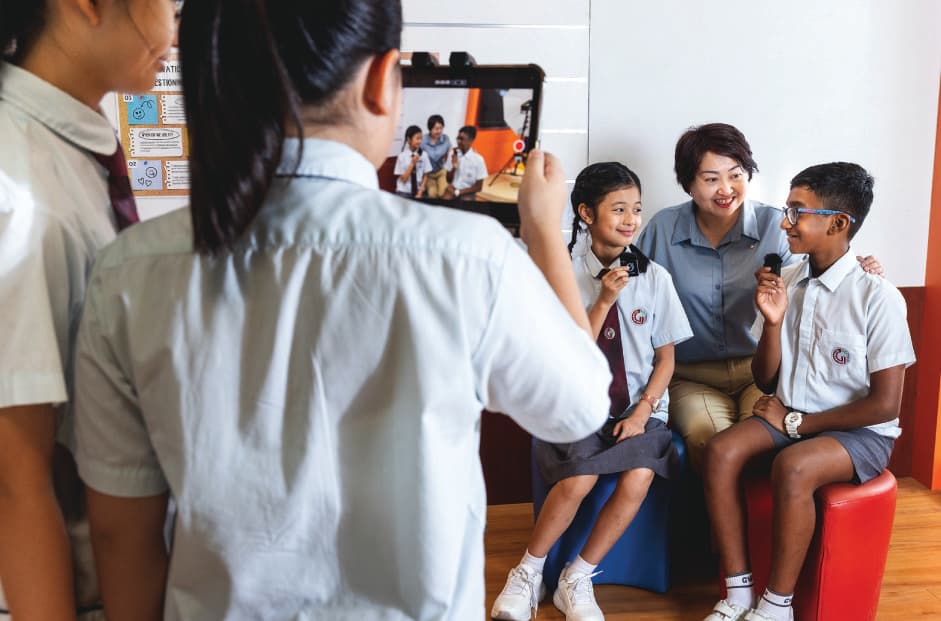
A few years ago, a parent came to Mdm Linda Goh Min Min with a familiar worry: Learning Mandarin is tough, so why are we putting children through it?
Mdm Goh did not disagree with the difficulty but offered parents a different view: Learning Chinese can be fun, even joyful, and there are easy ways to make friends with the language.
"Every Chinese character has a beauty and a story behind it," she says. Take the character 吞 (tūn, meaning "to swallow"). Rather than treating it as an abstract shape to memorise, Mdm Goh helps students trace it back to the ideas it is built from: 一 (yī, "one"), 大 (dà, "large"), and 口 (kǒu, "mouth") – each contributing its own layer of meaning to the whole. Put together, the character captures a single vivid image: “One large mouthful!” she enacts, something that delights her students to no end.
They soon look forward to uncovering the hidden meanings behind every brushstroke and along with it, little fragments of culture, philosophy and visual storytelling.
It is just not the same if they learned only hanyu pinyin, Mdm Goh stresses. “A lot of history, tradition and heritage is lost along the way.”
This conviction — that Chinese is not an obstacle to be cleared but a living language worth loving — runs through everything she does at Greenwood Primary School and leads the Mother Tongue Language department as Head of Department.
With even the smallest success comes joy
For many students, the early stages of learning Chinese can feel daunting.
Mdm Goh’s response is to begin with the basics — connecting Chinese characters to pictures, building foundational vocabulary — before nudging them towards more demanding work when they are ready.
She draws a comparison to why students will sit with a game for hours, failing and trying again, but not do the same for homework. The difference lies in how success is structured. "Level 1 is easy to go through. So is Level 2. That's how they hook them," she says. "Once they reach higher levels, the player is totally immersed."
Mdm Goh’s lessons are built on the same principle of achievement and excitement. "You must let them feel some success before they become self-motivated to learn," she says. "Students learn better if they feel that they are good in something."
Gamification, where it appears, is not a crutch but simply a way in, a hook that draws students into deeper thinking, richer interactions, and more intentional learning. The goal was never the game itself, but the curiosity and habits of mind it helps to build.
Teaching with intention, not just innovation
In recent years, Mdm Goh found new ways to draw out the quieter voices in her Primary 5 and 6 classes. To give them a safer space to ask questions and work through their doubts as the lesson progressed, she built an AI teaching assistant for use during digital learning, complete with an avatar that looks like her.
It draws from a closed set of content that Mdm Goh feeds on specific topics and is also programmed to deflect irrelevant questions.
Students can ask questions and clarify doubts with the tool as the class goes on, helping them to participate and stay engaged.
She also customised chatbots embedded in the Student Learning Space for speaking and writing practice.
For speaking practice, students get low-stakes opportunities to rehearse before they are asked to converse in Mandarin in more demanding settings. After practising with the bot, students become more confident conversing in Mandarin.
For writing, students first generate and refine their own ideas, then put their drafts up for peer comment, discussing what works and what doesn't in each other's storylines. Comparing their work with classmates exposes them to different ideas, and pushes them to think harder about what makes a story compelling. The real test comes the next day, when students write their composition independently, drawing on everything they have worked through.
Mdm Goh actively guides them on how to use the tools and helps them make sense of the feedback they receive. "You cannot let AI do all the work," says Mdm Goh. "Teaching must be intentional."
Making meaning, not just marks
Mdm Goh is also a champion of bilingualism. She leads Greenwood Primary’s Applied Learning Programme BLISS, which stands for Bilingual Literature apprecIation Student Series.
The whole-school programme uses second-language literary texts as springboards for values-based discussion. Teachers facilitate discussions with students on issues that have no easy answers. For instance, Mandarin learners may be offered the Chinese version of the children’s classic The Giving Tree (爱心树 ) about a boy and a tree, which explores themes of selflessness and the balance between giving and taking.
Students are asked: Is the boy selfish? Is the tree foolish to sacrifice itself? What is friendship, really? "There is no right or wrong answer," Mdm Goh explains. "They learn to see things from different perspectives."
Through these exercises, students learn language as well as values. "One’s mother tongue language is the key vehicle for values like respect, honesty and perseverance,” through which cultural narratives, idioms and moral reasoning are most powerfully understood, she explains.

Still finding the joy in teaching after all these years
One Primary 6 boy from a BLISS cohort stays in Mdm Goh’s mind. After going through the programme, the shy boy surprised her by asking if he could be the emcee for the school's Chinese New Year celebrations.
“Although he had a fear of public speaking, the opportunities he got from BLISS gave him the confidence to want to try speaking on a bigger stage.” She said yes, coached him, and watched him walk on stage and hold court. "He did very well,” she says. “I was so proud of him."
Mdm Goh believes a teacher’s work is never truly finished. Having experienced some success with EdTech tools, Mdm Goh’s goal this year is to refine her department’s teaching strategies for students who require additional support.
"This is the joy that I still find in teaching," she says. "It adds spark into work that can otherwise become boring."
Mdm Goh's teaching philosophy is rooted in a line from the Analects of Confucius: Is it not a pleasure to learn and practise what you have learnt? She is clear what she has learned about teaching – and certainly practises it.
"Content is not the most important thing," she says. "The most important thing is teaching students how to think, how to have the right values, and how to be a person who contributes to society."
She pauses, then smiles. "Happy teacher, happy child. When you go to work each day looking forward to seeing your students — then you know you're doing it right."
"Content is not the most important thing. The most important thing is teaching them how to think, how to have the right values, and how to be a person who contributes to society."
Mdm Goh



.jpg&w=3840&q=75)