




When 13-year-old Firash Faiq Bin Abdullah walked across the stage to receive the Changemaker Award last year, it marked a milestone for how much he had progressed. The award, given out twice a year at North Vista Primary School, recognises students for their efforts in positive change and learning attitude.
This was the same boy who once struggled to hold a pencil, write his own name, and whose home circumstances made regular school attendance difficult, shares Mrs Christine Er, the school’s Senior Special Educational Needs (SEN) Officer. She is among the staff who supported Firash during his primary school years.
“He’s really a pearl in an oyster shell,” she says. “His true potential is inside. When we discover it, it’s beautiful.”
Firash’s journey shows how much a child’s path can shift when the right support rallies around him.
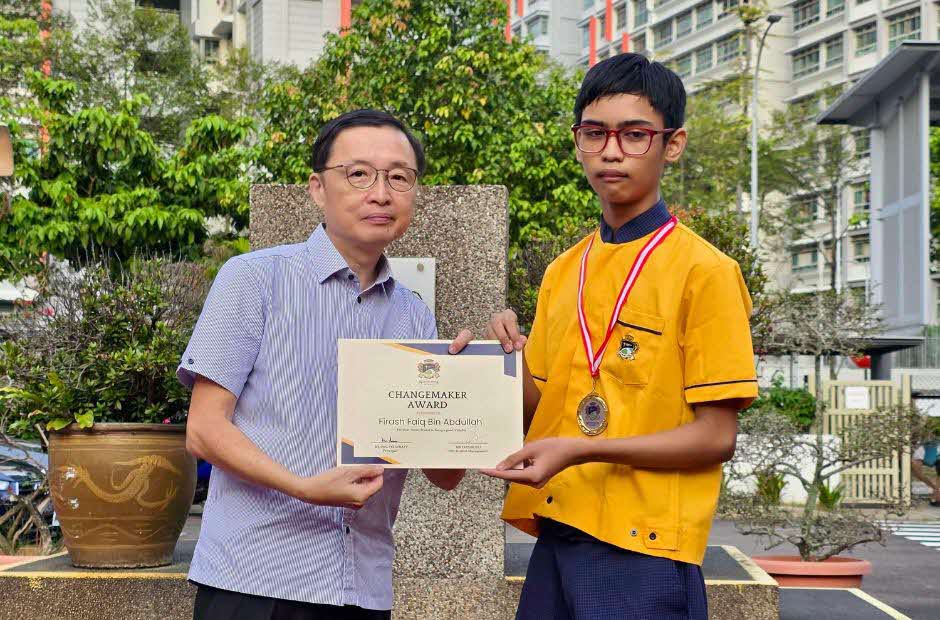
Firash received the Changemaker Award from North Vista Primary School's Principal Mr Ong Lye Whatt in 2025.
An unsteady start
Setbacks marked Firash’s early years, even before he entered primary school. He did not attend kindergarten, so while his classmates were reading simple storybooks and forming sentences on paper, Firash was still learning to grip a pencil and write his name. He knew the alphabet and numbers, but words, sentences and basic Maths concepts confused him.
When he finally secured a place in Primary 1 amidst family challenges, it was already halfway through the school year, and in the middle of the Covid-19 pandemic.
Recalling his early struggles in Primary school, Firash, who was diagnosed with dyslexia at around age 10, says, “I couldn’t read words. I felt left out of everything.”
As he entered school late, Firash also missed early screening programmes typically used to identify students who may need learning support. Even so, it was clear to his teachers that he needed help, both academically and beyond the classroom. His family faced difficulties providing basic school necessities, such as books and uniforms.
It takes a village
 The village of support that made Firash’s growth possible.
The school moved quickly to rally around Firash. Working alongside a Ministry of Education Roving Senior Student Welfare Officer (SWO), Ms Joyce Gan, they provided dedicated and specialised support to Firash and his family throughout his primary school years. This included working with Family Service Centres and the Housing & Development Board to ensure Firash had a safe and conducive environment to grow and learn.
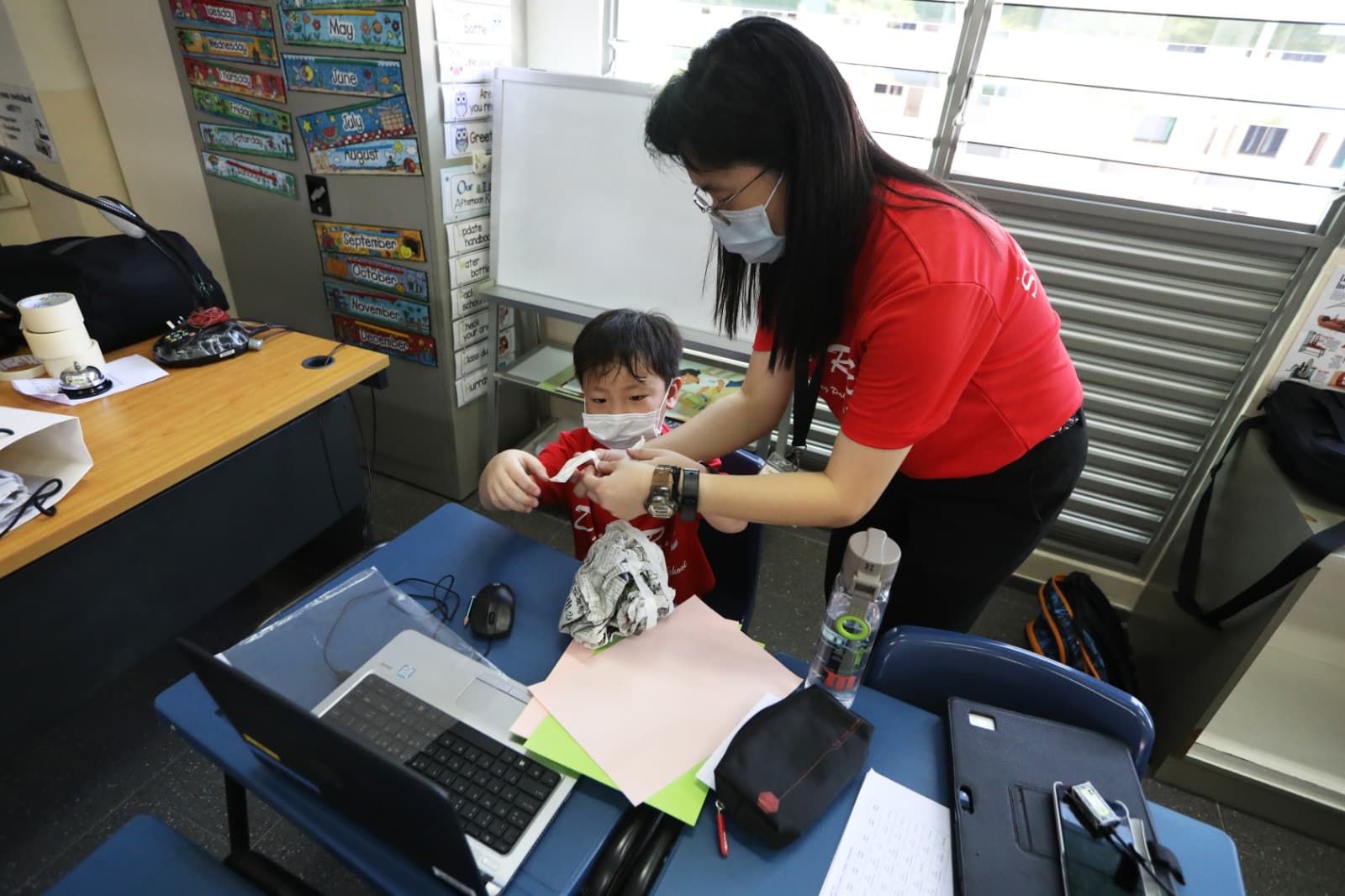
Within the classroom, Firash received structured support tailored to his needs. SEN Officers conducted regular one-on-one sessions, while his form teachers offered close guidance and encouragement.
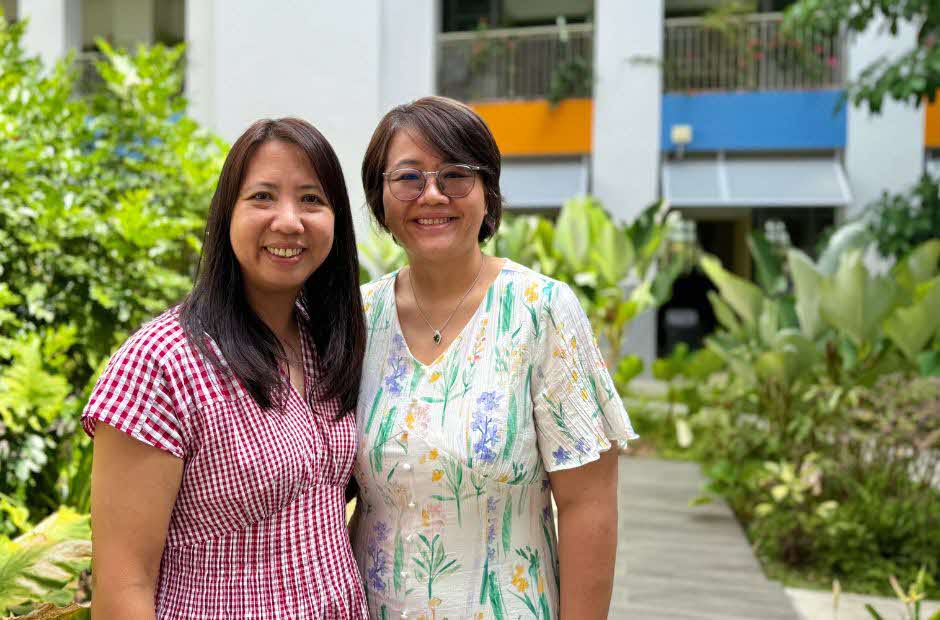
Mrs Er (left) and Ms Gan, who worked closely with the school to support Firash and his family.
At first, much of the focus was on building foundational skills. For example, a SEN officer Mr Sharizal Chandrayana worked on refining Firash’s fine motor skills, such as how to grip a pencil, trace letters, doing the basics of the alphabet, sounds and just writing words – just like what kindergarten students learn.
Firash was also referred for occupational therapy to support his motor skills, though attending appointments consistently was a challenge for the family.
To better support his learning pace, he was placed in foundation-level classes, where the smaller class size meant more individual attention. Even then, progress did not come easily. But his teachers never gave up.
Mrs Er recalls how one of Firash’s English teachers saw beyond his struggles and pushed gently but consistently. Drawing on learning approaches such as the “zone of proximal development”, which refers to the range of tasks a learner cannot yet complete independently but can potentially accomplish with guidance from a more knowledgeable other, such as a teacher or peer, the teacher helped Firash build confidence in his writing skills.
For Maths, teachers used approaches such as the Concrete–Pictorial–Abstract method, to help Firash better understand abstract concepts through hands-on objects and visuals. Even small adjustments like drawing lines on his Maths worksheets to guide writing, breaking down instruction into manageable, bite-sized steps helped.
Beyond the classroom, the school staff also ensured that Firash had the practical support he needed – clean uniforms, textbooks, and meals – recognising that learning happens best when basic needs are met.
Firash’s school attendance from Primary 1 to 4 was patchy. The school stepped up, with Mrs Er calling him at 6.30am every morning to remind him to come to school “no matter how late” he was. She also stocked up on snacks in the classroom, knowing that he might need breakfast to start the day.
Their efforts paid off, and over time, Firash’s school attendance improved drastically. By Primary 6 last year, he achieved full attendance, says Mrs Er.
Building trust with the family
On the surface, it might be tempting to view chronic school absenteeism as a lack of motivation. But the reality is often far more complex, says Ms Gan. Many of such cases are tied to challenging home environments, where adult caregivers may already be stretched thin, she adds.
Supporting students facing multiple challenges is often a long-drawn process, as trust between the family and school is key in supporting the child and takes time to build.
“When families feel safe and respected, rather than judged, it encourages constructive engagement. It strengthens the partnership between the school and the family, so that we can set a common goal and make decisions together about what is ultimately best for the child,” Ms Gan explains.
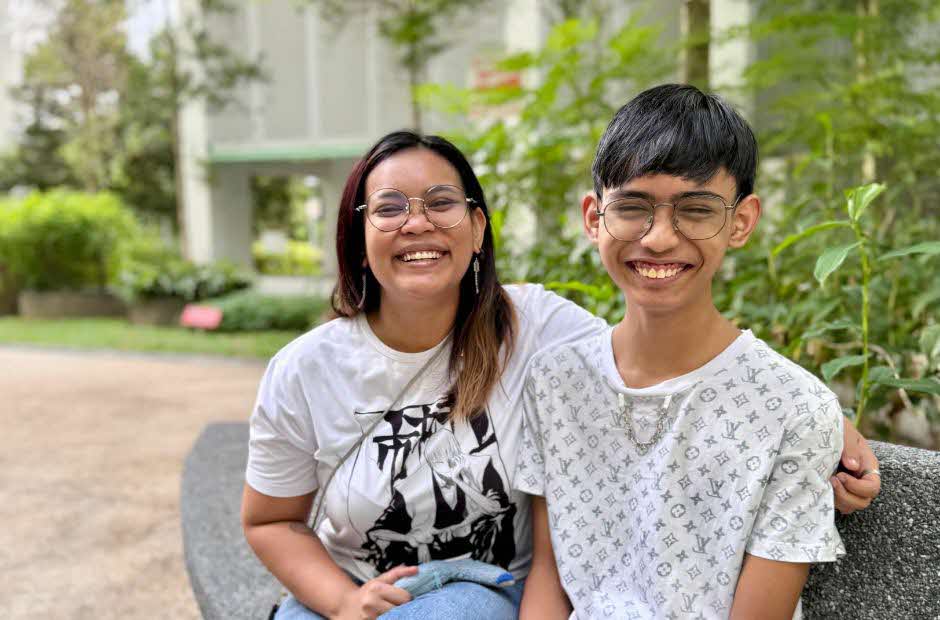 Firash and his mother, Mdm Fadina Farhain.
Trust also lays the foundation for longer-term engagement and support.
“It creates a sense of emotional safety to the child, particularly for families who are experiencing stress and vulnerability. A strong, trusting partnership creates a cohesive support system, and we can see how that contributes to improvements not just academically, but also in the child’s social skills, confidence and resilience,” Ms Gan adds.
Echoing this, Mrs Er emphasised the importance of the “village” in supporting Firash.
“It's not just one person; it’s every teacher and adult who has had a hand in his journey.”
How his confidence took root

Firash is grateful for the encouragement he received while at North Vista Primary School.
For Firash’s mother, Mdm Fadina Farhain, the journey is deeply personal. Having struggled with reading difficulties herself as a child and a lack of support, she was worried her son would face the same setbacks.
“I was scared for him, because I know how it feels like to get left behind,” she says. “But over time, with the help from the school and Joyce, we became more confident because he had people helping him. Firash’s confidence grew and he improved. I am happy that he managed to catch up.”
Now a Secondary 1 student at Spectra Secondary School, Firash says that his teachers’ encouragement made a big difference. Even after graduating from North Vista Primary School, those words of encouragement have stayed with him.
“I feel like the more my teachers encouraged me, the more I could improve on everything – Maths, Science, English. I am proud of all the accomplishments I made along the way, all the friends, everything I managed to learn,” he says.
Receiving the Changemaker award was a highlight for him. “After I won the award, I thought, maybe I can win more awards. There’s a chance I can,” Firash says, his eyes lighting up.
That positive thought, and the encouragement he received from his “village”, will continue to carry him forward in the years ahead.
Photos courtesy of: North Vista Primary School and Eveline Gan