




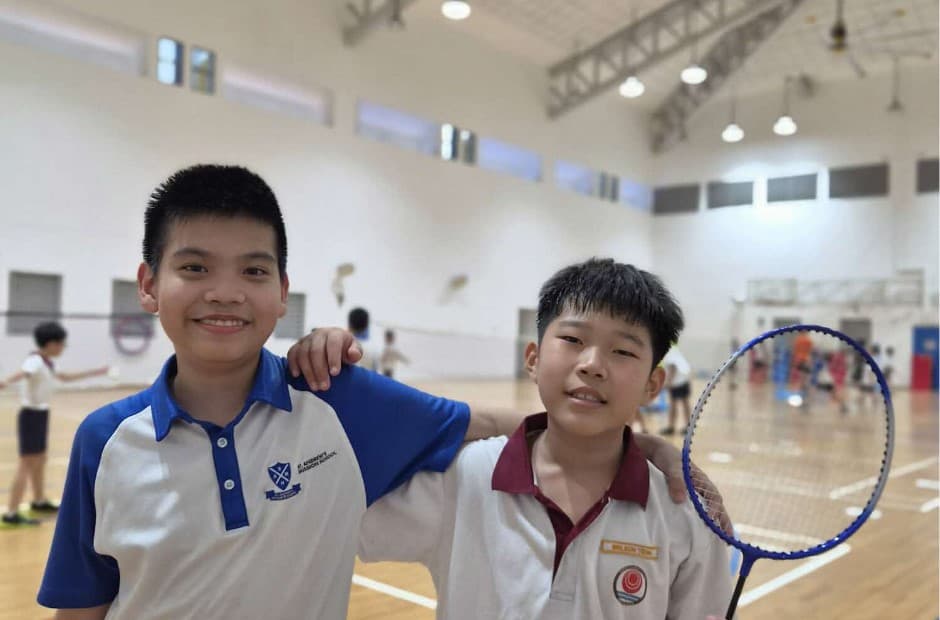
Ayser was anxious. He was going to meet his new badminton partner, but he wasn’t sure if they would play well together. Meantime, Melson had been briefed by his teachers on whom he was about to meet and arrived wondering how the two of them would get on.
Turns out, things didn’t go quite as either had expected – in the best way possible.
Because two seasons on, they are still playing together, dividing their side of the badminton court between themselves without discussion. Melson takes the back. He handles the drives, the returns that come at you with no time to think. Ayser guards the net, where the game is about placement rather than power.
These two 12-year-old boys met because their schools signed up to play badminton together. Melson is from Keming Primary School. Ayser is from St. Andrew’s Mission School (SAMS), a special education school for children and youths on the autism spectrum who can access the national curriculum.
Finding encouragement through the partnership
Melson, who has friends with special educational needs, says, “When I met Ayser, I didn’t see any difference between him and my friends in school.” He also sees Ayser as an equal he wants to learn from, adding, “He is very encouraging towards me and I will follow his good example.”
For Ayser, his initial nerves gave way to a partnership with a shorthand they both started using. “We always encourage each other by saying, ‘You can do it!’,” he says. When one of them makes a mistake, the other would say, “It’s OK.” He also reveals that the thing he had feared, which was being scolded for an error, never came.
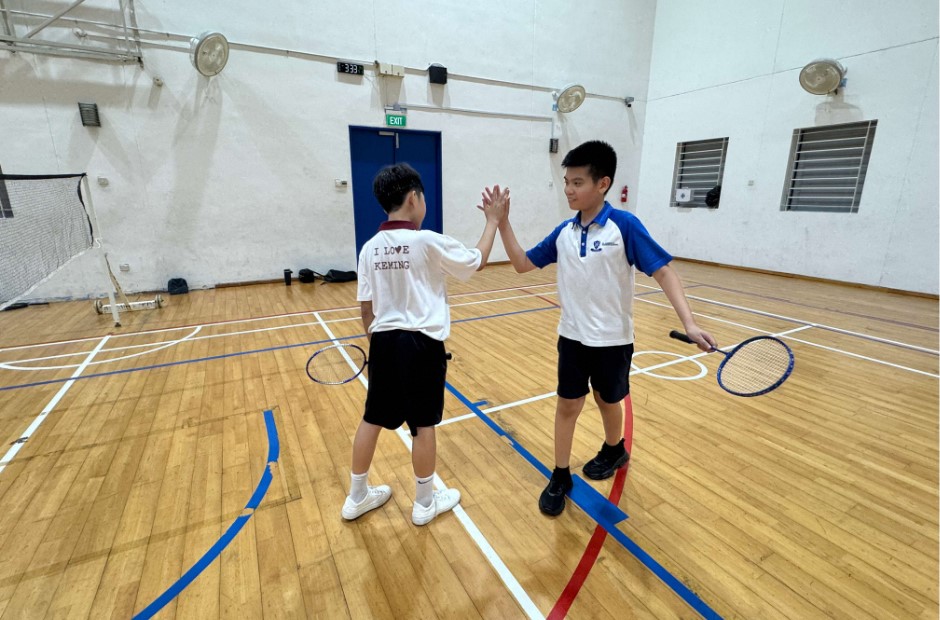
Melson (left) and Ayser celebrate a point. Two seasons of doubles have taught them who covers what, and when to say “It’s OK.”
Ask each what the other taught him and Ayser doesn’t hold back, saying, “We need to show ‘Love’ to each other so that we can be happy playing together.”
Melson, meantime, shares his observations of the gameplay. “I like to hit very hard, so I usually stand at the back of the court to catch all the hard and fast shots. Ayser hits a little softer, so he will stand in front and land the net shots and drop shots.” What the format taught him was expectation management – his own and his partner’s. “Sometimes, things don’t go your way and it’s OK.”
Why badminton doubles was chosen
Mr Mohammad Moiz Bin Malik, the teacher-in-charge of Keming Primary, selected students who could make friends to join Play Inclusive. Badminton was the practical choice – of the sports on offer, it was the easiest to organise, gave the students the most court time together, and was easy enough to pick up so students spent their time interacting with each other rather than focusing on acquiring techniques.
The doubles format also reinforces the importance of teamwork because players need to cover each other, and errors are jointly owned. “This safety net reduces the pressure, allowing both students to play confidently and with more strategy,” says Mr Moiz. It is why Ayser’s fear of being blamed for an error never materialised.
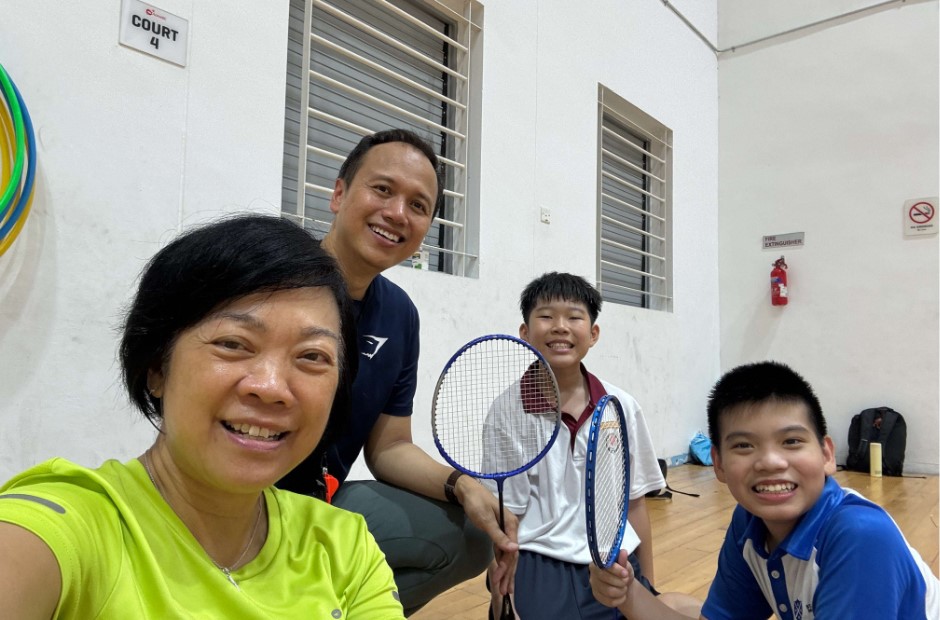
Ms Phoon and Mr Moiz with Melson and Ayser at a training session.
Communication is pushed to the forefront because the game collapses the moment two players stop reading each other; they need to learn their partner’s pace and habits almost immediately, often through nothing more than a glance or a hand signal. Melson and Ayser worked out early who takes which shots, and where each of them should stand to make that possible.
Ms Sandy Phoon, the teacher-in-charge of SAMS, saw the same logic from her side. “We discussed the students’ personalities and their sporting abilities to ensure that the pairing is compatible and they complement each other,” she says. On a doubles court, each student has exactly one other person to attend to, which also keeps the social task manageable.
What the teachers set up, and what they couldn’t
To help the students break the ice, Ms Phoon scripted the openings – say your name, then share a hobby that isn't badminton. Some students ran with it and were soon talking off court, while others needed a nudge. What she couldn't have planned for was the shift from polite small talk to genuine encouragement, where they “started motivating each other by affirming efforts and encouraging a growth mindset.”
Mr Moiz, too, watched the partnerships grow over two seasons. In between practices, students chatted about video games and cracked jokes, just like schoolmates. What he hadn't expected was to be drawn into this community that the students formed. “When I visit their campus, I’m greeted by the Play Inclusive players as though I were one of their own teachers,” he says of the SAMS students.
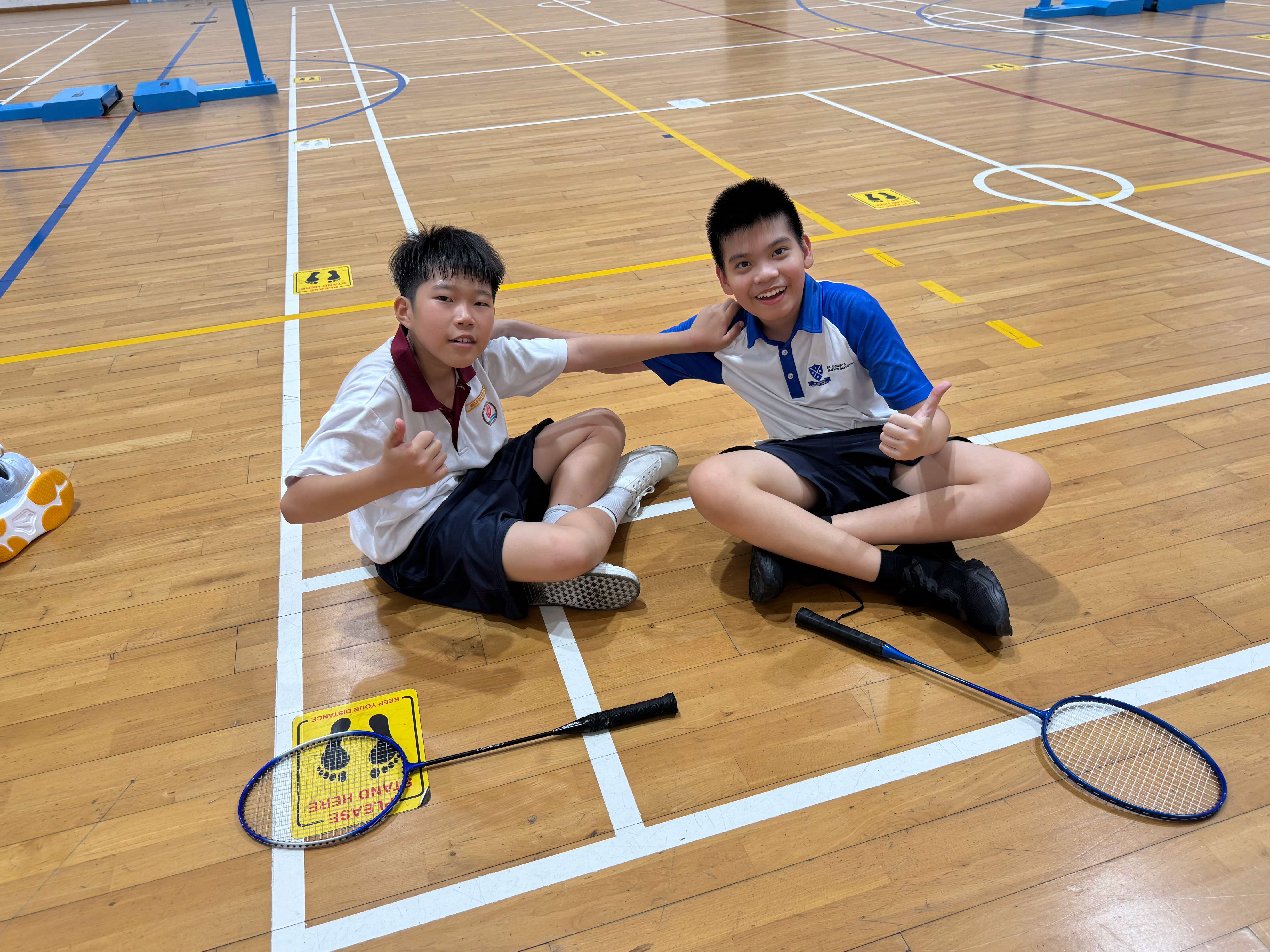
Ms Phoon hopes the students find other reasons to meet or keep in touch long after the last match is played.
Back in class, off the badminton court, Keming students took more initiative to look out for their classmates with special educational needs.
Then, when planning opened for the 2026 edition of Play Inclusive, the same students put their hands up again. “Despite their PSLE preparations, they readily volunteered to participate in the hopes to see their friends again,” says Mr Moiz.
Ayser’s response to whether he would play with the Keming students again is immediate: “Yes, definitely. The Keming students are strong and smart. They are nice people and also friendly too.”
Ms Phoon hopes the students find other reasons to meet or keep in touch on their own, over games, long after the last match is played. “I really hope to see that they can support one another and work towards an inclusive society.”
Play Inclusive 2026 takes place on 1 August. Melson and Ayser will be on court, along with hundreds of other students from special education and mainstream schools. Spectators are welcome. Visit the Play Inclusive website for venue, schedule and entry details.
Play Inclusive is organised by SportCares with Special Olympics Singapore and the Singapore Disability Sports Council, and supported by the Ministry of Education.


cab507a7a8a66eb2afccc900c73e6f2e.jpg&w=3840&q=75)