



Singaporeans’ love for food is indisputable. But while there’s always chatter about hawker culture and how we miss local food when we go overseas, there are deeper conversations about food happening in junior colleges (JC). In particular, how does Singapore, which imports more than 90% of our food, build up our capacity and capabilities for local production despite space constraints?
These discussions are triggered by Project Work (PW), a core part of the A-Level curriculum to help students develop crucial competencies such as collaborative skills and cross-disciplinary knowledge. PW also aims to prepare them to come up with creative solutions to real-world challenges, such as how to improve volunteerism rate and public transport, among others.
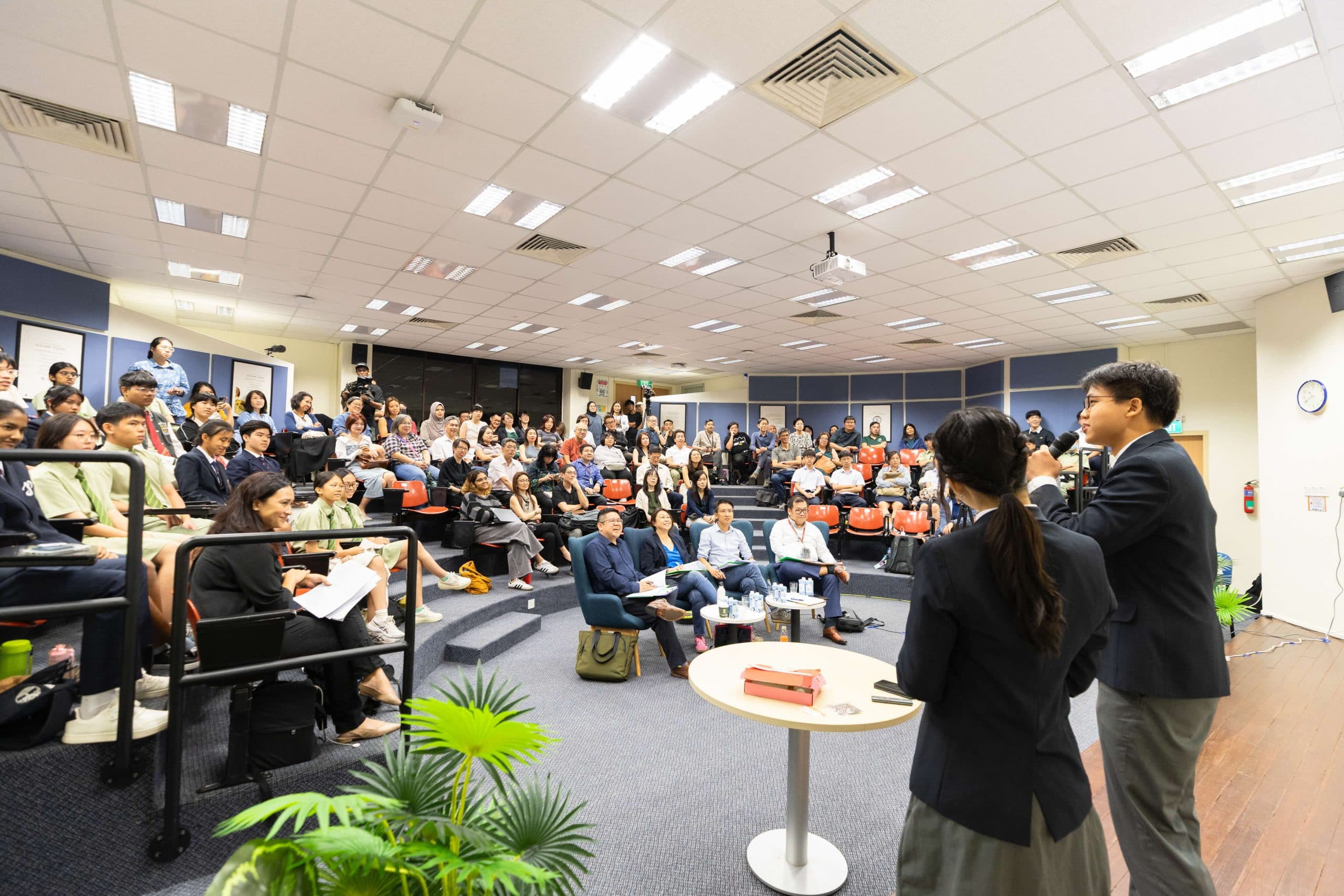
But it’s the solutions to improve food security that took the top three spots in this year’s Marketplace of Ideas (MOI) Pilot Pitch, where PW groups were invited to present their proposals to judges from MOE and its partner agencies for the 2024 MOI – Land Transport Authority, National Volunteer and Philanthropy Centre, and the Singapore Food Agency /Ministry of Sustainability and the Environment.
Here are the winning teams’ proposed solutions.
Eunoia JC’s Sustainabite wants to normalise the consumption of insect protein
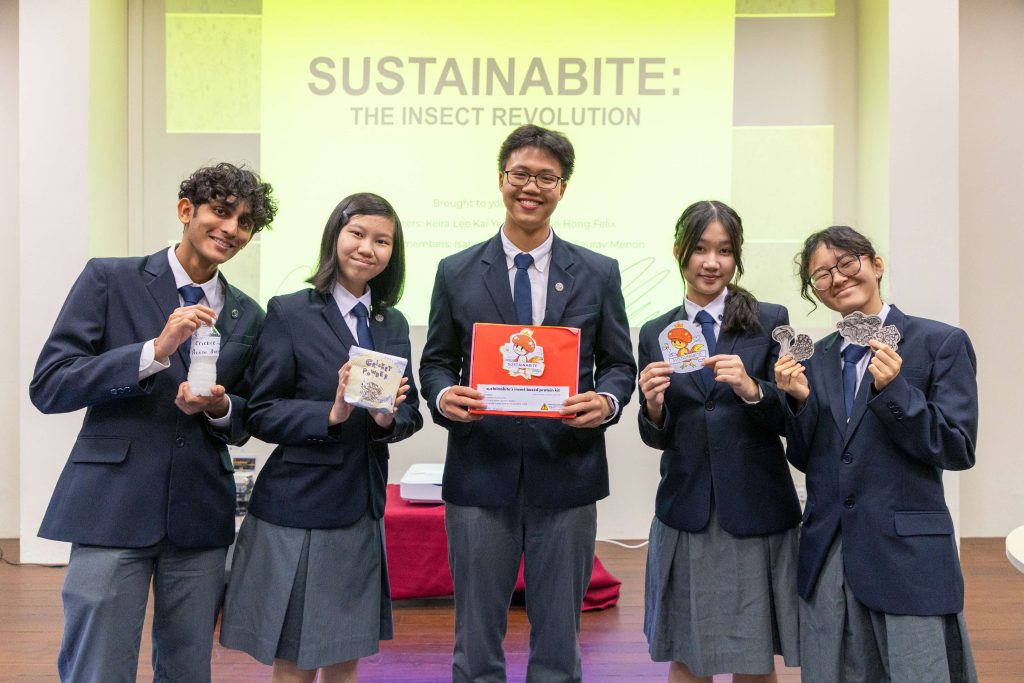
From left, Saurav Menon, Isabelle Goh, Felix Lay, Keira Lee, and Jocelin Teh from Sustainabite.
With a group that comprises several self-professed insect lovers, Sustainabite’s idea of selling recipe kits with cricket protein batter and a customisable vegetarian base, like oyster mushroom, won first place in the PW Pilot Pitch. Their proposal came with an educational and promotional marketing campaign, which impressed the judges.
The team says that in order to come up with an effective solution to their chosen topic, they had to understand the roadblocks, such as consumer perceptions on insect protein, and work our way around them. They also mentioned that they were fortunate to be able to jump on the recent legalisation of insect products, to pioneer the novel use of insect protein.
With the repositioning of PW to a pass/fail subject (students are no longer given letter grades), the team also felt encouraged to think of more novel solutions. They stepped out of their comfort zone and tried things they’ve never done before, such as doing a pilot test, by inviting their principal, dean, and other teachers and friends to test out the recipe kit. While the team admits that the pressure to step into the unknown was felt by all of them, the environment allowed them to pursue a more passion-driven project, and made their efforts much more worthwhile.
Jurong Pioneer JC’s Aquafarm aims to improve the supply of locally farmed fish
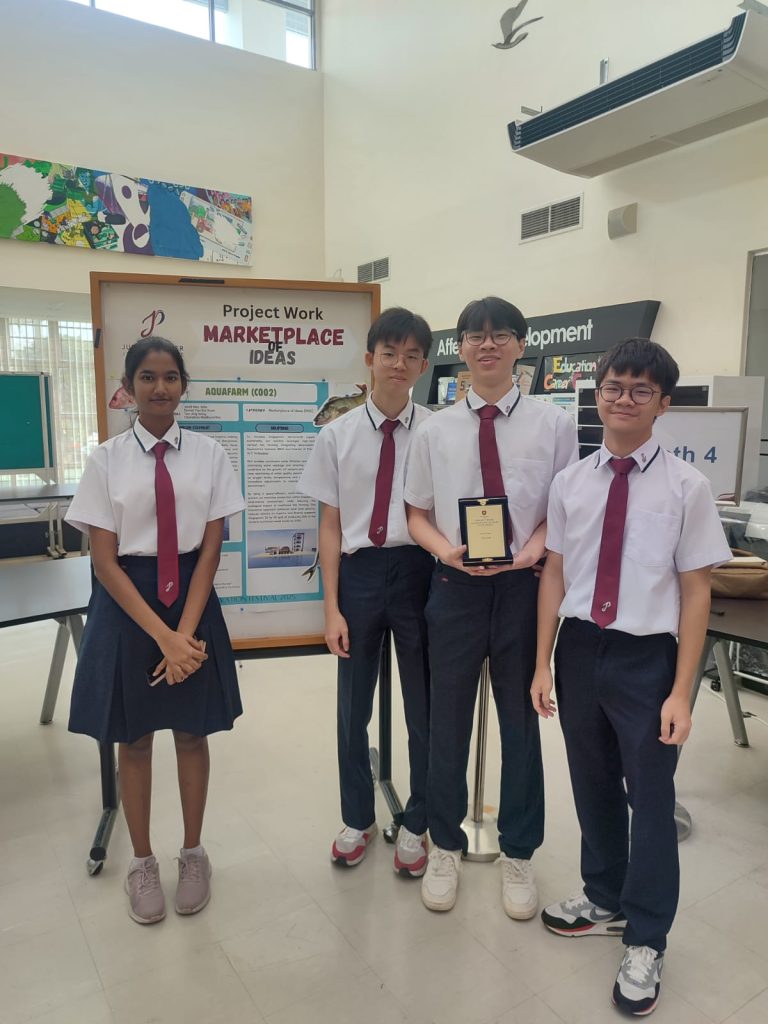
From left, Chandran Madhumitha, Jerell Neo Jiale, Tan Jing Hong and Daniel Yip Kai Xuan from Aquafarm.
A nine-storey vertical farm to breed barramundi. An advanced recirculation aqua culture system backed by IoT technologies. A Shark Tank-worthy pitch. That’s how JPJC’s Aquafarm won over the judges with their idea of improving the supply of barramundi in Singapore.
“Singaporeans consume a lot of fish, and only 9% of our fish is locally farmed,” says Jerell Neo. “We wanted to tackle this gap in food security, so our team explored the idea of a vertical farm to maximise limited land space in Singapore. Barramundi stood out to us because it is hardy, fast-growing, and already popular with local consumers, making it an ideal choice for sustainable farming.”
But it’s not just research and pitching skills that the team picked up in their PW journey. “While refining our pitch, we were advised that our project, though innovative and well-researched, lacked a compelling human narrative,” says Jerell Neo. “As we pushed ourselves to reframe the project from the lens of real-world impact, I began to understand the deeper purpose of innovation. It’s not just about systems and efficiency—it’s about people, and balancing analytical precision with empathy and communication.”
Jurong Pioneer JC’s MRTshrooms reimagines underused MRT station pillars as mushroom farms
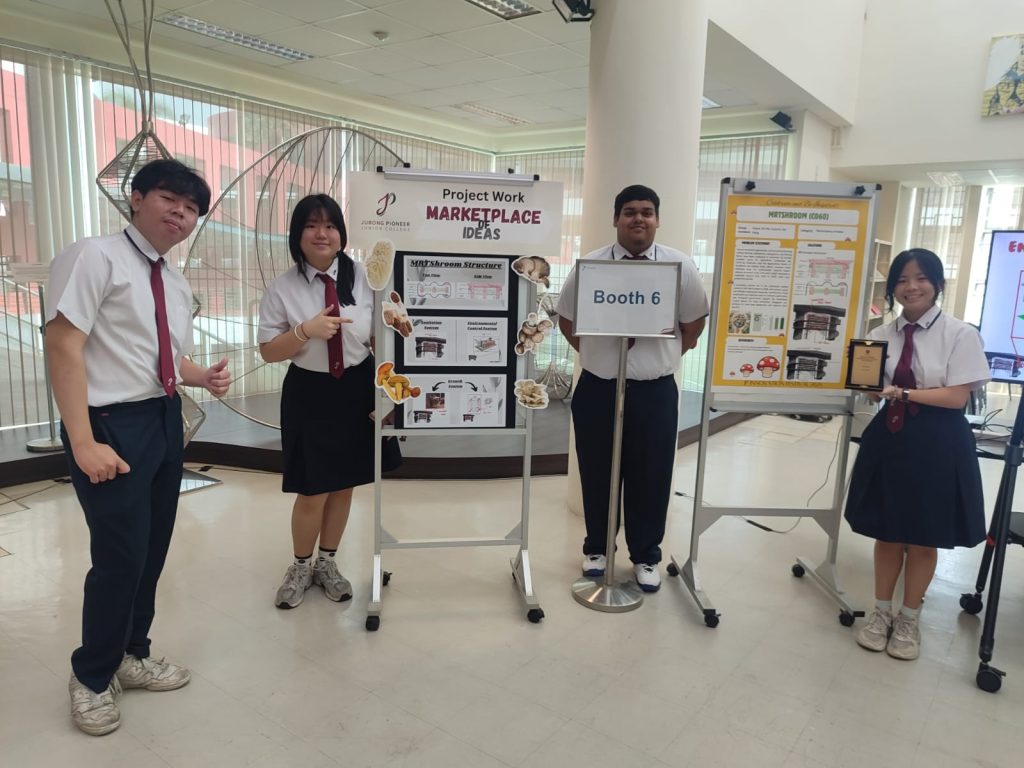
From left, Sim Kai Feng, Fayre Wang Si Jin, Sasvint and Soh Zhi Min from MRTshrooms.
While MRTshrooms’ unprecedented idea of growing mushrooms under MRT station pillars won them the third place in the MOI Pilot Pitch, the path they took to arrive at this creative proposal was a rocky one.
“At first, we thought of using unused spaces on rooftops or car parks to grow crops. However, our PW teacher told us that most of the rooftops and car parks already have solar panel farms,” says Soh Zhi Min. “Then, after zooming in on unused spaces beneath the MRT station pillars, we faced the problem of inadequate sunlight in those areas. That eventually led us to arrive at the idea of growing mushrooms, as they need little to minimal light.”
By overcoming these unexpected roadblocks, Sasvint from MRTshrooms says that creative resilience was a surprising skill that the team picked up. “We gained the ability to keep pushing an idea forward despite uncertainty, and also discovered the importance of narrative design to tell a compelling story that isn’t just data-driven, but also human-centred and emotionally engaging.”
The impact of the refreshed PW syllabus
In 2024, the refreshed PW syllabus rolled out, and the most marked change was it being repositioned as a pass/fail subject. Teachers and students alike say this has created more room for experimentation, as well as allowed the students to pursue projects that they are passionate about.
Ms Ng Lee Siah, who teaches at EJC and has been teaching PW for over 15 years, says that teachers have seen a huge jump in the diversity of topics proposed by the students since the refresh. “Students feel more comfortable exploring various topics instead of opting for widely reported problems. There’s also an increase in students working on problems closer to their hearts – such as issues their grandparents or close friends have faced,” she elaborates.
Chandran Madhumitha of JPJC’s Aquafarm summarises her biggest takeaway: Creativity thrives when there are fewer restrictions. “PW gave me the space to experiment with ideas, visuals, and writing styles I wouldn’t normally try in other subjects. It reminded me that when we’re given freedom, we often push ourselves further and take more pride in our work.”
Photos courtesy of: Jurong Pioneer Junior College