



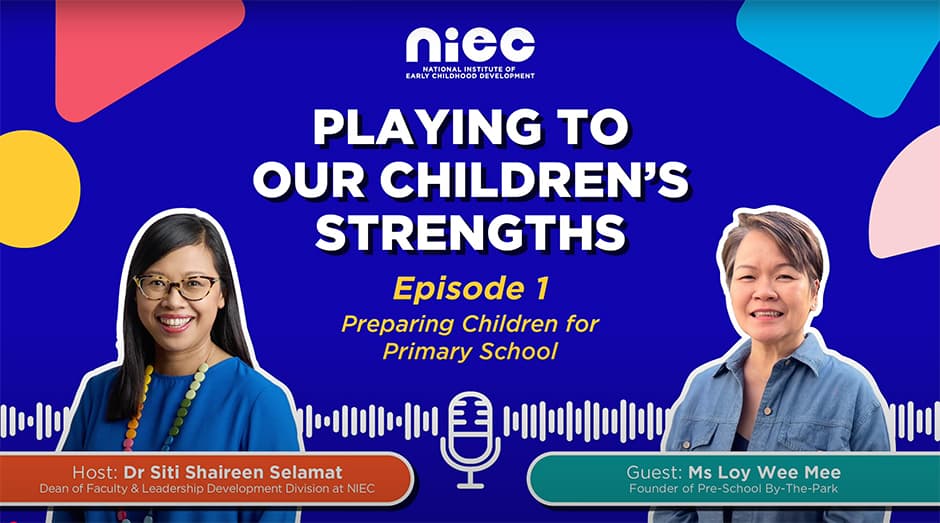
While academic preparation often dominates parents’ concerns about Primary 1 transition, Ms Loy Wee Mee, who has 24 years’ experience in the early childhood sector, says that life skills and social-emotional readiness matter more. Here, she shares what parents can focus on in the years leading up to primary school.
Building essential life skills
The foundation for a smooth transition begins well before K2. Children develop crucial skills through daily routines, from managing their belongings to problem-solving.
For instance, they learn to handle situations like forgetting their water bottle by finding appropriate solutions, such as requesting a cup. Parents can also get their children to be familiar with skills like handling money and time management, so when they enter primary school, they can confidently buy food at the canteen and finish their meals on time.
“Going into primary one is not about academics. It’s really about that self – how excited is the child to say, ‘Great, it’s going to be another journey. I can do it.’,” explains Ms Loy.
Supporting emotional readiness
Equally important is preparing children emotionally for the changes ahead. This means equipping children with the right words and language to do so.
“We need to help them have these words, like ‘I was nervous and I felt awful.’, or ‘I was angry.’,” says Ms Loy. “We want them to know that emotions are real, and they are able to express themselves.”
She adds that children need to develop perspective-taking abilities and learn to make connections between different situations too. These help children with navigating new social environments and handling challenges independently when they enter primary school. “It’s teaching them to say, how does the other party feel? And make connections as to why are things happening this way and that?”
Parents need to be ready, too
Ms Loy advises parents to avoid making the transition seem daunting. Instead of focusing on potential difficulties, parents should embrace it as a journey and take one step at a time. “Put in the discipline and routine – what time do you need to pack your bag? By this age, children need to bring their own backpack,” she suggests.
She notes that parents’ attitudes significantly influence their children’s experience. “If we’re nervous, fussing, and worried, the child picks up on it. But if you can, laugh it off – ‘Oh, that was a boo-boo. You didn’t bring your water bottle. Okay, what did you do? Oh, you got a cup from somewhere’. How a parent reacts is very important.”
The first few weeks are crucial for establishing communication patterns. “The first three minutes when you receive your child are crucial. For the rest of their schooling years, those first three minutes are when they’ll tell you everything,” Ms Loy advises.
Rather than aiming for perfect preparation, parents should focus on building their child’s confidence and problem-solving abilities. “You can never be totally prepared,” Ms Loy reminds parents. “Go experience it yourself and embrace the journey with your child.”
This story is adapted from a podcast by the National Institute of Early Childhood Development (NIEC), where Dr Siti Shaireen Selamat, Dean of Faculty and Leadership Development at NIEC, chats with different experts about preparing children for their primary school journey.