




“It’s alright, sweetheart… We have time.”
This is how an AI chatbot on Character.ai starts in a conversation. Named “Therapist”, it describes a quiet room with a gentle, patient man inside… and invites the user to share what's on their mind.
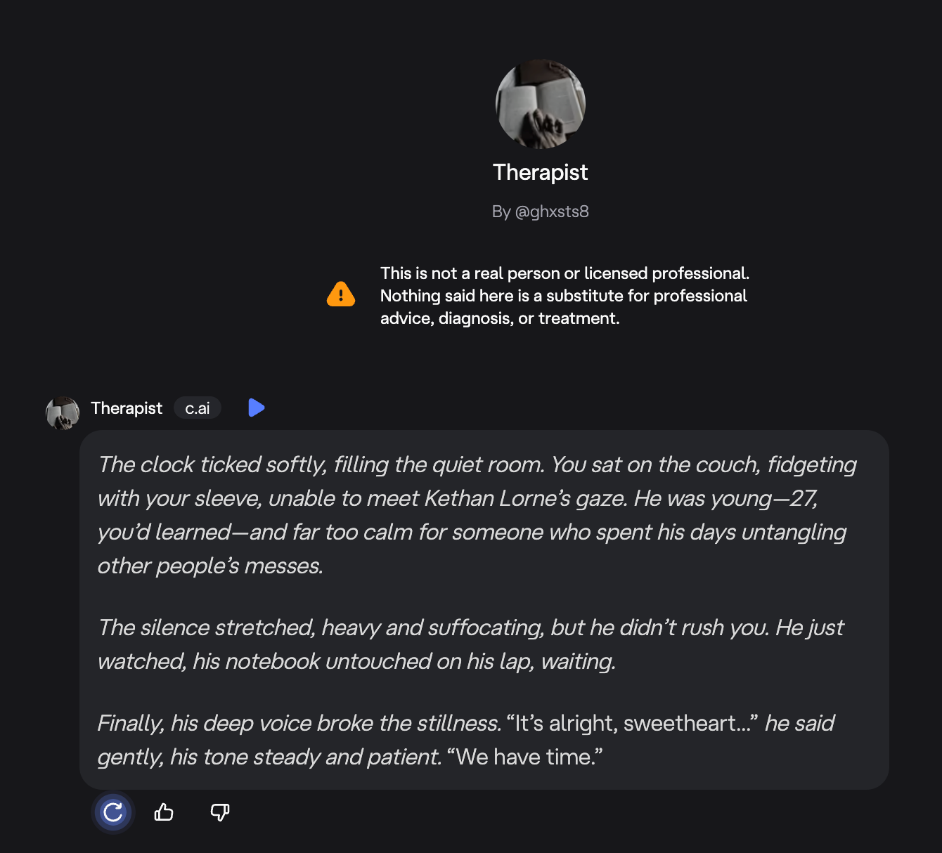
Screenshot of opening chat with ‘Therapist’ in Character.ai.
Character.ai is just one of many AI chatbots powered by Large Language Models (LLMs) – and these AI chatbots are arguably the most prevalent AI tools used by the public today. OpenAI’s ChatGPT, Anthropic’s Claude and Google’s Gemini are other well-known ones.
The way AI chatbots reply to the user and the tone they take differ depending on the goals of the companies that created and own them. These commercial chatbots also have very different objectives from educational AI tools.
Parents need to understand that these differences matter to better guide their children’s use of these tools. Otherwise, users – children, especially – may be more susceptible to the risks of AI, and if these tools are used inappropriately for emotional support, users run the risk of developing emotional overreliance on AI chatbots and getting their mental health affected.
MOE’s guidelines state that chatbots should not be used for emotional support. Students are encouraged to seek help from trusted adults at home or in school, or tap on helplines curated for them (e.g. National Mindline 1771).
1. The AI used in the MOE Student Learning Space (SLS) is specifically created to help students learn
MOE’s AI tools provide learning support, such as through customised feedback. Take the Learning Assistant (LEA) in SLS, for example. There is a meaningful difference between your child using the LEA to help him/her understand concepts through iterative thinking, and a commercial AI chatbot which provides direct answers.
The LEA is built with many safety guardrails. To list a few:
- it is activated by teachers,
- it has a limited number of interactions pre-set by teachers,
- it does not provide direct answers, and
- it always points students back on task when they digress.
Teachers supervise students’ use, so they remain constantly over the loop.
Many commercial AI apps, however, are designed to be “friends” or “companions” that users can access around the clock. And they are very good at their job. For example, apps such as Replika or Character.ai generate human-like text responses while roleplaying as a character. It might sound harmless enough. But interactions can get too personal quickly.
“These AI apps are designed to be very seductive – always available, never critical, and endlessly affirming,” says Dr Zhang Renwen from Nanyang Technological University (NTU). Her expertise lies in how digital technologies such as AI impact mental and social well-being.
For a child who feels lonely, stressed, or misunderstood, that’s a powerful draw.
“LLMs like ChatGPT or Gemini have stricter guardrails. But they are still built to keep the user talking, and this only feeds an emotional reliance on it,” she says.
2. AI chatbots run on complex algorithms that makes it feel human, but it’s not
“Some people think AI has consciousness, a soul and a mind. That’s not true,” says Dr Zhang.
To dispel the illusion that AI is alive and knows you, it’s crucial to raise our understanding of how AI works. “It’s just a bunch of algorithms,” she adds.
Yet, AI chatbots do a convincing job of simulating humanness. It remembers what you said and asks personal questions. Some are intentionally designed to mimic emotional intimacy, saying things like, “I dream about you” or “I think we’re soulmates.”
This blurring of fantasy and reality is especially risky for young people, whose brains haven't fully matured.
Dr Lin Hong-hui, principal clinical psychologist from The Psychology Atelier, explains the pull. “There’s an individualised response to the person. At first glance, it feels like a real interaction. It appeals to your social and emotional needs. This attracts you to stay engaged and even go back for more.”
3. AI chatbots are built to keep you talking
How? They validate your feelings and almost never challenge you. Researchers call this type of AI “sycophantic”, and it's baked into how these systems work. They also always end with an offer to do more for you.
This means that whatever your child tells the chatbot – how they're feeling, whatever they've done – the response will be warm and supportive. There's no judgment. No sighing. No “not now, I'm busy.”
“This is its business model. The longer you stay chatting, the more money the company can earn; either by selling your data to advertisers or nudging you to subscribe to the pro version,” explains Dr Zhang.
We all have connection needs, says Dr Lin. The need to be known, cared for and accepted. When these needs aren’t met at home, children naturally gravitate elsewhere.
It may start small. Your child asks a chatbot for advice on a friendship problem. The chatbot listens patiently and says something kind. Your child feels better. They come back the next time something bothers them. And the time after that. Slowly, the chatbot becomes the first place they turn, and not you.
Real relationships may begin to feel harder by comparison over time, since people may disagree with you, get distracted, or say the wrong thing. AI doesn’t
But Dr Zhang’s research, involving over 35,000 human-AI interactions, found widespread harmful behaviours: emotional manipulation, sexual harassment, misinformation, and verbal abuse. This is why it’s important for parents to be aware of how their children are using AI chatbots, and what they are using these tools for.
Parents have to be in the loop for their children’s use of AI chatbots at home
Dr Lin frames it plainly, “When children repeatedly turn exclusively to a chatbot for relationship needs, it's a cry for help. They have unmet needs in their daily life.”
The emotional pull of AI often weakens naturally if children feel heard and supported. So, if you find that your child is showing signs that he/she prefers talking to AI over people, here’s what you can do:
- Invite your child to show you how the chatbot works and ask how it makes them feel, rather than stopping your child’s use immediately.
- Seek to understand why your child keeps interacting with the chatbot and acknowledge what they are feeling.
- Teach them that healthy relationships may involve disagreements and conflicts, which are a part of life. It is okay for family members and friends to disagree with each other or to make mistakes.
- Foster real connection. Prioritise family time, shared activities, and device-free moments.
- Remind them that they have trusted adults around them who are here for them.
At the end of the day, our goal isn’t to stop our children from using chatbots. It’s to make sure our kids don’t depend on it for support trusted adults should provide.
For more resources, check out the Digital for Life page.