




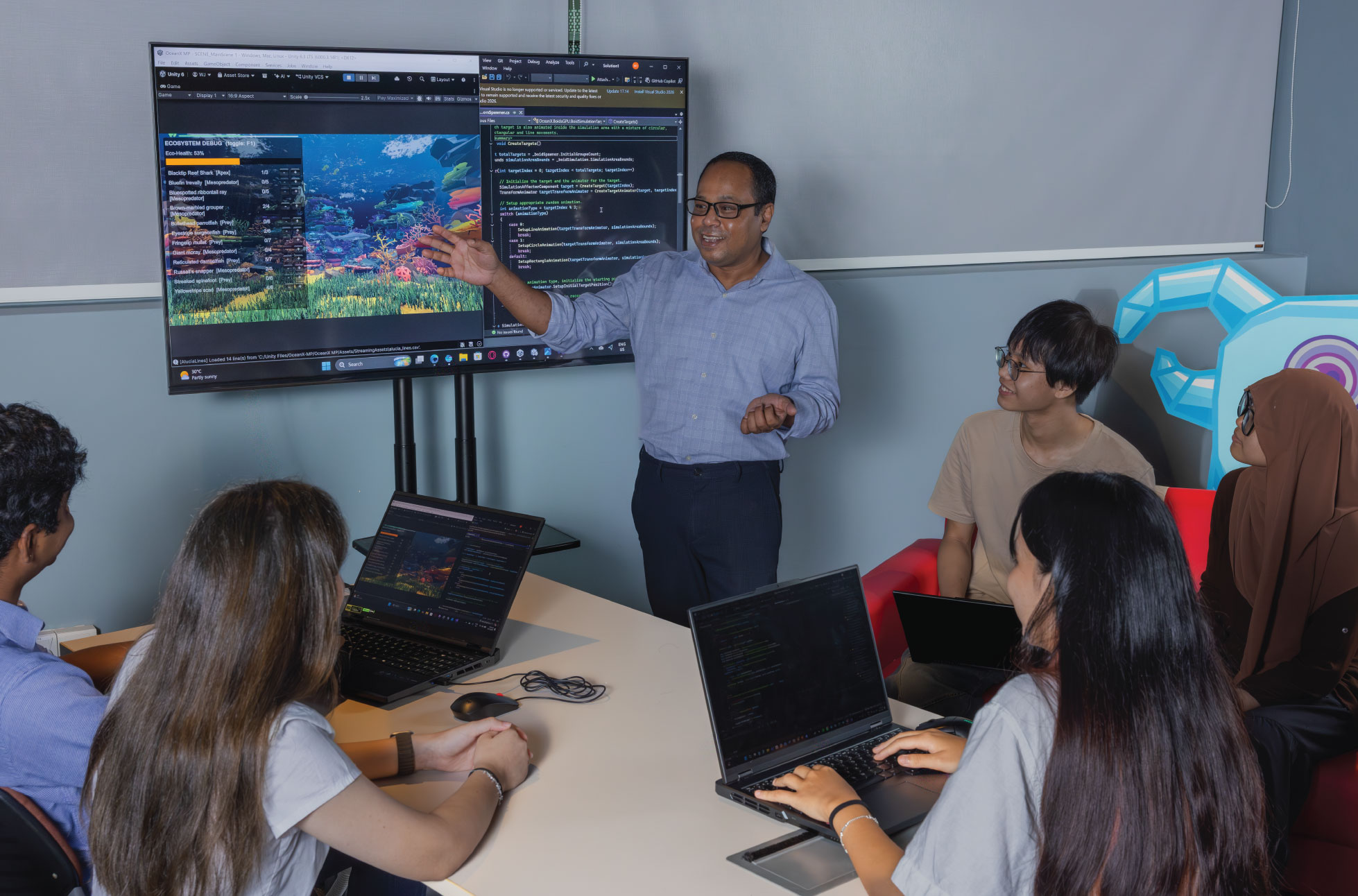
It was 11pm, the night before a simulation system was due to be demonstrated to an important client, when the system went down unexpectedly.
Mr Shamim Akhtar, a developer back then in 2006, worked through the night, eventually locating the exact problem in the dense codebase. The software was fixed and ready for the client demonstration by morning.
“I knew the answer was in there somewhere,” he recalls.
That same instinct to think critically, iterate constantly, and never give up, is something Mr Shamim wants to instil in his students. As Course Chair for the Diploma in Immersive Media & Game Development at Temasek Polytechnic, he developed his personal Enterprise of One Framework (EOF) for capability building to get them there.
The name of the framework that supports his students across all three years of their polytechnic education was chosen with intention. “You as a student are in control of your own lifelong learning, resilience and ethical use of AI,” he explains. “You are your own enterprise.”
Tackling that Year 1 problem
The EOF was a direct response to one of Mr Shamim’s greatest challenges as a polytechnic educator.
When students arrive in Year 1, they are fired up to build games and simulations. These could look like a cockpit simulator to train pilots, or an immersive game that introduces the sensory world of neurodivergent people. But first, students need to get through compulsory foundation modules, which they can find dry and challenging to relate to initially.
Some struggle and a few come close to withdrawing from the course altogether. “The core technical subjects, while critical, can feel irrelevant to their creative ambitions of diving into developing their own game,” he explains.
Others feel lost in the polytechnic system that requires more self-discipline than what they were used to in secondary school. On the side, Mr Shamim also started to see students rely increasingly on AI to do their thinking for them. All this formed a problem statement that he designed the EOF to address.
His Enterprise of One builds more than skills
Since 2025, Mr Shamim has embedded the EOF in his course modules to ensure these five principles are met during the students’ polytechnic years: self-directed learning, AI-augmented capability, real-world integration, continuous feedback, and identity and resilience.
The principles are applied whether for teaching and assessing a skill or a learning disposition like adaptability.
In Year 1, Mr Shamim’s framework starts students off on the right foot towards self-directed learning and resilience. He takes the students out on learning journeys into real studios.
At an arcade game developer, for example, students saw how a game gets published from a rough idea to a working machine in Timezone.
Back on campus, short workshops and tutorials fill the gaps. These include game development tutorials and 3D modelling sessions run by students from the course’s special interest group. Lecturers guide them closely, usually with questions and feedback, and do not spoon-feed with answers. Neither do they leave the students to figure problems out on their own.

The same structured approach applies to how students are guided to use AI. Starting in Year 2, rather than assessing the output, Mr Shamim and his lecturers assess how students interact with the tool. Students are required to fill out a template that documents their objectives, prompts and critical analysis of AI-generated answers – that is, they are using AI to find fault with its own output.
“They see that AI can also make mistakes. This keeps them thinking,” he explains.
The structures start to come off
Halfway through their second year, before they commence their Major Project and Student Internship Programme, students work on problem statements from industry partners. This builds on the real-world integration portion of the EOF and their identity as being nearly work-ready graduates. This is the change to the curriculum that Mr Shamim considers the most consequential.
The first attempt did not go as planned for one group of students; Mr Shamim expected Year 2 students working on a hospital project to manage the testing and improvements on their own. However, their first submission fell short, and some students became overwhelmed. “I underestimated the level of scaffolding they needed,” he says. He then introduced clearer stages and sprint timelines, gradually reducing this scaffolding as the students became more confident and independent.
In their final year, all students work on industry projects where they develop solutions independently, albeit with guidance from their lecturers. In addition, they learn how to use feedback to pivot and push on with their goals, hence learning resilience as a team.
In one instance, a group stalled on developing a game while waiting for the industry client to pick the game controller. Mr Shamim posed them a question, “If you were the creative lead, which controller would you choose for this game, and why?” What mattered to him was not the answer, but how they arrived at it. The students debated their ideas, challenged one another and ultimately reached a shared conclusion. At the next meeting, they returned with three versions of the gameplay, including one featuring voice control.
“When the students tackle an open-ended problem without structured rubrics, they ask themselves what to do next”, says Mr Shamim. This is a strong sign to him that his approach to teaching is working.
Structuring care to students’ learning experiences
Mr Shamim also structures care into the students’ learning experiences. “Good solutions begin with understanding the person you are building them for,” is what he tells them and how he approaches teaching too.
One student, on the autism spectrum, needed strong structured support in Year 1. Instructions were given in ordered steps, lessons were run the same way each week, noise-cancelling headphones were needed when the room grew loud. For this student, uncertainty came later, through small open-ended tasks and then an industry project.
Mr Shamim also sought to understand the student’s challenges before proposing a project involving elderly users, which would expose him to needs and perspectives different from his own.
For this project, the student interviewed potential users before designing a hand-held sensor that encourages arm movement. On his own, he arranged for it to be tested with residents at a nursing home. His work supervisor was impressed with the initiative to user-test. Even more unexpected was when the student ran a lively trial session, cheering the elderly residents on in their exercises.
When the student went far beyond basic requirements, “this is when you know the student has achieved self-directedness”, Mr Shamim says, revealing his trademark quiet smile.
When a student was feeling burned out after Year 1 and wanted to drop out, Mr Shamim saw that her affinity for UX and design thinking was not being capitalised on soon enough in the course. Among other interventions, he identified for her a year-long UI/UX internship at Cognizant Technology Solutions that could develop her strengths.
She shone at the internship and ended up becoming one of the MNC’s top 100 employees worldwide for inspiring her colleagues with her positive attitude and aptitude. She completed her final year at Temasek Polytechnic with outstanding academic performance and a perfect GPA of 4.0.
Developing tools that benefit the poly community
When not working with students, Mr Shamim works for them.
In 2025, he built MindVizu, an AI web application that converts dense academic text into notes, visual mind maps, and audio summaries. The tool was created in response to his students’ preference for course material in different formats. By designing and deploying it, he demonstrated the Enterprise of One philosophy to them: that an individual with the right skills and mindset can build meaningful solutions that scale.
Concern for student well-being also led him to develop TPCraw, an AI-powered tool to process publicly available Reddit discussions about student experiences and flag emerging areas of concern.
“If I expect students to build meaningful solutions, I must do the same,” he summed up. When he hits a road bump, Mr Shamim draws on memories of those late nights as a young developer, narrowing software problems bit by bit until he found the fix.
“This is what I always tell my students: Chaos will become clarity when you take one more step.”
“What makes me happy is when students take the initiative to make decisions for themselves instead of asking me what to do next. Whether that next step turns out to be right or wrong, what matters is that they are willing to take action and learn from it.”
Mr Shamim


.jpg&w=3840&q=75)