




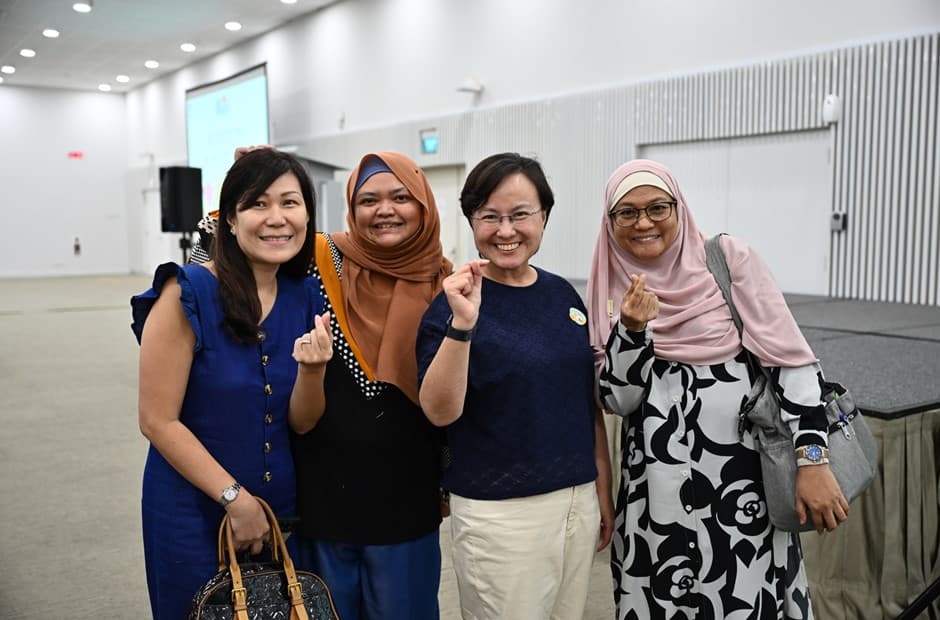
Back when Mrs Tan Chen Kee was a student, silence was golden when it came to parent-school interactions.
“My mum was a teacher then, but still, she didn’t really care about what was going on in school unless the school called her,” says Mrs Tan, who’s now MOE’s Deputy Director-General of Education (Schools) and Director of Schools. “And when that happened, it usually meant bad news, so it was better for the school not to call.”
While the belief then was that “no news is good news”, today’s paradigm between schools and parents is quite different. “The parenting approach has changed over the years,” Mrs Tan acknowledges. “These days, most parents want to be a lot more engaged with schools.”
That is a healthy sign, since both parents and schools share the same goal of helping the child flourish. However, being too involved can lead to over-parenting, which can have its drawbacks. One of these is what Mrs Tan calls “short-circuiting the process of learning”.
What does that mean? Well, let’s say a child is not able to get into the co-curricular activity (CCA) of their choice. How a parent responds can inform the life lessons their child absorbs from the experience.
Scenario 1: The parent helps the child to understand that in life you don’t always get what you want, but be open to what you get
In this scenario, the child comes to terms with the reality that in life, we don’t always get what we want. “So it’s about learning to deal with setbacks and disappointment, to be more resilient, and to bounce back” says Mrs Tan.
By opting for a different CCA, the child could also discover new interests and hone a sense of flexibility with regards to different pathways. Parental involvement could then be talking to their child about being open to alternative possibilities in life.
Scenario 2: The parent lets the child learn how to fight their own battles
Parents can encourage the child to advocate for himself, for example, by persuading the school to let him try out for the CCA again. Perhaps he works harder to qualify. Whether he succeeds or not, the child builds up a sense of agency as well as resilience.
Scenario 3: The parent inadvertently “short circuits” the learning process by intervening
A parent may decide to write to the school or appeal to MOE to relax the rules or to do away with hurdles such as selection trials altogether, so that every child can take part in the CCA they want.
In this scenario, the child may not learn anything except to turn to their parents to solve their problems. This may also not involve meaningful effort at relationship-building, which requires putting in the time to have parent-child conversations.
Great expectations, healthy boundaries
If there’s anything the three scenarios above show, it is that it’s important for parents to let their children have more agency. “Let the child experience failure, if necessary,” says Mrs Tan. “The school is a safe environment to do so, and that is how they grow and learn.”
However, this message can be challenging to communicate. Deeper parental engagement these days is often driven by the higher expectations of increasingly well-educated parents. With more dual-income families now, time-starved working parents may also prioritise by focusing on tangible goals (such as the CCA scenario sketched above, or academic performance), rather than the more amorphous but important process of getting to know their child better.
“With mounting pressures of work and responsibilities in life, parents sometimes don’t get to spend enough time with their children, and as a result they may not know their children well enough. Some may overcompensate by expecting schools to do certain things for their children,” Mrs Tan observes. This kind of parental involvement can lead to a “us vs them” mindset at times. But, she points out, the relationship between parents and schools was never meant to be adversarial. “When schools engage with parents, we always seek to put the child at the centre of all discussions, and we want to work together to raise happy, resilient, and kind children,” she elaborates.
Building strong school-home partnerships has been a longstanding focus for MOE. In 1998, the ministry set up COMmunity and PArents in Support of Schools (COMPASS), a national-level advisory body to enhance school-home-community collaborations. In 2019, MOE launched a set of guidelines on developing positive school-home partnerships. The goal: to provide greater clarity on how schools and parents can work together, particularly in helping children develop self-management skills, take ownership of their learning, and build resilience.
In 2024, these guidelines were refreshed, in collaboration with COMPASS. The refreshed guidelines included a renewed emphasis on respectful communication between teachers and parents, for example establishing boundaries such as communicating with teachers only during working hours.
This signals a recalibration of expectations, says Mrs Tan. Over the years, the expectations for how much teachers should engage parents have crept up, and that may inadvertently also be driven by educators as well. Mrs Tan shares an anecdote about a teacher who would text her students’ parents before each spelling test, so they could remind their children to prepare for the tests. One day, the teacher forgot to send a reminder, and was reprimanded by some parents who had come to expect that level of engagement.
“The recalibration is about setting reasonable expectations,” says Mrs Tan. Building strong teacher-parent relationships is at the heart of these efforts. “But we need to understand how can we do this in a way that maintains some personal space for the teachers, while also allowing the child to learn how to advocate for himself or herself. The agency needs to reside with the child and not the teacher.”
Building strong relationships between children, parents and teachers
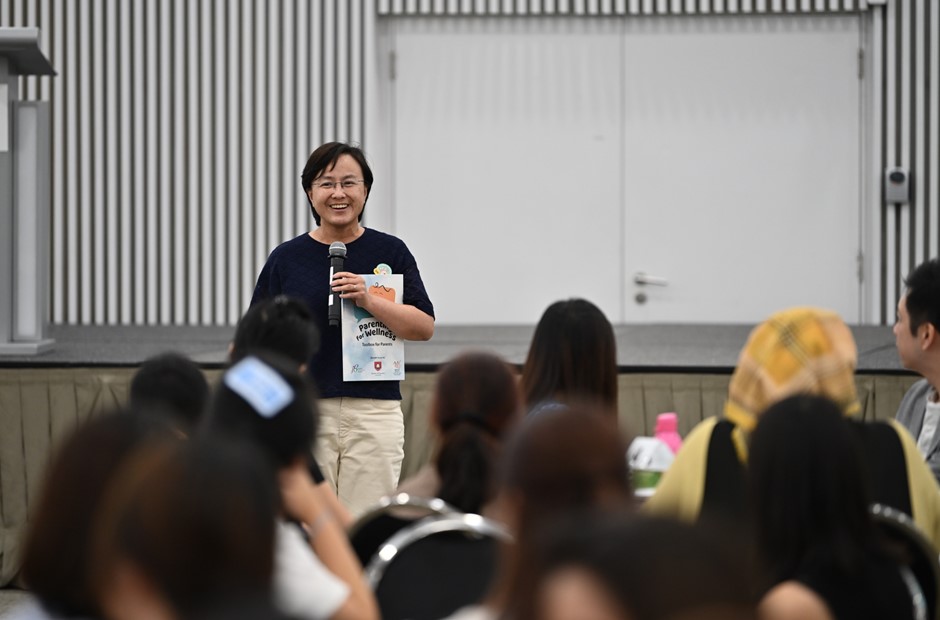
Besides adjusting expectations for the parent-teacher relationship, MOE also wants to better support the cultivation of a strong parent-child relationship. Along with the refreshed guidelines for school-home partnerships, the Ministry launched Parenting for Wellness, an initiative undertaken together with the Ministry of Social and Family Development and the Health Promotion Board.
Parenting for Wellness aims to equip parents with knowledge and skills to build strong parent-child relationships, strengthen their children’s mental well-being and emotional resilience, and parent effectively in the digital age. It includes tools such as a card deck designed to facilitate deeper conversations. A dedicated website with more parenting tips was launched in early 2025.
“There is some room to heighten parents’ awareness on the need to have open conversations with their children and to build their relationship with their children,” says Mrs Tan. She recalls chatting with some Primary 6 students recently about the secondary schools they were interested in, which were different from the ones their parents wanted them to go to, and how they were sad that they had to defer to their parents’ wishes.
Such observations are not uncommon. Besides making the effort to listen to their child’s aspirations and anxieties, parents can also be open to listening to what their child’s teacher has to say. Such parental receptiveness can only happen if the parent-teacher relationship is on sound footing, Mrs Tan notes.
At heart, both parents and teachers want what is best for the child, and more empathy on both sides goes a long way, Mrs Tan believes. When teachers and parents seek to understand each other’s perspectives, “that builds up the understanding and communication, and it really makes for a much better relationship so that we can raise happy, resilient, and kind children”.
.jpg&w=3840&q=75)