





The primary school student was clutching an unopened umbrella, catching up to his little sister to shelter her in the downpour. When their father approached, he took the girl’s hand and walked off without acknowledging the boy, leaving him standing there, drenched, his shoulders slumped in resignation.
“I just broke down,” Mdm Nurul Huda Bte Juma’at recalls of witnessing this scene involving her student from afar. “Children may be carrying invisible burdens.”
Difficult situations like this underpin her dedication to be empathetic and understanding towards every student’s needs. Currently the Head of Department for Character and Citizenship Education (CCE) of Fuhua Primary School, Mdm Huda develops comprehensive frameworks that guide in the implementation of pastoral care and weave character-building into every corner of school life.
Building systems that inculcate good values
In short, Mdm Huda doesn’t leave the inculcating of good values and outcomes to chance.
“We need to be intentional in our values education,” she says. “We need to ask ourselves — what are the learning outcomes in each particular lesson?”
Her comprehensive values chart anchors every term to one school core value, that is reinforced through multiple platforms. Each morning, student leaders share the day’s character focus during assembly with the school population. It might go like this: “The character trait of the day is care. We need to listen more, and exercise empathy for others.”
Teachers receive updates through calendar invites highlighting the core value for the week, along with curated lesson resources for reinforcement with students.
The message is then threaded through the Sixer Programme, Fuhua’s peer support programme supported by the House System that takes all the students through values-based games and activities.
To produce the chart, Mdm Huda also collaborated with the HOD PE and Aesthetics, Co-Curricular Activities (CCA) Coordinator and CCA teachers to map CCE developmental milestones into their weekly activities, ensuring classroom, CCA, and Sixer experiences reinforce one another.
The process of mapping was more intricate than it sounds: she took reference from the MOE CCE developmental milestones and repackaged them into bite-sized statements that teachers could relate to and apply in their lessons.
For instance, she created simple, adaptable statements like ‘demonstrate a positive outlook in life’ that teachers could easily incorporate across different subjects. Teachers could use this to recognise students who maintain an optimistic attitude when tackling challenging questions.
When Mdm Huda shared this milestone map with her colleagues, she was delighted that teachers appreciated its clarity and readily used the statements in their lessons.

Start-It-Right to avert crises
One of the several values-based programmes that Mdm Huda initiated is the Start-It-Right programme in partnership with the Year Heads.
On the first day of each term, the Start-It-Right programme allows students to immerse in activities that strengthen their peer relationships, social skills and confidence.
Through activities and talks, students learn how to build positive relationships, pairing up with buddies from a different level so they have familiar faces around them who are ready to show care. Teachers also openly discuss and role-model acts of care in class as reinforcement of their learning.
Mdm Huda was heartened when two students who got into a fight came up to her voluntarily the next morning to make peace. She had spoken to the class before on the value of restoring broken relationships and has had one-to-one conversations with both students. This paved the path to reconciliation when they told her, “we are ready to apologise to each other”, she recounts.
Mdm Huda acknowledges that customising care to each child can be a stress point for any teacher. “Listening to every child, especially those who need extra support, while conducting a lesson is tough, so every decision – from the routines I set to the support tools I choose – has to be intentional.”
‘Let’s have brave, messy conversations’
Aside from individual student support, Mdm Huda extends her impact to whole-school curriculum development.
As the teacher-in-charge of the CCE Strategic Foci Committee, she coaches teachers on instructional implementation, so that CCE is woven into academic learning outcomes and assessment.
To this end, she introduces pedagogical frameworks and structured methodologies, such as the Clarifying, Sensitising and Influencing (CSI) routine for teachers to facilitate “brave, messy conversations” with confidence.
A news report about inconsiderate behaviour between neighbours could be a springboard for lively classroom discussions, not to mention learning opportunities on perspective-taking, mutual respect and community living.
Along the way, students develop 21st Century Competencies like critical thinking and communication skills which helps them improve in their studies too.
To paraphrase a Lao Tzu saying, good habits build good character.
“If I put in place the structures and tools,” Mdm Huda adds, “the care flows naturally.” When a once-quiet student volunteers to help a classmate, or a house captain thanks the school attendant without prompting after a sports event, she knows her efforts are working.
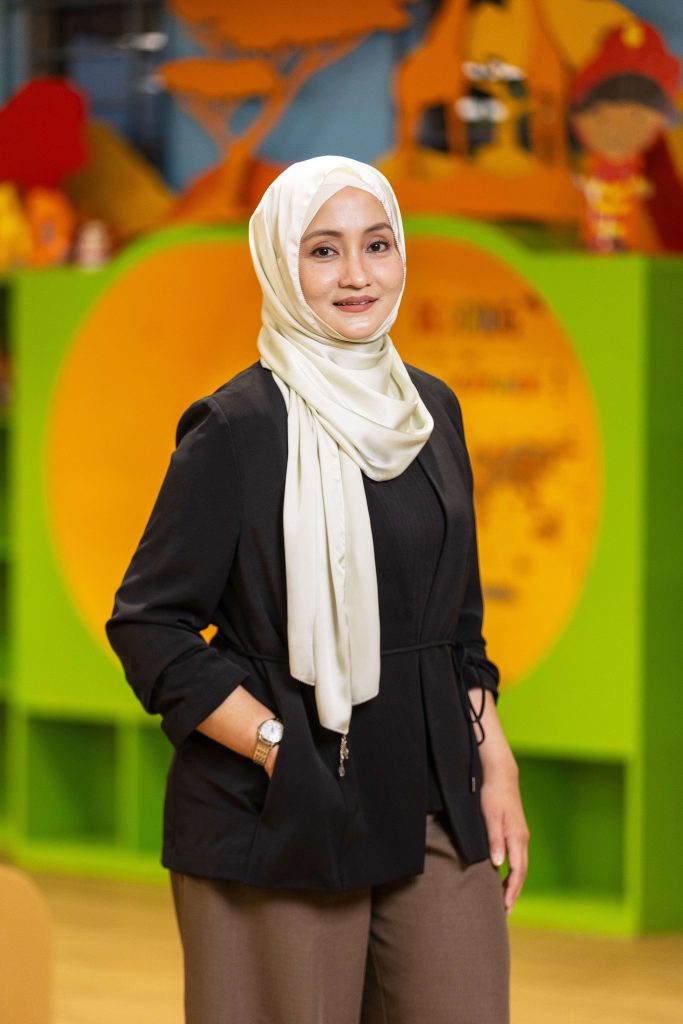
“Listening to every child, especially those who need extra support, while conducting a lesson is tough, so every decision – from the routines I set to the support tools I choose – has to be intentional.”
Mdm Huda
Care is a daily investment
At the end of the day, Mdm Huda’s efforts at broader instructional design are shaped by her experiences on the ground.
Every day, she goes through some of these touch points: Reviewing the emotional sensing data from student feedback, coaching the prefects who announce the school character trait for the week, pausing mid-lesson during her Science classes to emphasise values, and swinging by the Suggestion Box during recess to read ideas or calls for help from students.
“Every time I step into the classroom, I wonder: Are these children ready for today? You don’t know what they have gone through that day. I don’t want to miss a chance to help a child.”
She could well be referring to the caring boy at the start of this story, who was ignored by his father in the rain. The effect of his father’s biases was showing up in his classroom behaviour and his learning, and Mdm Huda sought to understand the family’s situation further. She convinced his parents to work towards a common cause and improve the home support he needed.
The outcomes validated her methods: He paid more attention during his lessons, his grades improved, and several parent-teacher meetings later, three happy faces turned up together to meet Mdm Huda.
This is what keeps her excited to show up at school every day: “We never know the young lives that we can impact.”

.jpg&w=3840&q=75)