



The art of storytelling takes different forms in different cultures. For Mdm Kamalavani D/O Palaiyan, the Tamil tradition of Villupattu, where verse and music revolve around a bow of bells, should be preserved. And what better way than to grow a love for it in her students.
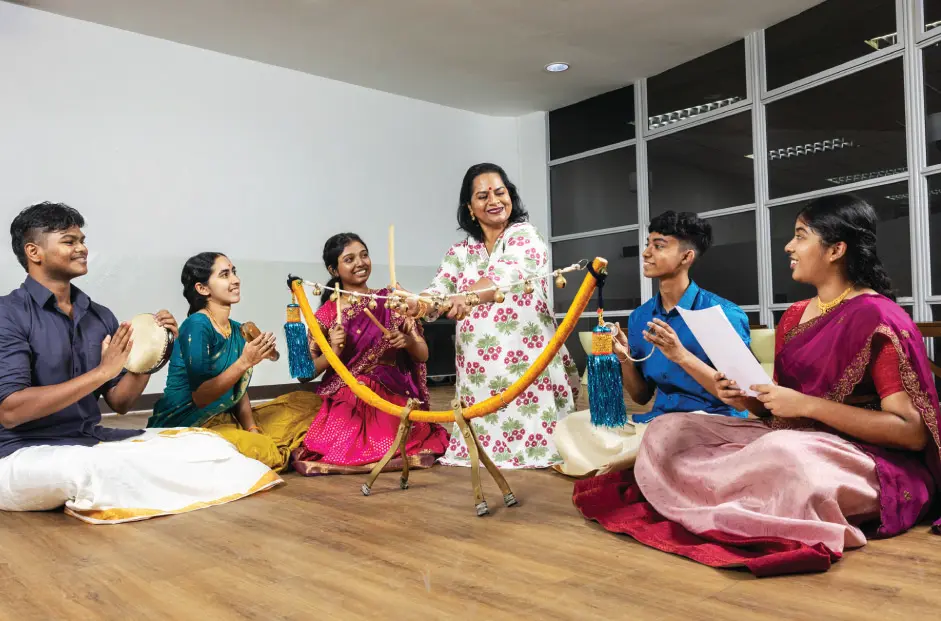
Of course, there were hurdles. Mdm Vani, as she’s fondly known, didn’t have the actual instrument, called the villu. So she fashioned one herself, using a hula hoop borrowed from the PE department, string, bells and shoeboxes, all held together with masking tape.
Then there was her students’ unfamiliarity with the language. "Many students come from English-speaking backgrounds," she says. "They approach Tamil with apprehension, as just an academic requirement. I want them to see it as a vibrant, living part of their cultural identity."
Finally, there might be a lack of enthusiasm.
“‘Teacher, these are old songs’, they would tell me,” says Mdm Vani, only half-amusedly. That is when her love for the language and culture shines forth. With a glint in her eye and a tilt of the head, she narrates and dramatises her way into their hearts.
With regular practice and coaching in and outside of their Mother Tongue lessons, they pick up enough to perform at AGNI, Anderson Serangoon Junior College (ASRJC)’s Tamil cultural showcase.
At the showcase, the students’ performance of the Villupattu was so spectacular, audience members mistook them for professionals.
Forging identity through performance
AGNI, which means “fire” in Tamil, is a biennial event that Mdm Vani has directed from the start.
Held in conjunction with Singapore’s Tamil Language Festival, the two- to three-hour showcase attracts an audience of 500 students and is put together by some 30 students from the Tamil Language Elective Programme and Tamil Language Debate and Dance Society.
The first AGNI session was held at the former Anderson Junior College (AJC). Following the merger of AJC and Serangoon Junior College, into what is now known as ASRJC, AGNI became an official event within Singapore’s National Tamil Language Festival.
From there, Mdm Vani steered the programme towards art forms that most young people have never encountered, and that are rarely seen even at professional events. Other than Villupattu, she has even brought in percussion instruments like the Parai and Thudumbu, paired with vibrant dance choreographies.
Each year, students train for three months before putting up performances. “Possibly 90 per cent of these students have no experience in acting, singing or dancing,” Mdm Vani says with pride. But she is confident that all of them will catch the culture bug.
Verbalising back and forth
The same conviction — that all students can grow in their proficiency and appreciation of Tamil — is carried into the classroom. In class, Mdm Vani expects students to not just give answers, but to explain their reasoning aloud. When students can articulate their thoughts in speech, their writing ability follows.
Spoken and written reasoning in Mdm Vani’s class follow the framework called PEEEL (Point, Evidence, Elaboration, Explanation, Link). “By the time the A-Levels are here, every student can talk through the reasoning of their answers like why this word is wrong or where the clue in a passage is,” she says.
She also employs dialogic teaching, a back-and-forth, conversation-based approach. For example, a single question about a character’s flaw in a story can extend to a broader conversation where students add on observations and find evidence to support one other’s opinions.
Building on this conversational approach, Mdm Vani and her colleague rolled out a ChatGPT-based chatbot last year to extend these discussions beyond the classroom, giving every student a space to practise articulating their thoughts. "Now, everyone gets a chance to verbalise," she says.
Spotting potential that others miss
Mdm Vani’s deep belief in every student’s ability to excel was most clearly demonstrated with a former student, Mr Syed Ashratullah, who is now a Tamil teacher himself.
Sensing that he could be stretched, Mdm Vani had recommended for him to be offered H2 Tamil, and even cast him as the lead in a traditional drama at a Tamil language seminar, winning him and his fellow performers a standing ovation.
Today, he returns to ASRJC regularly to train his juniors for AGNI. “He was a political science and South Asian studies student in university. He could have taught any subject,” says Mdm Vani, “but he chose Tamil".
Teaching across primary to JC levels
Given her vast experience as a teacher across the primary, secondary and JC levels, Mdm Vani is informally known as the person that new Tamil teachers could consult. She generously shares her repository of tried-and-tested notes and marking frameworks, ensuring that new teachers do not have to navigate the early teaching years alone.
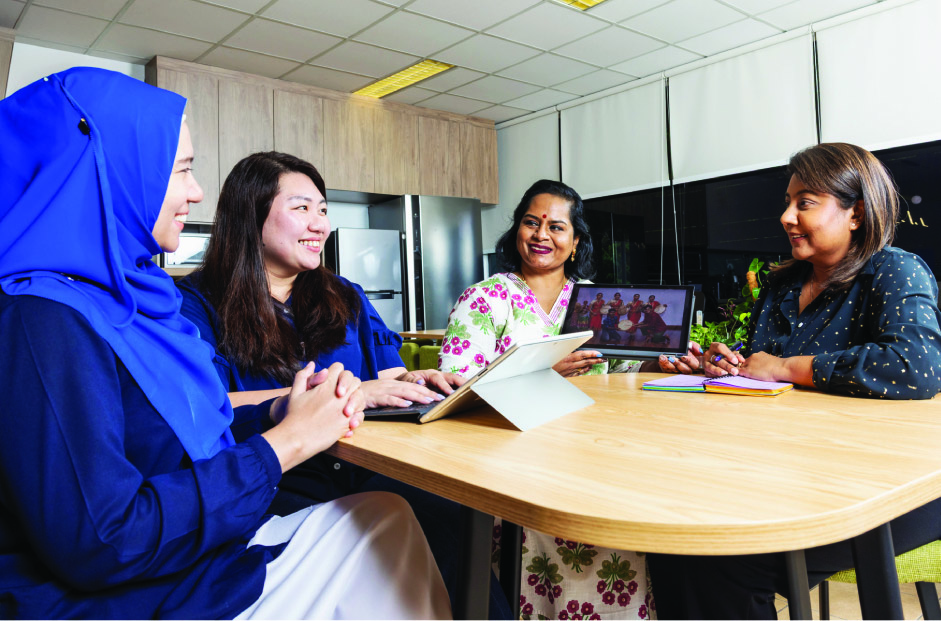
Beyond ASRJC, Mdm Vani has been secretary of the JC Tamil Language Teachers’ Committee and has mentored teachers across institutions. She has also contributed to national syllabus reviews and uploads resources to OPAL2.0, MOE’s official digital learning platform for educators and staff.
“I didn’t have a mentor back in the day. I don’t want any new teacher to have to struggle the way I did,” she laughs.
The spirit of renewal runs parallel to her work on AGNI. This year, the Villupattu made its appearance for the second time. But this time, it was with the real instrument, which took three months to source. The Villupattu may not be widely known even in India, but thanks to Mdm Vani, this art form is kept vibrant and alive at ASRJC.
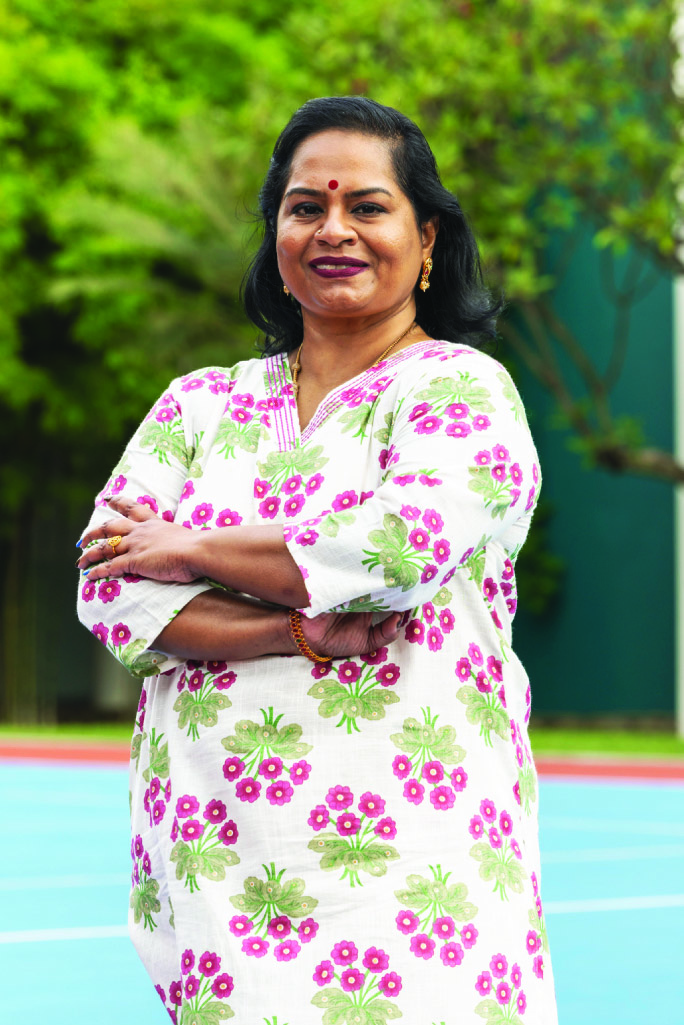
"Talk, and you will be enlightened."
Mdm Vani
.jpg&w=3840&q=75)