



Food isn’t just sustenance, says Ms Lina Tan Lay Nah. It’s care, comfort, and when done well, a form of dignity. And above all, it must be tasty.
“If it’s not tasty, forget it,” she often tells her students. No matter how nutritious a dish is, she believes it won’t succeed unless people actually want to eat it.
That focus sharpened in 2019, when her father-in-law, who had dysphagia, choked after she made him a nutrient-rich porridge, thoughtfully enhanced with goji berries. The berries’ seeds, which retained their firmness after cooking, created a dual texture that was hazardous for someone with swallowing difficulties.
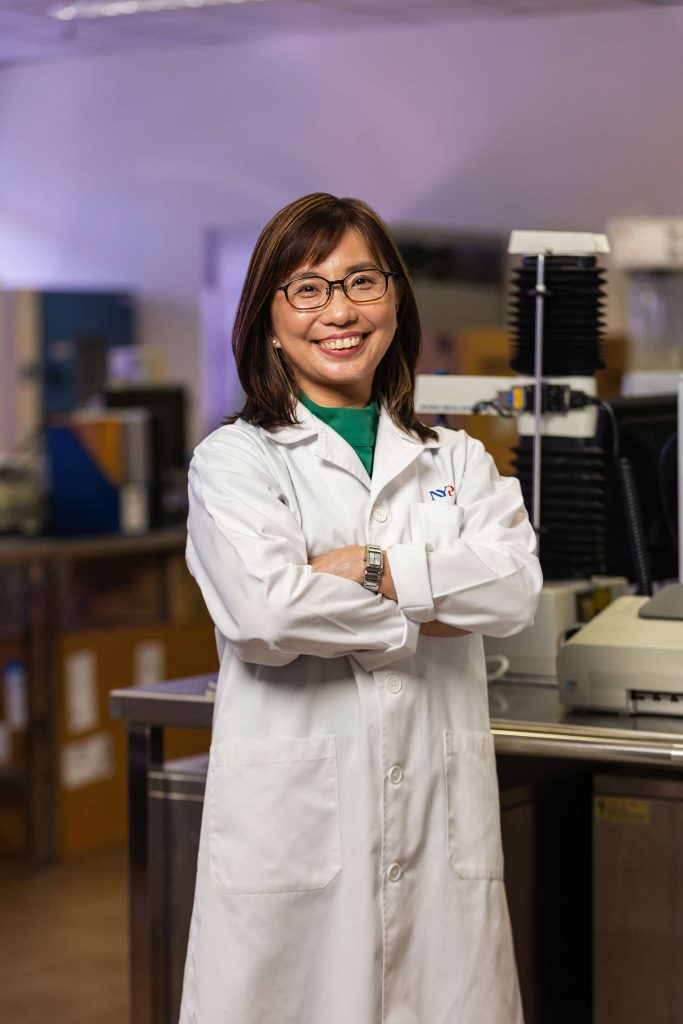
For Ms Tan, a Specialist (Food Technology) and Senior Lecturer at Nanyang Polytechnic, the experience wasn’t just humbling. It marked a turning point.
Overcoming her berry bad start
In ageing Singapore, where nearly one in four citizens will be 65 or older by 2030, dysphagia is a growing concern. The condition, which affects one’s ability to swallow safely, can lead to malnutrition, aspiration pneumonia, and even death.
Yet food options for its patients are somewhat limited, bland, and unappealing. Ms Tan then made it her mission to develop meals that are both suitable and enjoyable.
She introduced the International Dysphagia Diet Standardisation Initiative (IDDSI), encouraging students to reimagine food for people with swallowing difficulties.
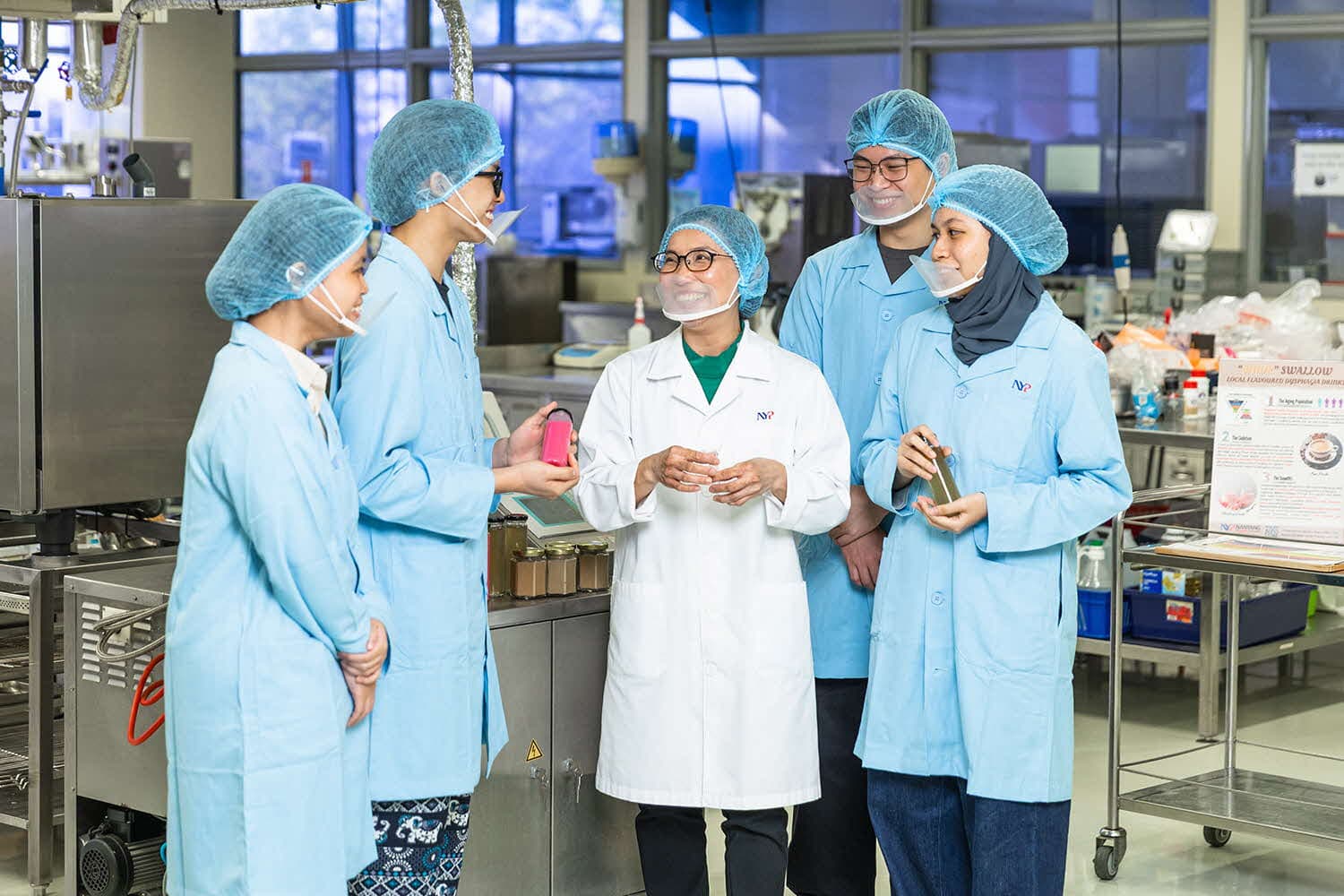
One of their creations included the world’s first nutrient-fortified local dessert for such patients, a Herbal Tea Duo that won at the 13th Asia Pacific Eldercare Innovation Awards 2025 (Food & Nutrition category), and a mocktail that was recognised by the World Food Innovation Awards 2025 (Best Drink Innovation).
One team even reimagined bandung, the nostalgic rose syrup drink, into a safer version, as liquids that are too thin may go down the windpipe.
Where the food lab meets the world
“You can’t just memorise and hope for the best. In the real world, things are unpredictable. You need to think on your feet.”
Ms Tan
At Nanyang Polytechnic, Ms Tan has rebuilt the Food Science curriculum with a strong industry focus; 70% of it is now Work-Oriented Learning Experience.
Students rotate through collaborations with multinational companies such as dnata and UCC Coffee, and Small-Medium Enterprises (SMES) like AJ Delights and Thong Siek.
The industry exposure extends to her Food Security & Sustainability module. During a visit to homegrown food and beverage company Mr Bean, students explore practical supply economics. She cites an example of how decision-making in food security is not always simple, where perishables may cost far less than produce that is less easy to spoil. “Wet okara is one dollar a kilo. Dried? Fifteen. So, which one will you use?”
These visits prepare students for Singapore’s ’30 by 30′ food security goals, teaching them to analyse how geopolitical disruptions affect supply chains. Even their assessments reflect this practical approach, with open-book exams testing their ability to respond to real-world scenarios.
“You can’t just memorise and hope for the best,” Ms Tan says. “In the real world, things are unpredictable. You need to think on your feet.”
Why a screw cap and not a flip cap?
Ms Tan’s own career – spanning fishball production to machinery sales – before she became an educator shaped this realism. It also gave her the credibility to launch one of NYP’s most active student innovation groups: the Food Technology Innovation and Enterprising (FTIE) Interest Group. Since 2017, she has guided 102 students in developing 44 products, many with commercial potential.
But, she insists, their ideas must be grounded in science and shaped by user needs. She challenges them to ask: Who is it for? Can it be mass produced? What nutritional gap does it fill?
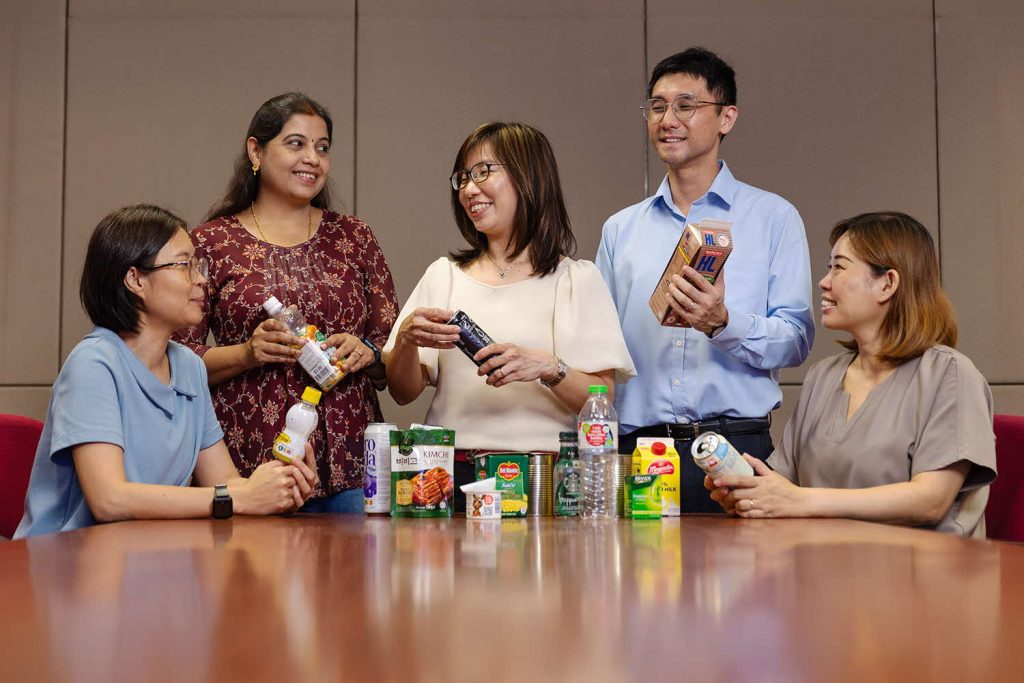
Even packaging classes are hands-on. Students bring in supermarket items and discuss their design features. “Why is this bottle tinted? Why is this heavier? Why a flip cap here, but a screw cap there?” she asks. “They have to think like both a consumer and a manufacturer.”
The process also invites reflection. “Sometimes, students realise they’ve been eating something their whole life and never thought about why it’s packaged a certain way. That’s when the light bulb goes on,” she says.
Pressure that cooked up a sustainable dessert
Whether students are redesigning packaging or reworking a failed recipe, they develop persistence and problem-solving skills they’ll need in life. Samantha Chia would know. Reserved by nature, the former student, now 24, was stunned when Ms Tan picked her for a year-long innovation project. She hadn’t expected the spotlight – nor the pressure.
Her team’s first prototype was “bitter, grainy – honestly, horrible”, says Ms Tan with a laugh. So Samantha and her team were challenged to improve the product with just the right amount of guidance.
“I won’t give you the answer,” Ms Tan tells her students, attempting to recreate workplace scenarios where staff are often expected to work independently. “You need to fail and figure it out.”
The struggle they go through builds grit and makes the learning stick, she adds. “The knowledge, internalised and meaningful, becomes truly theirs.”
After much trial and error, Samantha’s team created Tropicosea, a coconut-sesame meal made with by-products from sesame oil production. Marketed as a sustainable fusion dessert, it impressed the judging panel of the World Food Innovation Awards 2024. The team placed second, right behind global brand Mengniu Dairy.
It was a proud moment, but what stood out most was how far the students had come on their own steam.
Flavour meets science and industry feedback
Moments like this don’t just happen in competitions.
In the lab, Ms Tan gets students to explore the intersection of science and cuisine through molecular gastronomy and AI. Using techniques like spherification, foams, and edible films, students transform familiar flavours into elegant creations such as fruit caviar and restructured sauces. She beams when she talks about her students’ work: Some of their creations, she says, wouldn’t look out of place in a fine-dining restaurant.
While generative platforms help students prototype faster, Ms Tan maintains perspective. “AI is a great assistant, but you – and your tastebuds – have the final say.”
“AI is a great assistant, but you – and your tastebuds – have the final say.”
Ms Tan
To further their industry readiness, the students’ work is presented to industry partners for authentic feedback. “No need to prepare them. Let them face it. This is how the real world is,” she states firmly but kindly.
All her attempts to bring delight and discovery to the learning process pay off in her eyes. She recalls a molecular gastronomy session where her students experimented with textures that fizzed, melted, or burst unexpectedly. “They were totally immersed,” she notes. “Not everything worked but that’s the fun of it. When they’re curious and engaged, that’s when the best ideas come through.”