




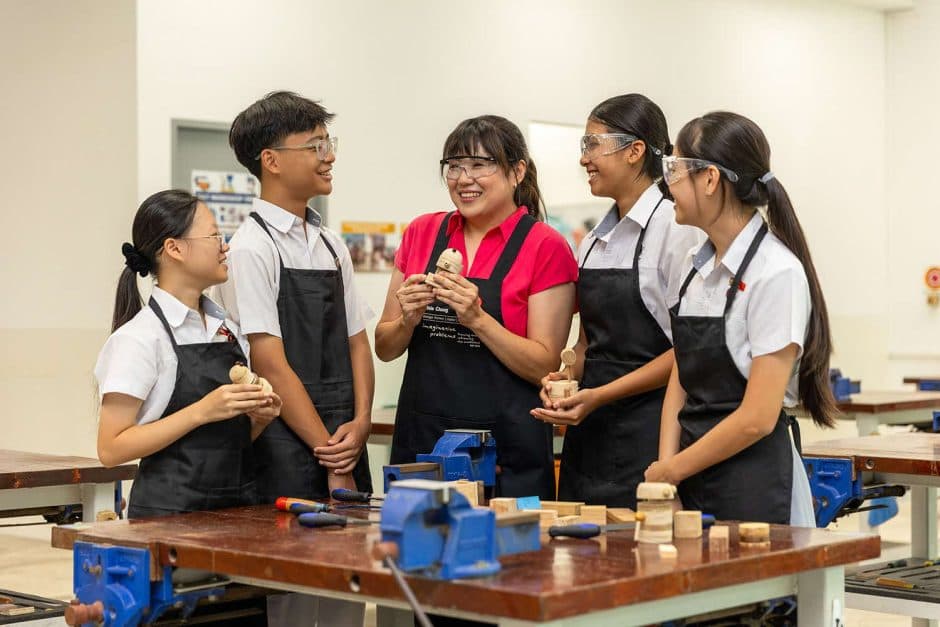
There is a moment that Mdm Elsie Cheng Swee Eng will never forget: Her Design and Technology student, passionate about cats, was struggling to sketch his idea for a grooming device. His drawings were a far cry from the elegant solution he envisioned.
Mdm Cheng could see where the possibilities lay, but she was not about to lay them on a silver platter. Instead, she offered tips to guide him there.
Months later, that same student built a prototype that dispensed powder while grooming, which helped contain the flurry from the pets’ shedding fur. As she holds up a photo of his creation, Mdm Cheng, the Head of Department for Craft & Technology at Edgefield Secondary School, smiles with pride. What mattered to her was not the result, but the growth of the student as he worked towards his goal.
This moment was one of many that cemented her decision to leave the corporate world to become a teacher.
“You have to let students start from what they care about. Even if the idea is rough, we will work on it together. Some students need time to find their voice.”
Mdm Cheng
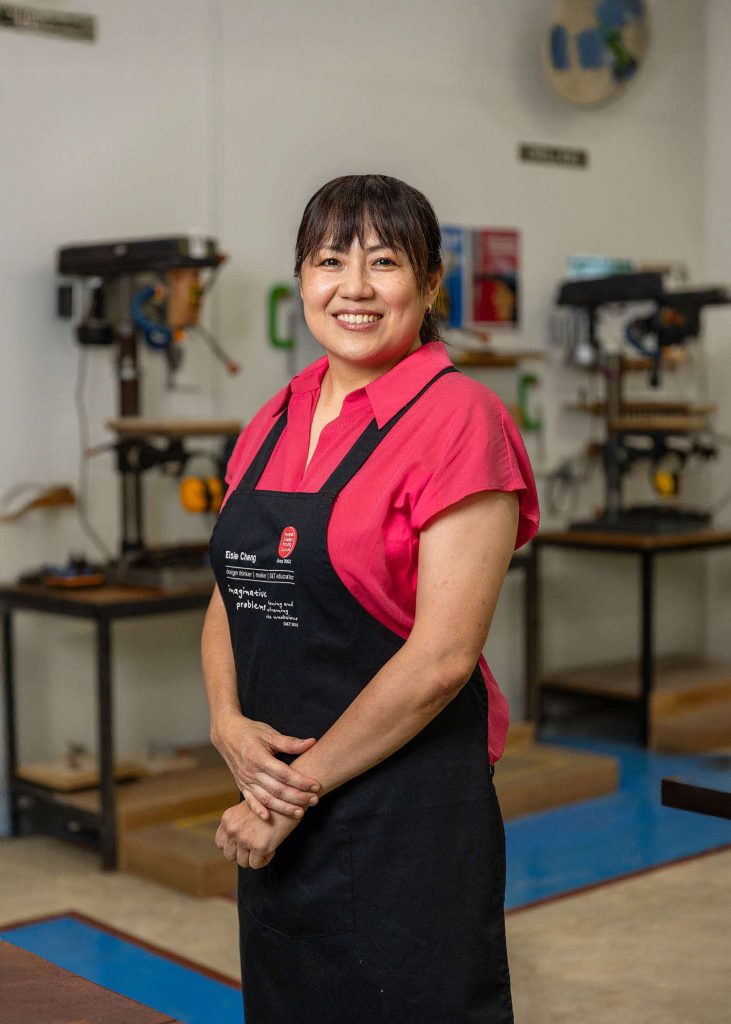
From engineer to educator
At the start of her career, after graduating with a degree in mechanical engineering, she joined Hewlett-Packard as a procurement engineer. But that left her feeling unfulfilled somehow. “I could not get the kind of job satisfaction I wanted. I did not get to see the end product, or the impact of what I was doing.”
She thought about how her Secondary 2 Form Teacher had seen an educator in her and suggested that she take up some tutoring work way back when.
Hence, she made a shift to education in 2011 – with no regrets. Her engineering expertise gave her a systematic way of breaking down challenges, but teaching gave her something deeper: the chance to shape lives. “In engineering, I was solving problems. In education, I am helping others learn to solve them.”
‘Not just to look but also to see’
Enter her teaching space and you will find a structured kind of freedom. “Some students learn faster, while some take a little longer, but everyone eventually crosses the finish line,” she says. This is why she differentiates her lessons to cater to those who explore concepts independently as well as those who require more targeted support.
Her engineering mindset informs her pedagogy. For students who struggle with sketching, she uses overlays and scaffolding tools. “They realise they can actually draw,” she says. “It is not about perfect lines; it is about building confidence and helping them find the courage to embrace imperfections.”
Goh Ai Ling, a former student of Mdm Cheng, was spurred to improve herself. “Mdm Cheng taught me that design is not just about drawing. It is about thinking, planning, testing, and improving,” says the 15-year-old. “She did not just teach me to look; she taught me to truly see. Where I once missed the fine points, I now have an eye for detail.
Ai Ling recalls how Mdm Cheng would make time for one-on-one feedback despite her packed schedule. “She made sure she was in touch with everyone. It made us feel seen and that she really cared.”
Something to hoot about
In Mdm Cheng’s classroom, imperfection is a starting point rather than a flaw.
She exudes a kind of empathy and attentiveness that also shapes how she handles mistakes – gently, and without judgement.
“Sometimes, students feel discouraged because the sketch does not turn out the way they envisioned it to be. But I don’t ask them to redo it. I tell them to keep going.”
Through their programme and the way they teach, Mdm Cheng and her D&T team reflect the subject’s shift in emphasis over the years from skills to design thinking and 21st Century Competencies.
Edgefield Secondary clinched the inaugural Design and Technology Awards (Lower Secondary Programme) in 2023, which recognises D&T departments’ teachers and Education Workshop Instructors for their collective efforts in implementing a good lower secondary D&T programme.
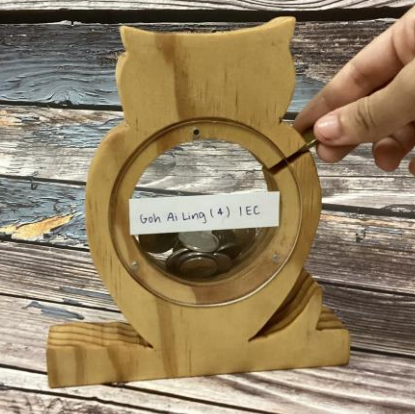
Ai Ling’s owl-shaped bank was displayed under the Secondary 1 “Save Me!” Coin Bank project, where students design a bank shaped like an endangered animal. “I was really proud of it! It looked exactly like how I imagined.”
Digitising the design process
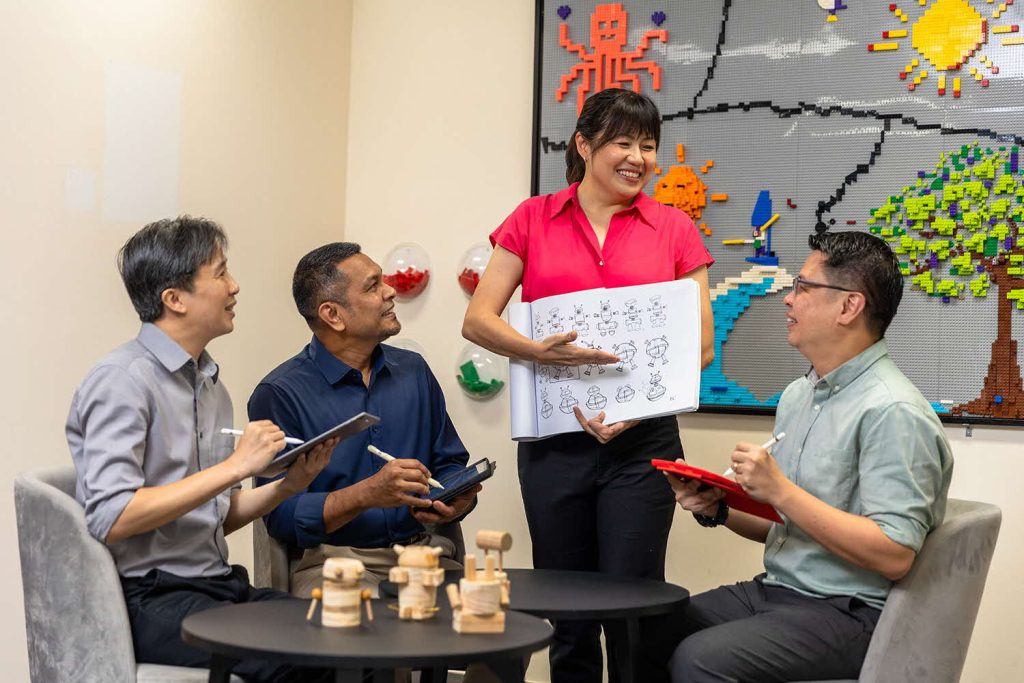
Mdm Cheng, together with her team, was among the first in Singapore to introduce digital sketching into the classroom. “We started with just two students. We had to figure everything out – where to store files, how to conduct digital marking,” she recalls. Today, students can work faster, iterate more easily, and spend more time refining their ideas thanks to digitisation.
She has also extended this rethinking of tools and workflows to STEM education and is working to integrate Mathematics, Science and Technology into her design curriculum.
Her latest project – a door chime – calls for students to incorporate concepts from across disciplines, such as mathematics, sound, design and engineering. “It is about helping students apply what they know: to design, to rethink, to solve. Design does not work in silos.”
The grit behind the growth
“The role of teachers as co-designers and design facilitators never ends,” says Mdm Cheng. During the design process, she works alongside students, engaging in research and problem-solving together to navigate uncertainties and unknowns.
Because design can be so subjective, and students need to deliver a physical product under time pressure, Mdm Cheng confesses to moments of doubt. “Sometimes I feel I am not doing enough – for my students, my team, my family.” But small wins, such as a sign of progress, a thank-you note, or a student learning to express their ideas with confidence, are what sustain her. “You have to let students start from what they care about. Even if the idea is rough, we will work on it together. Some students just need time to find their voice.”