



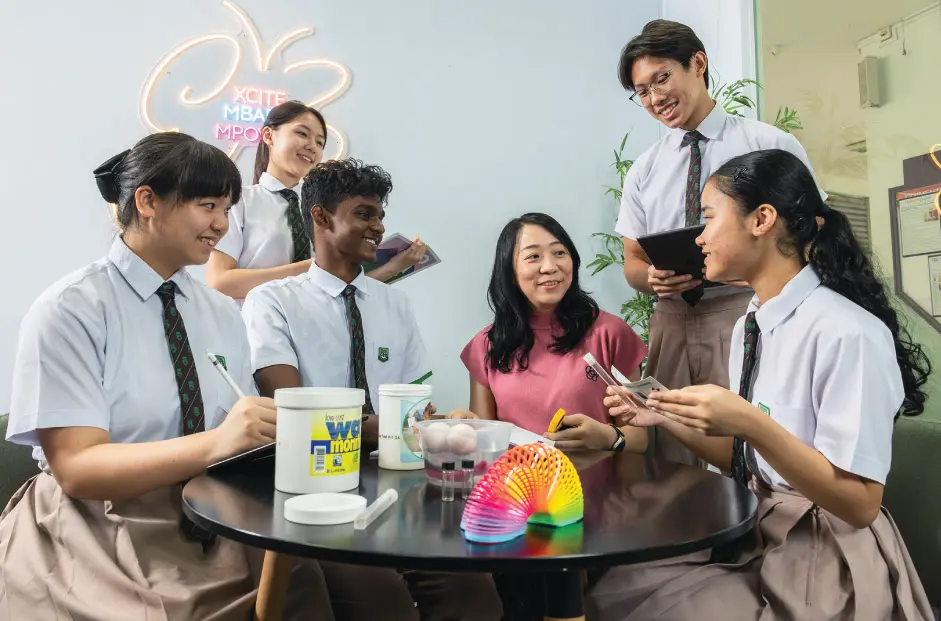
Mdm Emmeline Tay places a container of honey and a container of water in front of her class during a Geography lesson on plate tectonics.
To explain why some volcanoes erupt explosively while others do not, she gets students to blow bubbles into both. In water, the bubbles escape easily. In honey, they remain trapped.
"They can immediately see that trapped gases in viscous lava give rise to explosive eruptions," she explains. "So they don't memorise. They understand."
For the Lead Teacher in Geography at Clementi Town Secondary School, learning Geography has never been about memorising facts. It is about creating tangible experiences and leaving less to the imagination – while helping students discover that the world around them is alive with stories, systems and connections.
From the earth's core to a container of styrofoam
Geography is full of processes that cannot be seen easily and in real time – tectonic plates grinding beneath the ocean floor, convection currents circulating inside the mantle, liquefaction turning solid ground to slurry during an earthquake.
In Mdm Tay's classroom, complex topics are transformed into tactile, visual experiences that students can touch and feel.
To teach the layered structure of the earth, she gives students styrofoam balls and plasticine, drops them in water, and asks them to observe which sinks and which floats — and to explain why, using the concept of density.
Rather than presenting Geography as a set of facts to be received, she creates moments where students can observe, question, and connect what they see to what they are learning. For liquefaction, she recreates the tremors of an earthquake by shaking a container of water-saturated sand. Students observe the sand lose its strength and behave like a fluid, visualising the process in a way that a textbook diagram alone cannot explain.
"It's all very visual, instead of just telling them," she says. "And it's a lot more fun."
These are not gimmicks. They are entry points into concept-based inquiry – a teaching philosophy built on the conviction that students construct deeper, more lasting understanding when they discover it rather than receive it.
"Watching students construct their own understanding, sharpen their critical thinking, and gain the confidence to tackle complex problems reminds me why I chose this calling," she says.
Let’s do the Huddle
At some point in almost every lesson, Mdm Tay says the word: “Huddle!”
The class knows what to do. They stand, form a circle, and take turns to speak. No one is exempt. No one can repeat what the person before them said – they must build on it, extend it. "In the usual class, if you ask a question, only one or two people will answer," she says. "We will not be able to get to the whole class."
With the Huddle, all students are encouraged to gradually become more confident thinkers and speakers. "At first, they kept asking for model answers," she says. "Now they know that in my class, they are required to think."
Technology extends those opportunities further. Through platforms such as the Student Learning Space, AI chatbots and interactive digital tools, students test ideas and debate solutions in real time. In one lesson, students proposed tourism sustainability strategies to an AI chatbot, which challenged them to consider unintended consequences. This prompted them to explore different perspectives, compare possible solutions, and weigh trade-offs before refining their ideas – developing cognitive flexibility.
Joy in the teaching and the learning
Some of Mdm Tay's most insightful lessons happen outside the classroom. She built a water-testing programme for Secondary 1 students around the school's own garden, which has a micro-drainage basin and a working well. Students who have only read about underground water in textbooks are brought outside to see it, to understand how water is channelled and stored.
For upper secondary students, geographical investigations in the neighbourhood put sampling methods and data collection into their hands. They design their own hypotheses, choose their own questions, and discover through experience what works – and what does not. The dead ends are part of the plan.
"A question that fails to yield useful data is not a problem to be avoided," she says. " It gives students an opportunity to reflect, revise and try again. That is productive failure. We want them to go through it."
This belief in embracing setbacks stems directly from Mdm Tay’s own schooling years. Long before she joined the teaching profession, Mdm Tay knew she wanted to teach. Yet her journey into education was deeply influenced by her own experiences growing up.
In Secondary 2, she missed a chance at switching streams by a small margin. She gathered the courage to approach the Principal directly for a second chance. She sat for a qualifying test and passed.
"That was the first time I felt empowered," she says. "It taught me that you shouldn't give up on your dreams."
Today, she shares that story with her students whenever they need encouragement.
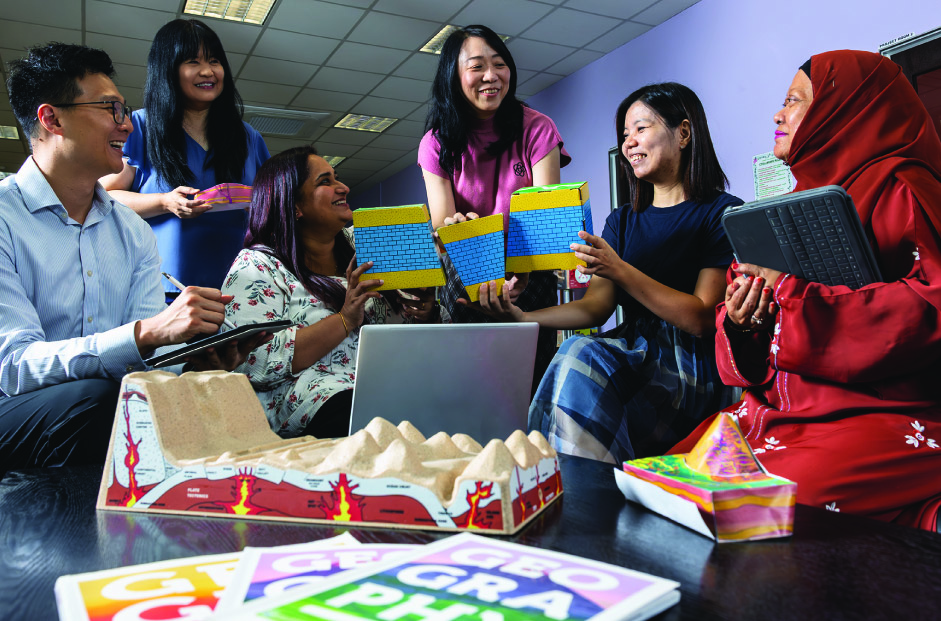
Beyond her own classroom, Mdm Tay leads a Networked Learning Community for Geography fraternity, mentoring teachers and sharing pedagogical strategies across schools. At a recent hands-on workshop she ran, a teacher came to thank her afterwards – not just for the liquefaction demonstration, but for helping her rediscover the joy in teaching.
Because ultimately, Mdm Tay believes, joy matters.
"When we have the joy of teaching," she says, "students will find the joy of learning too."
"Watching students construct their own understanding, sharpen their critical thinking, and gain the confidence to tackle complex problems reminds me why I chose this calling.”
Mdm Tay