





It is an undeniable fact that artificial intelligence (AI) tools are improving rapidly. But the decision on when and how to use it in teaching is something that educators approach with care and thought constantly.
Take the Social Studies team at Edgefield Secondary School (EFSS), for example. When AI tools first became widespread a few years ago, their potential for augmenting teaching and learning obvious, the team experimented with them. But when the tools’ limitations at that point quickly became clear, the teachers took a step back.
Here’s a look into the team’s thoughtful adoption of AI tools, and how they are moving forward intentionally as technology continues to advance rapidly.
Learning objectives as the North Star
Social Studies is built on critical thinking and perspective-taking, shares Mr Darren Woo, Subject Head (Value-In-Action) at EFSS, who also teaches Social Studies. Through assignments and essays, students learn to strengthen their communication and collaboration skills, as well as hone civic, global and cross-cultural literacy.
“But handing back marked assignments didn’t always lead to growth,” says Mr Lim Mingxun, who taught Social Studies at the school, and is currently with MOE’s SkillsFuture Division.
Students often focused on their marks rather than their thinking. And while traditional feedback written in the margins of scripts had its strengths, some skipped the feedback entirely, while others read the comments but were unsure how to act on them.
AI tools, which can give personalised feedback, seemed to be a potential solution.
Experimenting, failing, evaluating
When the launch of ChatGPT made waves, the Social Studies team got themselves up to speed with prompt engineering. They came up with guidelines and scaffolds so that students can learn better and deeper with these AI chatbots.
“But we found students picking answers without processing the why. The metacognition aspect – where they understand their own thinking – was lacking,” says Mr Woo.
“Also, there isn’t just one right answer for Social Studies,” explains Mr Lim. “We want to see how students think and argue. But at that point, AI wasn’t great at giving meaningful feedback in the way that we wanted students to learn. They need space for conversations and feedback – to clarify ideas, ask questions, and reflect on how to improve.”
Mr Woo adds, “Even if we fed every possible answer into an AI tool, it could never capture the nuances and human emotions. Context is everything in the humanities. That’s where the human touch comes in.”
Building feedback that sparks thinking
As the teachers reflected on their classroom practices, they asked themselves: What kind of feedback actually helps students think better? And what can be done better to help students develop higher-order skills?
Their conclusion is that feedback had to become more meaningful, more reflective, and more conversational, which led them to using dialogic feedback. This approach encourages students to articulate their thinking and set personal goals. It also helps them develop metacognition, take ownership of their learning, and think beyond “right” or “wrong” answers.
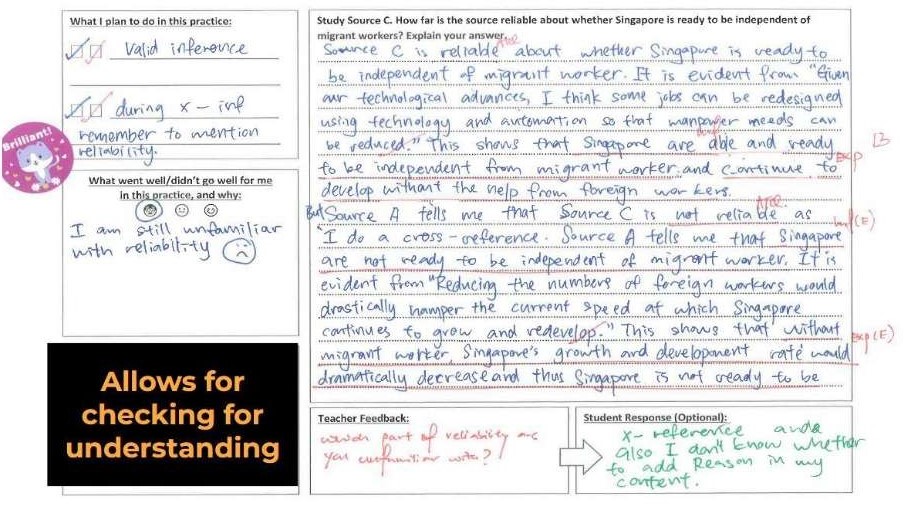
An example of a filled-up Feedback Log worksheet that’s embedded directly into each assignment.
By placing the student’s written answers, teacher comments, and student reflections all on a single page, students can more easily connect insights and engage metacognitively. The log also sets the stage for meaningful teacher-student dialogue, where teachers affirm effort, acknowledge emotions, and guide students toward improvement.
The key is good outcomes for students

A student works on the Feedback Log.
Secondary 4 student Cidney Huang, who experienced using both pedagogical approaches, says that the Feedback Log has been most helpful in her learning, but acknowledges the efficiency of AI tools. “Written feedback is syllabus-specific, while AI is fast but gives more general feedback. Teachers can help us correct misconceptions – that’s important for Social Studies – but it takes time.”
Megan Low, another Secondary 4 student, shares, “Dialogue-based feedback has changed how I approach new questions and sources. My teacher often highlights perspectives I hadn’t considered, helping me look at sources from different angles, organise my thoughts better and structure my answers more clearly. I’m now more confident and faster at tackling new questions.”
Nurturing thoughtful, self-directed learners by using tools agilely
At the end of the day, AI tools are just that – tools. What teachers do, besides providing the human touch, is to determine which ones to employ to help students think deeply, discern information critically, and build the confidence to navigate an information-rich world.
While the team has pulled back on the use of AI chatbots to give feedback in assignments, it doesn’t mean that they’ve shut the door to it completely.
“Our main focus is to grow students’ thinking and we’re constantly thinking about how to integrate AI better into teaching,” clarifies Mr Lim. “AI is developing at a rapid rate, and there will be new affordances. There are other areas where AI works well. For example, in our Applied Learning Programme (ALP), which focuses on problem solving, so we get students to use AI to generate solutions for discussions. It all comes down to the possible affordances of AI.”

EFSS gets students to critique AI-generated solutions as part of their ALP.
At the end of the day, the teachers will keep up with these new developments to see how they can improve learning outcomes for students so that they become thoughtful, self-directed learners who take charge of their own learning journey.