



%20(9).jpg&w=3840&q=75)
At nine, Ethan Wee noticed something many adults might have walked past: plastic wrappers landing on the grass, next to a bin. It bothered him because he had learnt how microplastics harm the environment. So when the chance came to become an Eco Ambassador at Waterway Primary School, he put up his hand.
His classmate Sharon Seow came to be an Eco Ambassador by a different path. A lover of plants and the sea, she felt disturbed when she encountered images of ocean pollution. "I don't want sea creatures to become extinct," she says. "It made me want to save marine life and reduce pollution."
Both students are now Primary 6 students at Waterway Primary School. For the past three years, they have served as the school’s Eco Ambassadors.
Across Singapore, primary and secondary schools build rich sustainability programmes that go well beyond the curriculum. Eco-consciousness is woven into daily routines and student leadership opportunities, for students like Ethan and Sharon to grow in awareness and action for the environment.
For World Water Day this year, the two were part of the organising team for a school carnival they had helped to plan and run – to drive home the need for water conservation.

Watch Ethan, Sharon and friends introduce the activities at their World Water Day carnival. Can you guess what CCA Ethan is in from his game booth? Answer below.
Making green living a WAVE of life
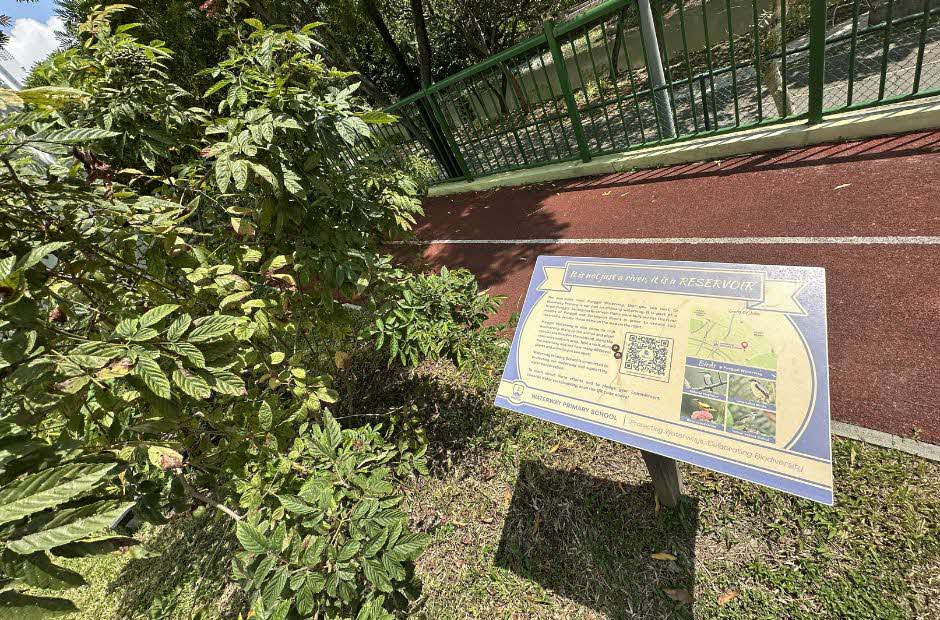 Students learn more about sustainability and biodiversity through information panels like this to help them connect to their location next to Punggol Waterway.
With a name like Waterway Primary School, it seems only natural that eco vibes flow through its veins. The school, which just celebrated its 10th anniversary this year, is situated right next to Punggol Waterway.
The commitment shows up everywhere: Single-use plastics are avoided across the school. Waste is sorted in bins in every classroom. And student Eco Ambassadors collect the segregated waste for the school’s recycling bins weekly, turning good habits into ownership.


Eco messages and green initiatives such as recycling bins are everywhere across the school campus.
The school’s gardens, including an Eco-Garden tended by WAVE (Waterway Advocates for the Environment) Club, the school's environmental CCA, give students hands-on spaces to learn about biodiversity.
Waterway Primary’s Eco-stewardship (ESP) Committee, a staff team led by Science Teacher Ms Shermin Chia, oversees the school’s environmental efforts, including school-wide activities, WAVE Club, and student Eco Ambassadors. The committee organises school-wide activities every term, on themes such as sustainability, water conservation and biodiversity.
One key strand is the Eco Ambassador programme, which supports students like Ethan and Sharon through a sustained leadership journey from Primary 3 to Primary 6, allowing them to deepen their understanding of environmental issues while taking increasing ownership of sustainability efforts in the school
A framework to help learning bear fruit
In primary school, students begin with simple habits such as sorting waste or saving water. In secondary school, they often take on more complex projects that ask them to research, plan and persuade others.
Yuying Secondary structures its sustainability education around a 4A Framework of Awareness, Appreciation, Application, and Advocacy. Students first understand environmental issues, then act on them, and lead others towards action.
Curriculum integration allows students to see sustainability in action, connecting scientific inquiry with food preparation, language learning and environmental stewardship. The learning continues with the annual Food Sustainability Programme, where students experience the rice-growing process firsthand, including harvesting and milling rice grain. This fosters a lasting appreciation for food, the environment and the people who produce it, and reinforces the importance of food security and responsible consumption.


Vegetables are grown in the school’s vertical garden, coming in useful for observations and investigations in Science lessons. After the crops are harvested for cooking during FCE classes, the experiences are captured during Mother Tongue lessons.
When Hougang was identified as a dengue red zone, Yuying Secondary's Eco Ambassadors researched dengue prevention, surveyed their peers, and designed a game booth around NEA’s 5-Step Mozzie Wipeout. Building on this, the initiative has since expanded into a broader Keep Singapore Clean campaign, where students champion clean environments through awareness activities that promote public health, environmental stewardship, and responsible citizenship.
Kimiko Chia, a Secondary 3 student, and Teo Choo Bing, who is in Secondary 2, get so much practice, they could comfortably take visitors through all the stations of the school’s Earth Day carnival held in March this year.
Fellow Eco Ambassador, Secondary 4 student Mon Myat Thu, ran a game booth there. Mon Myat, who is also the chairperson of the school’s Eco-EAGLES sustainability CCA, had designed a game that lets players guess which birdcall matches which local songbird.
“Our wildlife are worth protecting and I want to help my fellow students to do their part,” she explains for her game inspiration.

Watch Kimiko put her bird knowledge to the test at Mon Myat’s quiz booth at Yuying Secondary’s Earth Day carnival.
Partnerships multiply the impact
To make food sustainability tangible, Yuying Secondary created a padi plot where students learn how rice is grown. Their new hydroponics farm will grow fruiting vegetables such as brinjals and tomatoes, letting students track the full plant life cycle.
Through a cross-disciplinary programme, students grow vegetables at a vertical garden during Science lessons, harvest them for Food and Consumer Education cooking classes, and document the entire experience during Mother Tongue lessons.
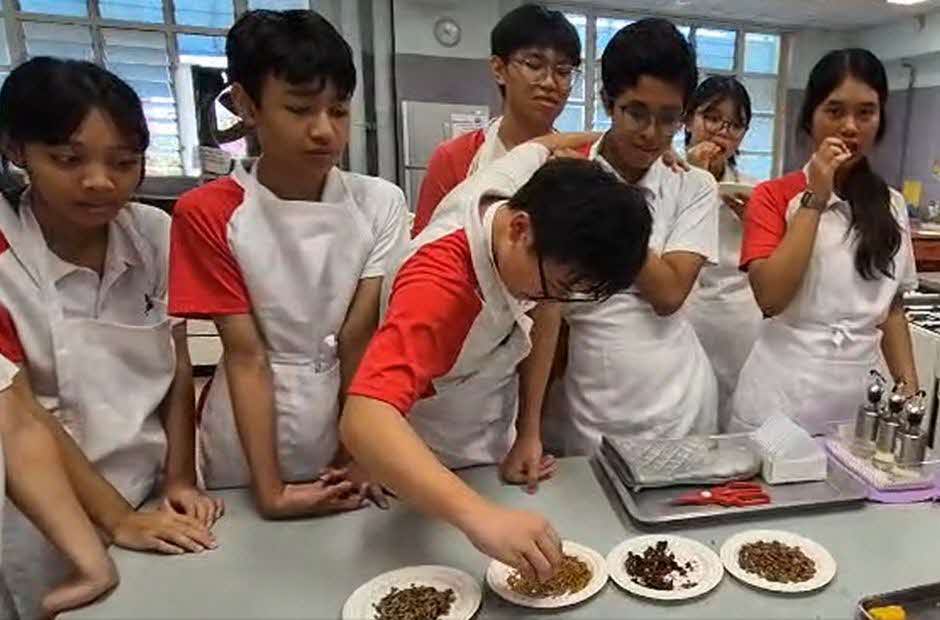 A collaboration with A*STAR brought scientists into the school for an interactive food sustainability game, including tasting plant-based burger patties and edible insects as alternative proteins. (Image obtained as a video still)
Students also learn from partners beyond the school, such as with Nanyang Technological University (NTU), which runs an annual programme for Secondary 3 students funded by the James Dyson Foundation. This year’s programme centred on marine sustainability, to introduce students to technological solutions and challenges around ocean pollution and biodiversity conservation. The students then ran a similar programme for their peers.
A collaboration with A*STAR brought scientists into the school for an interactive food sustainability game, including tasting plant-based burger patties and edible insects as alternative proteins.
Back at Waterway Primary, parents are key partners in its sustainability efforts. This year, they helped run the World Water Day carnival, and recorded students’ water-saving dance videos, extending the message beyond the school community into homes.
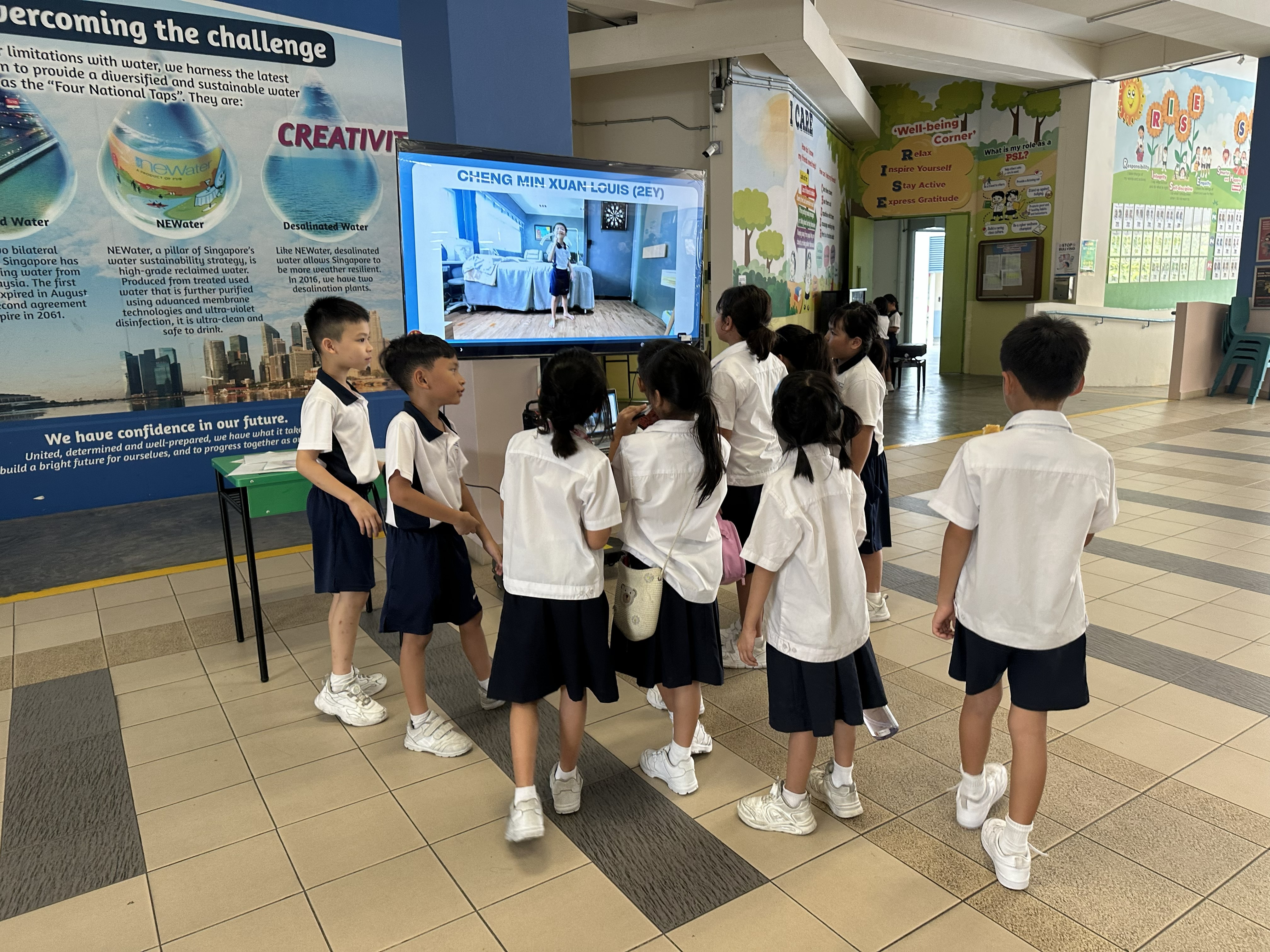 Videos of students performing dances for a competition related to water conservation were screened during recess.
Habits flow from seniors to juniors
Together, Waterway Primary and Yuying Secondary illustrate something important: sustainability sticks when it becomes part of everyday school – in lessons, CCA, shared spaces, and student leadership.
The schools’ Eco Ambassadors are instrumental to making these efforts felt on the ground, and in their younger cohorts.
At Yuying Secondary, the upper secondary students are in charge of cultivating rice, and then guiding their Secondary 1 juniors through the rice planting process.
At Waterway Primary, Ethan continues to persuade his friends to use less plastic and make better choices at recess.
That may be the power of sustainability education. It helps children see that their actions matter, and that even small habits can grow into care for the world around them.
*Answer: Ethan is in the Basketball CCA.
.jpg&w=3840&q=75)