



They gained independence at home and in public
At APSN Katong School, which serves students with mild intellectual disability or ASD with intellectual impairment, 12-year-old twin brothers Sim Kai Hang and Sim Kai Xiang, who have autism, have each found their own path to independence.
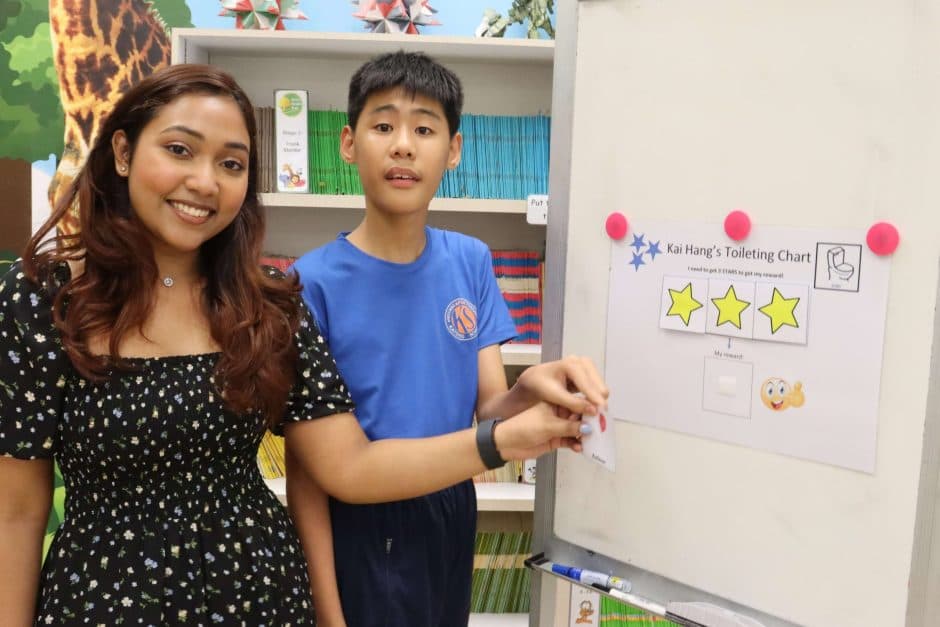
For Kai Hang (pictured above), a fear of public toilets restricted his daily activities and routines. Due to this, the family’s activities and routines were also affected. His teacher, Ms Sindhu Bramya D/O Kumar, worked with his mother to uncover the root of the fear, discovering that he disliked the sound of hand dryers. Together, they designed a reward system: each attempt to use a public toilet earned him stars, which could be exchanged for balloons.
This proved to be the right motivator for Kai Hang. Ms Sindhu adapted the reward chart for home use, while also providing visual communication cards.
What began as simple gestures evolved into verbal requests. Kai Hang now confidently asks, “I want to go to the toilet, please.” This breakthrough in communication has transformed not only his independence but also his family’s daily life. With his mother no longer worrying about communication challenges, the family can now venture out to shopping centres and public spaces. They can enjoy activities they previously avoided, creating new opportunities for family bonding through shared experiences and community participation.
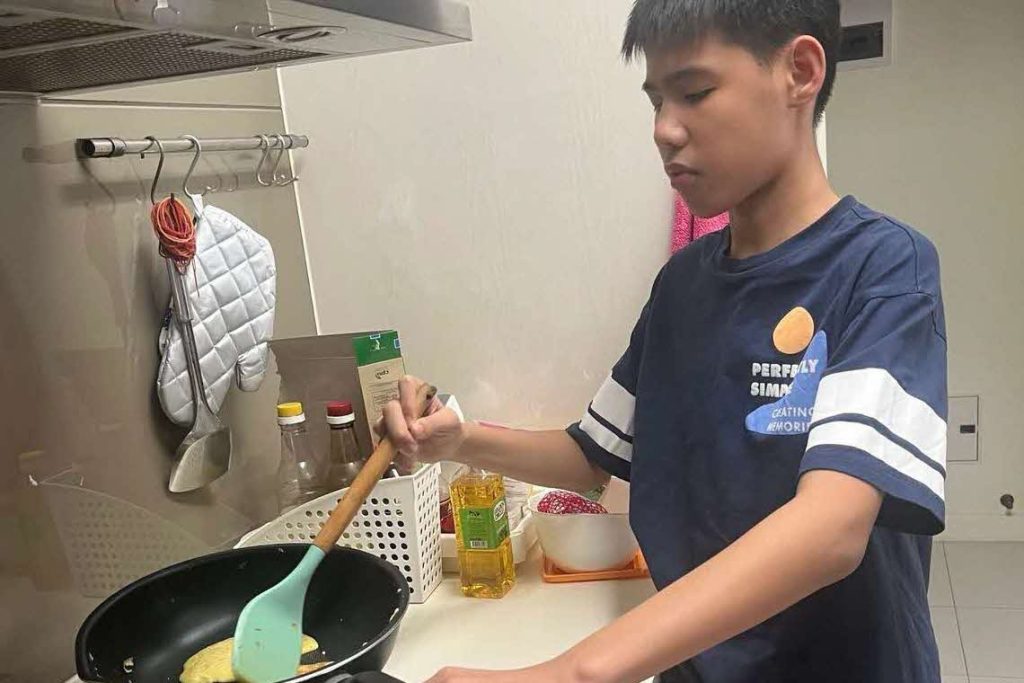
Meanwhile, his twin Kai Xiang thrived in movement and hands-on tasks. His teacher, Mr Alex Teo Poh Seng, tapped into his love for cooking to strengthen both motor and cognitive skills.
“When working on counting and motor skills, we use meal preparation activities that he enjoys,” he explains. To ensure consistency at home, Mr Teo recorded short demonstration videos and suggested simple recipes that Ms Lin Chau Yin, the twins’ mother, could try with her sons.
Cooking soon became a family routine. Kai Xiang took pride in measuring ingredients, stirring pots, and proudly presenting their home-cooked meals. Each session boosted his confidence and sparked conversations. “I want to make pancakes! Or fry eggs or noodles,” he often said, eager for the time he could prepare a meal with his mum.
For Ms Lin, these moments were more than practice – they were signs of her son growing in both skill and voice.
Re-creating classroom successes at home
When eight-year-old Ayuni Nursyahirah Binte Masrizal, who has Down Syndrome, joined MINDS Lee Kong Chian Gardens School (LGS), her sister and primary caregiver, Ms Karyawati Binte Mohamad Hizan, worried constantly. At Ayuni’s previous school, Ms Karyawati had shadowed Ayuni’s every step. The thought of Ayuni walking alone down corridors caused sleepless nights.
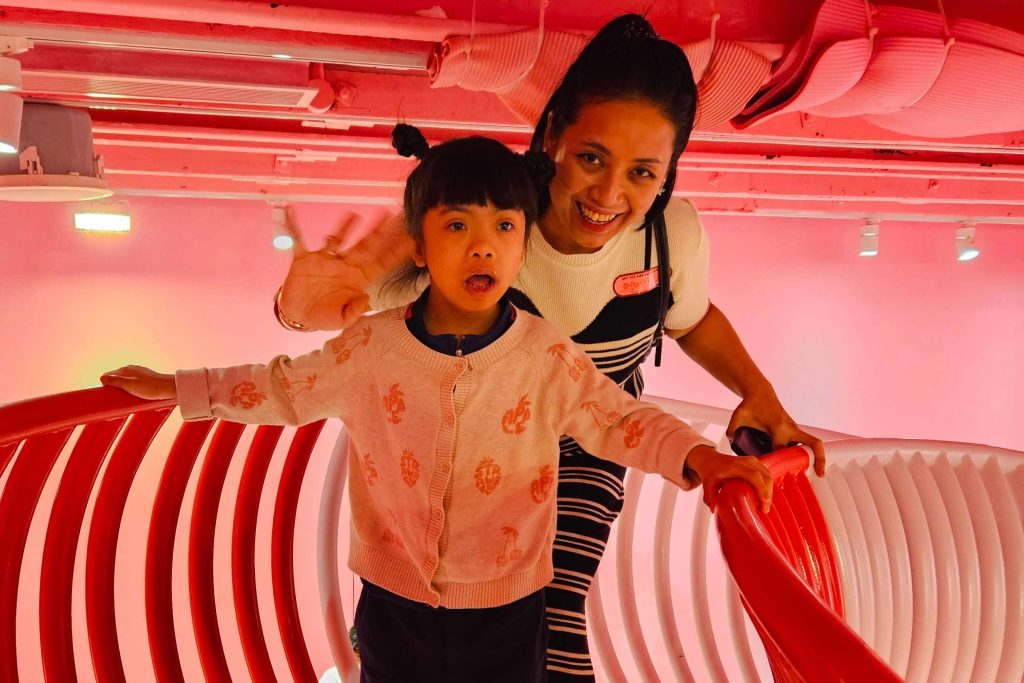
MINDS LGS is a school which serves students with moderate-to-severe intellectual disability and/or autism spectrum disorder (ASD) with intellectual impairments. Sensing the caregiver’s concerns, Ayuni’s form teacher, Ms Stacey Goh Sui Lee, reached out directly. She shared photos, videos, and updates of Ayuni’s day. “I try to put myself in the shoes of my students’ families and understand their concerns,” she explains.
Then came a surprise: In class, Ayuni began showing signs of self-feeding – something her family had never seen at home. Believing this to be a significant moment, Ms Goh shared her observations in detail: the table height, the type of cutlery, the pacing of prompts.
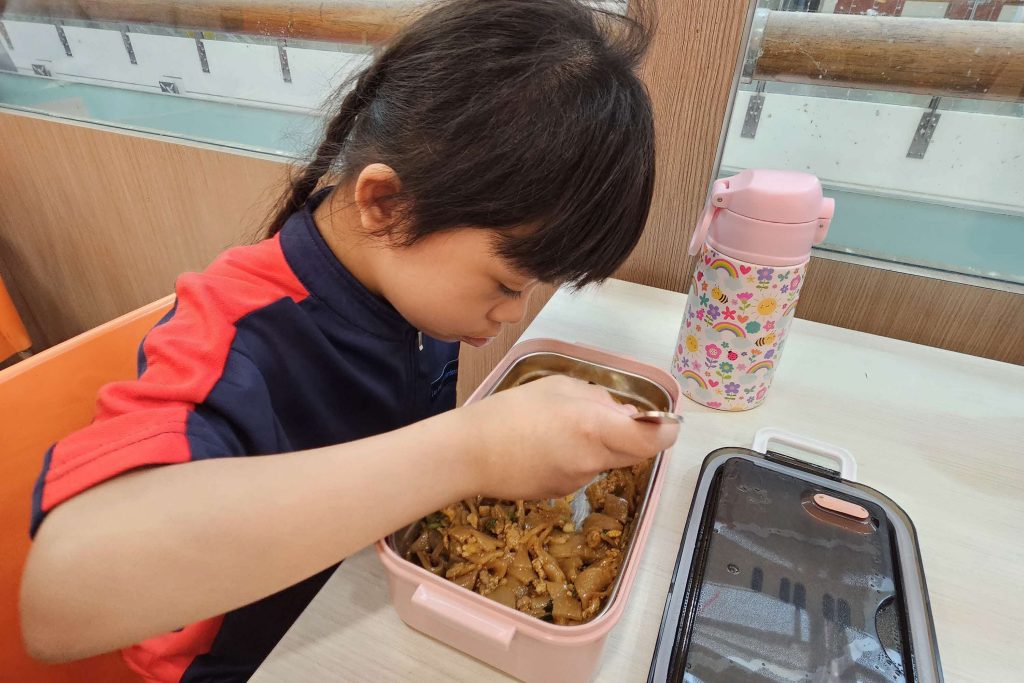
At home, Ms Karyawati recreated the classroom setup. She used the same lunchbox and cutlery, set up a small table, and followed the cues. Day by day, Ayuni improved.
It took nearly a year, but eventually, Ayuni fed herself independently. Soon after, she began helping with chores, even picking up tissue from the floor without being asked.
“It’s okay to ask for help and assurance from teachers, as long as we’re mindful of their personal time,” reflects Ms Karyawati. For her, the journey reinforced the importance of patience, trust, and open communication.
‘My child started making choices’
For years, Ms Sheryl Lee had grown accustomed to making every decision on her daughter Jolee’s behalf, as Jolee has multiple disabilities and is non-verbal.
Eight-year old Koh Yu Xin Jolee joined Cerebral Palsy Alliance Singapore School (CPASS) (West), a school that serves students with multiple disabilities, in 2024. When she first joined the school, Ms Lee and her family were anxious and worried: Would Jolee be able to cope with the new routines? Would teachers understand what she needed?
To understand Jolee better, the school’s Trans-Disciplinary (Trans-D) team – comprising teachers, speech therapists, and occupational therapists – began with a home visit. They asked: How does Jolee express likes and dislikes? What comforts her? What frustrates her?
“It’s a lot of trial and error to see what works to support the child, then we build from there step by step,” explains her teacher, Ms Sai Vina V Vimalenthiran.
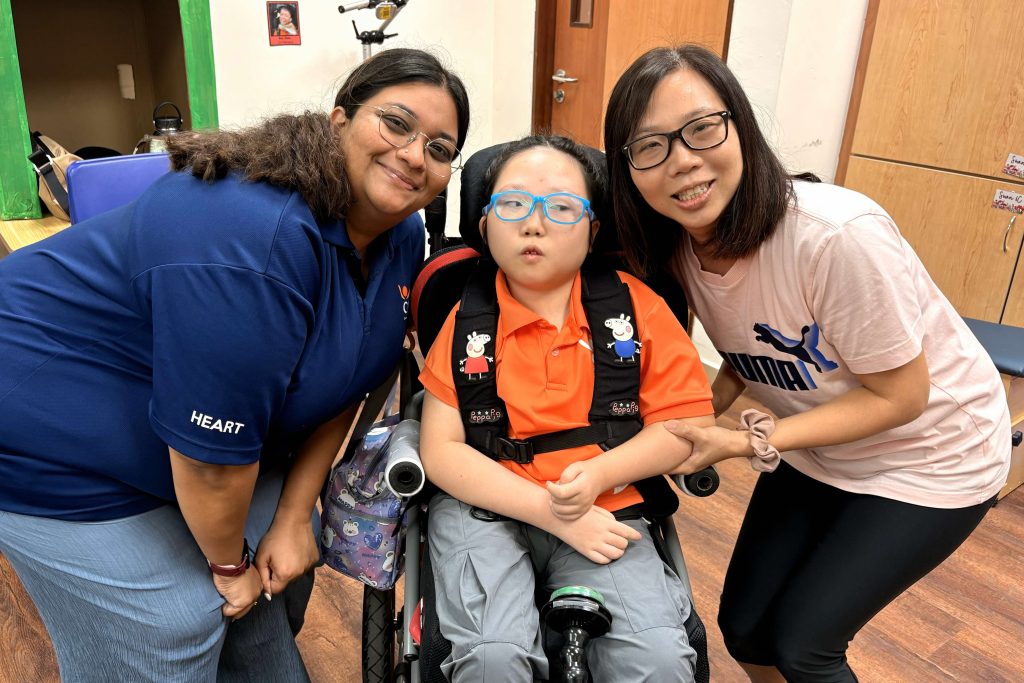
Those visits developed into monthly meetings with Ms Lee, where strategies were reviewed and refined. Shortly after, Jolee was using the Universal Switch Mounting – Magic Arm (MAG) switch, which allowed her to indicate choices with a tap. The team also provided picture cards Jolee already used in class, so she could practise the same cues at home.
The breakthrough came after a month. “When I asked if Jolee wanted to move to the sofa bed, she tapped ‘Yes.’ That’s when I realised – my child has a voice. With the right training, she can be heard and make her own choices,” recalls Ms Lee, still joyful at the memory.
In class, Jolee grew more alert and participative. Teachers offered her choices – such as which classmate to greet or which activity to do – while at home, her family mirrored the same routines.
“Sometimes, even the smallest things we do can make the biggest difference,” reflects Ms Vina. “When we give children a voice and acknowledge them, they become more involved in their own learning.”
Ms Vina works closely with Ms Lee to help her replicate successful strategies at home. “The MAG switch has made a significant difference in our daily life,” says Ms Lee. “It provides Jolee a simple, accessible way to confidently express her needs both in school and at home.”
What unites these families
The specific turning points for each of these families were different. For Jolee, the turning point was discovering she could communicate her intentions and preferences. For Ayuni, it was mirrored routines and a caregiver’s faith. For the twins, it was passions turned into learning – balloons that conquered fears, cooking that built bonds.
But teachers like Ms Sindhu and Mr Teo emphasise that progress and turning points come when strategies align with children’s interests and are carried through at home.
“Rather than focusing solely on academics, we look at what serves the child’s needs and build on their interests,” says Mr Teo.
“When parents feel heard and understood, that’s where we can get them to be more engaged in the partnership,” adds Ms Sindhu.
What unites these families is their courage to believe in their children’s potential and their dedication to creating environments where that potential could flourish, transforming not just skills but entire family dynamics.
When teachers plant seeds of possibility and families nurture them with unwavering commitment, children don’t just learn – they discover their own capabilities and find their voice in the world.
.jpg&w=3840&q=75)