





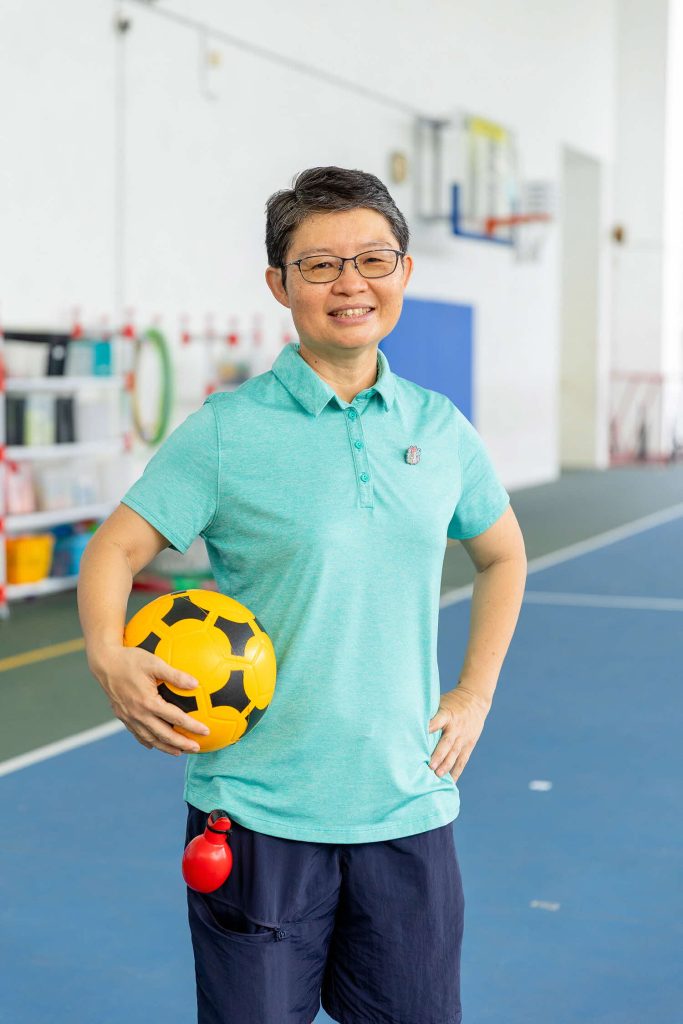
At 55, after 24 years in the teaching service, Mdm Lee Siok Kwan has taught thousands of students. For all her students, she hopes to leave behind moments that matter to each.
Mdm Lee, who currently teaches Physical Education (PE) and Programme for Active Learning (PAL) at Woodgrove Primary School, gets so much job satisfaction that she cannot picture herself retiring. “I want to keep teaching as long as I can,” she says. “Teaching warms my heart and fills my soul.”
Teaching in their DNA
Coming from a family of teachers – grandparents, parents, husband, and soon, her son – Mdm Lee initially resisted the pull of the classroom. “Teaching is in my DNA, but I never knew it,” she says.
After her GCE A-Level examination, without any clear goal in mind, she enrolled in what was then known as the College of Physical Education at the suggestion of her father, a PE teacher himself. Her initial years as a beginning teacher were challenging, but also rich in learning, which laid the foundation for her teaching career. Subsequently, she took four years off to raise her four children, but she had already been bitten by the teaching bug by then.
“I was grateful I was there for my children’s milestones, and thankful that MOE kept the job open for me all those years.” When she was ready to return to work, what surprised her was how much she missed teaching and she appreciated the opportunity to continue “touch(ing) many lives”.
The class that made her realise her true calling
Posted to Woodgrove Primary School to teach PE and English after her extended absence, she faced a class which posed various challenges. There were social-emotional concerns, learning difficulties, and dysfunctional home situations rolled into one – her toughest class to date.
“I made the effort to get to know the students well, eat with them during recess, and find out their interests,” she says. Through these informal encounters, she listened to their stories and began to understand them better while forging bonds with them.
She picked up on their need for interaction during lessons, and through research, adopted pedagogies that enabled her to provide hands-on learning experiences that actively engaged them. For example, English lessons became theatrical performances with still image exercises that taught both language skills and emotional regulation.
She also started a classroom ‘economy’: Students were split into groups, with intentionally assigned roles for an even balance of personalities and abilities. They also earned tokens that rewarded delayed gratification to promote intrinsic motivation. They engaged in lessons that inspired them to focus beyond their personal challenges and discover new meaning in moving forward.
To keep at this pace all the time was not easy but by the end of the year, something beautiful had emerged. Students who had arrived angry and disconnected were now helping each other, showing care, and demonstrating the school values that Mdm Lee had patiently modelled and nurtured.
“They were not as angry and were not shouting as much at each other. They were also more responsible and respectful. During the class photo-taking, they took the initiative to help straighten each other’s uniform, adjust their friend’s tie,” Mdm Lee recalls with fondness. These seemingly small acts represented significant shifts in their capacity for empathy and care for one another. It also showed her the power of patience, empathy and truly listening.
Something shifted inside of her too; she knew right there and then that teaching was where she belonged.
Students spending less time outdoors
Of all the subjects she has taught, PE is where Mdm Lee is in her element.
Teaching PE is where she applies educational psychology and differentiated learning pedagogies in a high-energy environment, in what is easily most students’ favourite subject.
She could be coaxing a shy student to step up and throw a ball, or an overly-enthusiastic student to follow a sequence of instructions. Students with special educational needs receive enhanced support through peer partnerships, modified activities and colour-coded equipment and teaching cues.
But perhaps her biggest challenge today has emerged: students who spend far less time outdoors than previous generations. “They sit a lot, using their handphones and iPads to access social media content and play online games,” she explains. “Many students say their parents do not let them play outside; this results in poor psychomotor skills, low cardiovascular endurance and poor attention spans.”
“My lessons would not be too vigorous because I know they do not have cardiovascular endurance,” she says. Rather than simply lowering expectations, she developed a multi-pronged strategy: “I go through the basics in class, ensure they perform them correctly to an appropriate level and standards, and teach them certain exercises they can do at home. To complement their in-school development, students can practise these skills at home together with their parents.”
Her co-creation of the WGPS Outdoor Family Experience, which won a Commendation Award at the MOE Innergy Awards, was part of her efforts to encourage students to venture outdoors, bond with their family and appreciate Singapore’s natural wonders.
How gymnastics and iPads go together
In Mdm Lee’s PE lessons, students do not just move – they move to learn and learn to move.
In gymnastics, for example, she amplifies learning using technology and the flipped classroom approach, where students engage with learning materials online before their in-person classes.
Students might watch and read about, say, what smooth transitions look like between two movements, on the Student Learning Space (SLS) platform, and be more ready for class. To deepen their learning further, Mdm Lee captures their movements on video and shares this with them.
Game invention is another way of helping students to learn and practise social-emotional competencies. This approach not only develops and tests physical skills but also enhances the students’ ability to negotiate roles, synthesise ideas, and evaluate peer work through sharing platforms and SLS.
“When we use technology, it is not just to teach the skill or evaluate their performance, it also teaches 21st Century Competencies such as collaboration skills and critical and adaptive thinking.”
“When we use technology, it is not just to teach the skill or evaluate their performance, it also teaches 21st Century Competencies such as collaboration skills and critical and adaptive thinking.”
Mdm Lee

.jpg&w=3840&q=75)