




You heard me right. I sent my four-year-old for an art enrichment lesson, and she came home with her artwork marked up with a grade and a series of scores.
It took a moment to decode: An ‘A’ grade awarded overall, full marks for Drawing, and 7 out of 10 for Colouring.
She walked in the door and declared: “I want to get an ‘A’. I like getting an ‘A’.”
My heart sank. This had never been my intention for her. This was entirely missing the point of the art lesson.
I wanted art to be a place where she could experiment without worrying about getting things right. A place to draw something weird and out of shape and make it beautiful in her own way. A place to mix colours until they all turn grey and then mix them again. A place to create in her own time, not produce on demand.
She is only four after all.
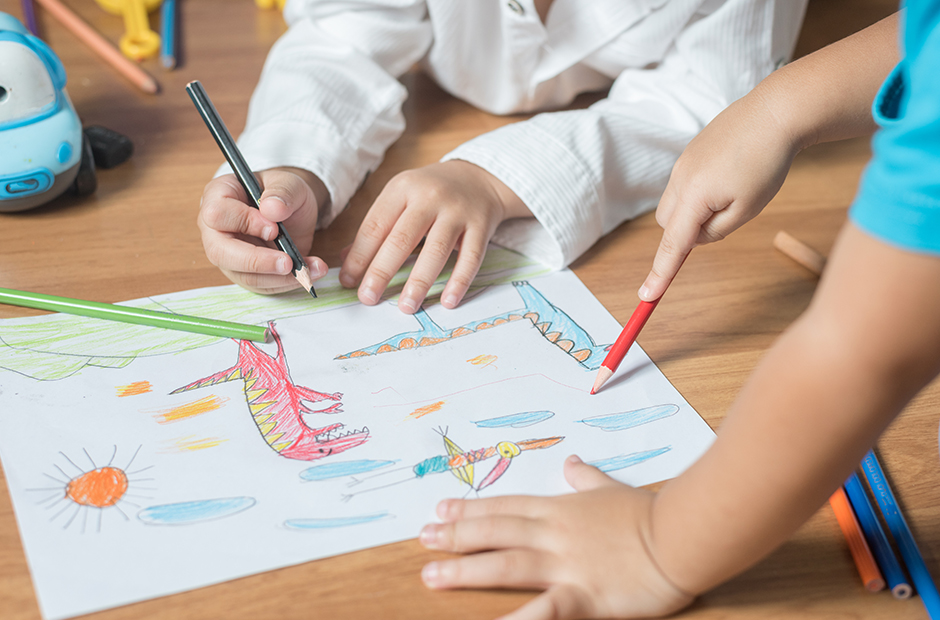
For comparison, she had attended a different art lesson around the same time. The focus was on warm and cool colours, and mixed media: cutting, pasting, glitter, crayons, paint... She had come home proud of what she’d made. More than that, I noticed her practising at home – circles as motifs, triangles as pyramids, bunny ears and hearts that looked like one another. These later made their way into her handmade Father’s Day gift. She drew a tree without leaves and explained, matter-of-factly, that the wind had blown all the leaves away. She was making meaning through her drawings. She was making connections.
After the graded lesson, I didn’t hear her talk about what she'd drawn. I didn’t see her pick up a pencil to try similar shapes at home.
The lesson, as far as I could tell, had involved the teacher demonstrating on the board and the children copying what they could. It’s called “modelling”, but I know from my teacher training days that art assessment at a young age isn’t about letter grades, but about evaluating a child’s work against developmental stages (like Lowenfeld’s).
The grade conversation
I have 10 years of primary school classroom experience. I know what grades are for. They have their purpose. When we grade something, we tell a child that there is a standard, and that we are measuring them against it. At the right points in life, that is appropriate and necessary. But not here, not at this age.
After this experience with my daughter, I had a further insight about grades at this age: It redirects attention. This incident shifted the conversation from the one I was hoping to have with my daughter. It was no longer about what she had explored, experimented with, or enjoyed. Instead, getting an ‘A’ had become the goal.
And once that shift happens, it can be quite hard to undo.
The art of mindset change
As a parent, I find that a significant part of my energy goes into exactly this kind of undoing. We are surrounded by well-meaning adults – family, friends, the broader culture – whose words and actions carry their own assumptions about what success looks like for a child. I don’t say this to be critical of anyone. These are people who love my children. But love and good intentions don’t always translate into the mindset I want my daughter to grow up with.
So I decided to do a ‘debrief’ with my four-year-old. I asked her how she might feel if I spoke to her teacher about not giving her a grade. What if, instead, the teacher just told her what she did well in? What if she got a sticker at the end of class? I watched her think about it. She nodded but still seemed unconvinced. It was a small conversation, but it mattered – because I was trying to give her a different frame for what the class was actually for.
That conversation also reminded me of how quickly and quietly we can kill curiosity. Not intentionally, but through reduction. A grade collapses everything – the joy, the process, the story behind the drawing – into a single number or letter. It ends the conversation before it begins. Instead of asking "What did you make today?” and hearing about a tree that lost its leaves to the wind, I got “I want to get an ‘A’.”
Art from the heart
There is an art to teaching, and it lies precisely here. Good educators don’t just direct and instruct – they elicit. They ask a child what they see in their own work, what they were thinking, what they might try next. They guide rather than just grade. They make the child feel that their perspective is worth having and worth sharing.
My intention in sending my daughter to art class was never to produce a skilled draughtsman. It was to nurture her curiosity, her confidence, her willingness to try things and make a mess and try again.
A child who draws a lopsided bunny and tells you it is for Dada because she loves him “sooo” much means a lot more to me than a child who copies a bunny correctly and scores 7 out of 10 for Colouring.
At this stage in her life, her dad and I are actively resisting the instinct – in ourselves and in the environments we place her in – to chase the mark. To benchmark. To compare.
If she shows an interest, whether it’s in reading, writing, Maths, art or sports, we follow her lead. No drilling.
So, play, experiment, imagine, dabble all you want, kid.
Grades, stay away. Not here, not yet.
P.S.: At the next lesson, I politely told the teacher, “No grades, please.” And when my kid returned, she chattered on about what she drew, the colours she used, and how she preferred using the markers this time...
Small wins.
.jpg&w=3840&q=75)
.jpg&w=3840&q=75)