



On the day that Primary 6 students Daisy Ma and Aarnik Mahajan were supposed to present their group’s prototype to a panel of judges, the prototype broke.
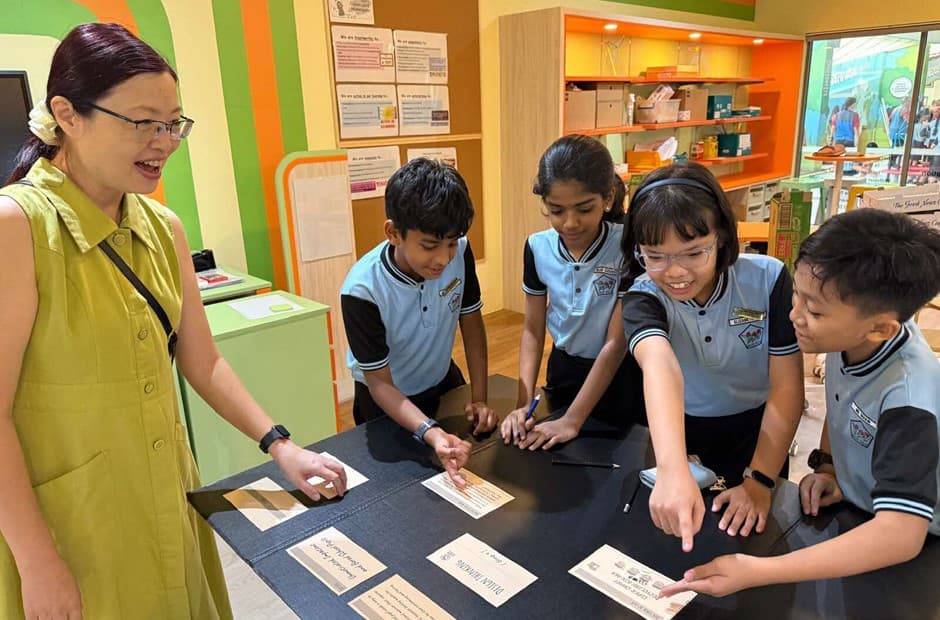
The students from West View Primary School had spent weeks interviewing friends and family members to understand the challenges they face in growing plants, brainstormed for sustainable solutions, and designed a prototype of an auto-watering device to help water plants.
With the help of their teachers from the Design Thinking Capstone Project, Daisy and Aarnik’s group quickly rebuilt their prototype from scratch, and even improved on the original design.
“We were very sad when our first prototype failed, but then we tried again,” says Daisy. “We even came up with a new idea of placing a camera on the device to check when the plant is dry and needs more water.”
Aarnik adds, “At the end of the presentation, we were really proud of what we made. I learnt to see things differently and not give up, even when we face challenges that seem difficult to overcome.”
That act of failing, then trying again and succeeding, is exactly what the Design Thinking Capstone Project aims to instil in students.
Learning to solve problems with empathy
Working on capstone projects around sustainability is one of three components of the Da Vinci Programme at West View Primary, a two-year programme for Primary 4 and 5 students who are selected based on academic strengths and teacher recommendations. The other components are the Brain programme, which focuses on developing communication and presentation skills, and Excellence 2000 (E2K) Mathematics, which develops mathematical reasoning.
In 2024, Prime Minister Lawrence Wong announced in his National Day Rally speech, that the Gifted Education Programme (GEP), in its current form, would be discontinued. Instead, students with strengths and talents in the academic domain would be stretched through a different approach.
Under the current GEP, students transfer to one of nine designated primary schools that host the programme in Primary 4. With the revised approach, these students would remain in their schools, which are all equipped with school-based provisions to develop them in English, Maths and Science – beyond the normal curriculum.
Students who are assessed to benefit from even further stretch can choose to attend centre-based advanced modules after school at designated schools nearby. The modules will start running from 2027 for Primary 4 students.
At West View Primary School, students with strengths and talents in the academic domain attend the Da Vinci Programme, which is held after school. What distinguishes it from other school-based programmes is its strong emphasis on design thinking, which Principal Mr Eugene Lee introduced when he joined the school in 2024.
His previous stint at MOE’s Gifted Education Branch had allowed him to understand the learning needs of students who are advanced in their cognitive abilities. “They have lots of ideas which can be very brilliant and very technical,” he explains. For such students, “it is crucial that they build up empathy for others, which is what Design Thinking is essentially about because it takes into account users’ needs”.
For his students in the Da Vinci Programme, he adds, “we also wanted to do more to develop them in their 21st century competencies, such as critical, adaptive and inventive thinking, as well as their communication and collaboration skills”.
Growing together through teamwork
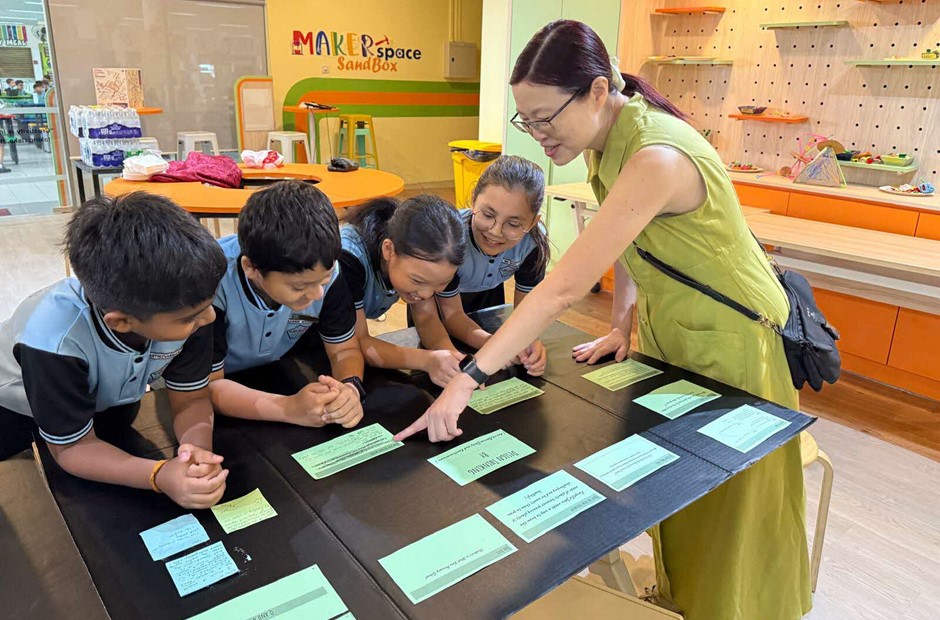
Compared to the regular curriculum, the Da Vinci Programme involves more group projects. Mdm Chua Kiat Eng, one of the teachers in charge of the Design Thinking Capstone Project, shares that the programme is more student-driven rather than teacher-driven. “We let students take the lead as much as possible. We simply guide them to pick a project related to environmental sustainability, and then we let students go and carry out their own projects.”
Through this process, students have been able to develop stronger collaboration skills. Aarnik shares that he has become a more responsible and empathetic teammate through working closely with others – including learning to understand one another’s point of view and navigate mistakes together.
His mother, Mdm Palak Gupta, has observed a noticeable change. “Aarnik has always done well academically, but he used to be more reserved. Now, he’s a lot more confident and open in sharing his views,” she says. “If I ask him to do something independently, he doesn’t shy away from that. He’s also more of a team player now.”
Daisy’s father, Mr Roger Specker, also observes that Daisy has become more independent and outgoing since attending the Da Vinci Programme. “She’s always explaining things that she learns in the programme at home, and is more attentive to her surroundings now,” he says. “She often mentions the good friendships that she has made in the programme, and how they all help and support one another. There’s a certain level of understanding among them, which has been very positive for her.”
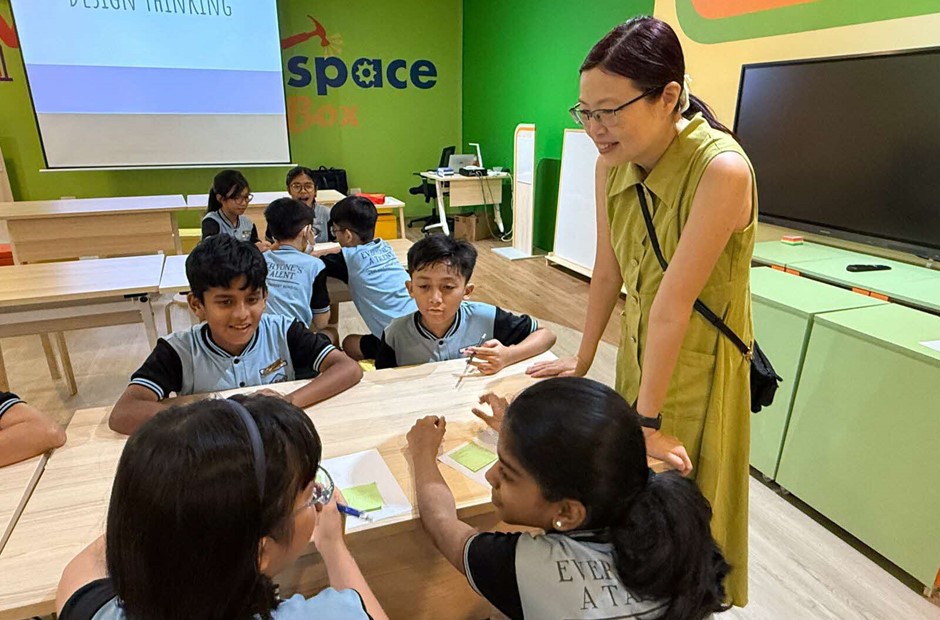
In catering to students with strengths and talents in the academic domain, both Mr Lee and Mdm Chua emphasise the need to provide them the space to learn and explore together.
“It’s very easy for people to assume that these students are already doing well in school, so there is no need to stretch them further. But we believe in supporting the holistic development of every student in our school. These students have their own passions and interests, and it’s our responsibility to further enrich their learning,” says Mr Lee.
Mdm Chua adds, “These students are vocal and independent thinkers. They are not afraid to speak their minds, and they will argue with you – sometimes with reason, sometimes without. As teachers, we should embrace these interactions and give them space to experiment, make mistakes, fall, and pick themselves up again.”
Photos courtesy of: West View Primary School