



What’s really needed at Primary 1?
Children need fundamental self-management skills, not solely academic preparation, to thrive in primary school, says Mrs Chen. She emphasises that children should be able to handle basic tasks independently, such as packing their school bags with a given timetable and managing toilet routines.
Social-emotional preparation is equally crucial. “Children need to understand how to make new friends, how to interact with new friends,” says Mrs Chen.
Is it even possible to over-prepare my child?
While parents’ intentions are good, over-preparation through excessive academic enrichment classes can be counterproductive. “Too much of it can actually take away the joy of learning because students start to associate learning with stress, a packed schedule, or even overly challenging tasks,” Mrs Chen cautions.
She highlights concerning scenarios where students end up disengaged due to over-preparation. “We do see instances of students in class being very bored, and when asked why are you not engaged? The child’s reply can be, usually, ‘I have already learnt this two weeks ago during my tuition class.’”
This disengagement can affect crucial aspects of learning, particularly the development of soft skills through collaborative projects and group work, Mrs Chen says.
What can I do to make sure my child keeps up in primary school?
Mrs Chen reassures that teachers are well-equipped to handle different learning paces through differentiated instruction. She adds that success is when “the child is actively engaged in the classroom… willing to be self-directed enough to ask questions, to ask for help if he or she requires help in class, and follows up with assignments”.
An advocate of play-based learning, Mrs Chen piloted the approach in her school with a group of teachers, and found that learning outcomes have been excellent for both academic and social aspects.
“We do see that for some parents, when their children enter primary school, they feel it’s the end of play and it’s now time for more serious matters and serious work,” Mrs Chen says. “But I feel that, all the more, children should continue playing (in primary school). So that the curiosity doesn’t stop, the exploration doesn’t stop.”
“The advice is really to play, play and play more with your children. Bring in delight, bring in wonder, bring in opportunities to bring about awe. Because with this emotion and disposition, I’m certain that our students will grow up to be very self-directed, to be able to be comfortable with the uncomfortable. That’s necessary in this new world, and they will continue to be lifelong learners,” she emphasises.
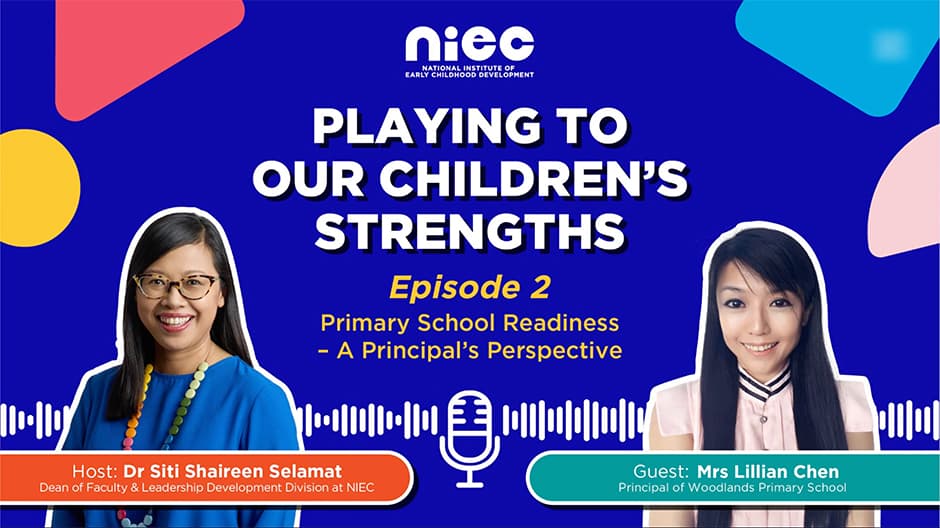
This story is adapted from a podcast by the National Institute of Early Childhood Development (NIEC), where Dr Siti Shaireen Selamat, Dean of Faculty and Leadership Development at NIEC, chats with different experts about preparing children for their primary school journey.